
Rotary Drum Filter (RDF)How It Works and Where to Use It
Rotary drum filters (RDF) explained: how the drum, screen, rinse cycle and waste gutter work, the benefits, where they are used, how to size one by flow, and standard versus UV models.
 EQUIPMENT REFERENCE
See the mechanism.
Understand the duty.
Select a route or a stage to inspect the process. The cutaway explains the equipment and water environment; it is a teaching illustration, not a project drawing.
Capture solids
Use actual flow, screen opening and solids duty.
Particles are retained as water crosses the screen. Dissolved contaminants require other treatment stages.
- Use actual flow, screen opening and solids duty.
- Confirm approved levels, wash supply and waste drainage.
- Observe a complete guarded cycle before changing settings.
Key takeaways
- A drum filter removes solids by screening and then flushes them away on its own, so the dirt leaves the system before it decays.
- Size it by flow, not by pond volume: divide the water volume by the turnover time to get the flow in cubic metres per hour.
- It is a mechanical filter. It does not remove dissolved ammonia or nitrite, so it works together with a biofilter.
- The standard screen opening is 75 micron stainless steel, and the cleaning cycle runs only when the screen needs it.
What is a rotary drum filter?
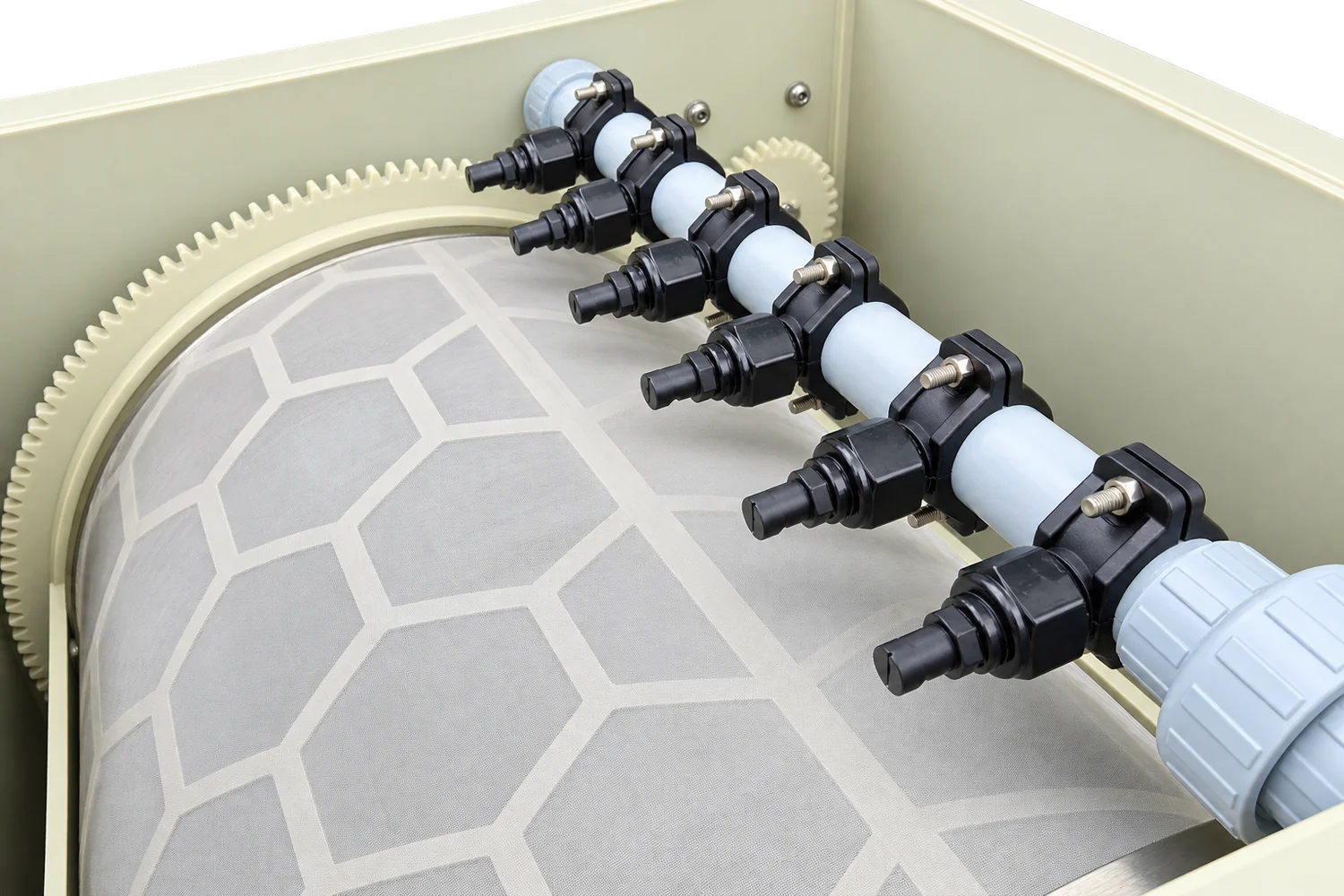
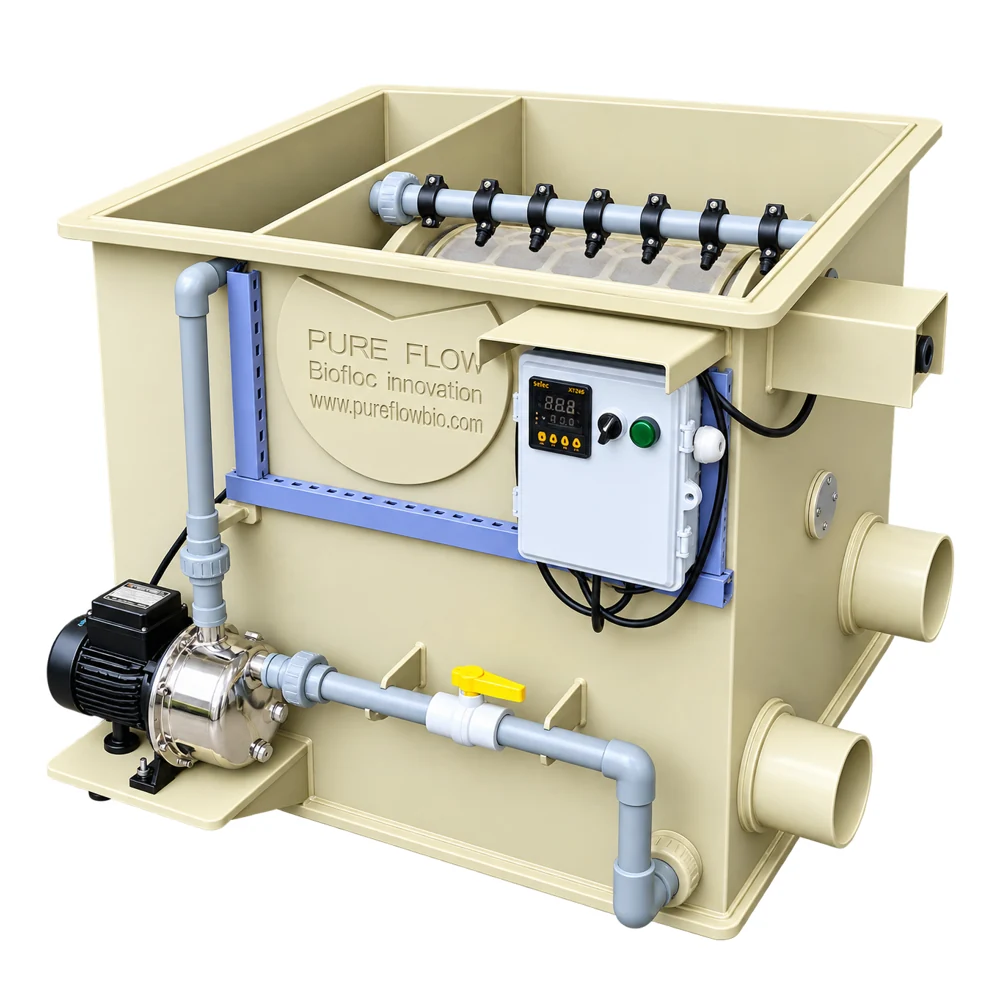
A rotary drum filter, or RDF, is a self-cleaning mechanical filter. Water flows into a rotating drum wrapped in a fine screen of 316 stainless steel. The screen holds back fish waste, uneaten feed, string algae and leaf fragments while the clean water passes through. When the screen loads up, the drum turns under a row of spray nozzles that wash the dirt into a drain gutter, and filtration carries on without a pause.
That makes it the standard first stage of treatment in modern koi ponds, natural swimming ponds, aquariums and fish farms. In a recirculating aquaculture system it comes before everything else, because solids removed early mean less oxygen demand, less bacterial growth and a lower risk of disease. Read the RAS guide to see where it sits in a full loop.
Work with your own numbers.
Use the tools below to explore the relevant arithmetic. Enter measured values or declared assumptions. An estimate does not establish equipment capacity, biological performance or a safe operating limit.
Flow & turnover planner
Relate a measured water volume to a selected turnover time. Confirm the time from the application and hydraulic design.
Assumptions and limits
A planning allowance is your assumption. This calculation does not choose a filter, prove treatment capacity or account for pump head.
Measured wash-water use
Use measurements across complete wash cycles and the recorded daily cycle count.
Assumptions and limits
Identify whether you measured wash supply or total waste discharge. No default litres per Pureflow wash cycle are assumed.
Convert units before you calculate
Planning arithmetic · inputs remain visible for review · example values are not operating recommendations
How a rotary drum filter works
The process runs from inlet to drain without anyone touching it. Watch the animation above for one full cycle, and use the steps below to follow what each part does.
- Water enters the first chamberWater from the pond or system flows in through one or more inlets, then into the drum.
- The screen catches the solidsWater passes outwards through the screen around the drum. Anything larger than the openings stays on the inside, and the screened water collects in the clean chamber that leads to the outlets.
- A sensor notices the loadAs the screen clogs, the water level inside the drum rises. A level sensor reads that change and starts the cleaning cycle, so rinsing only happens when it is needed.
- The drum turns and the nozzles rinseA motor turns the drum while a high-pressure pump feeds the stainless steel nozzles. The spray pushes the dirt off the screen into the waste gutter, and the rest of the screen keeps filtering.
- The waste leaves the systemThe gutter carries the solids to a drain or a collection point, so there is almost no manual cleaning.
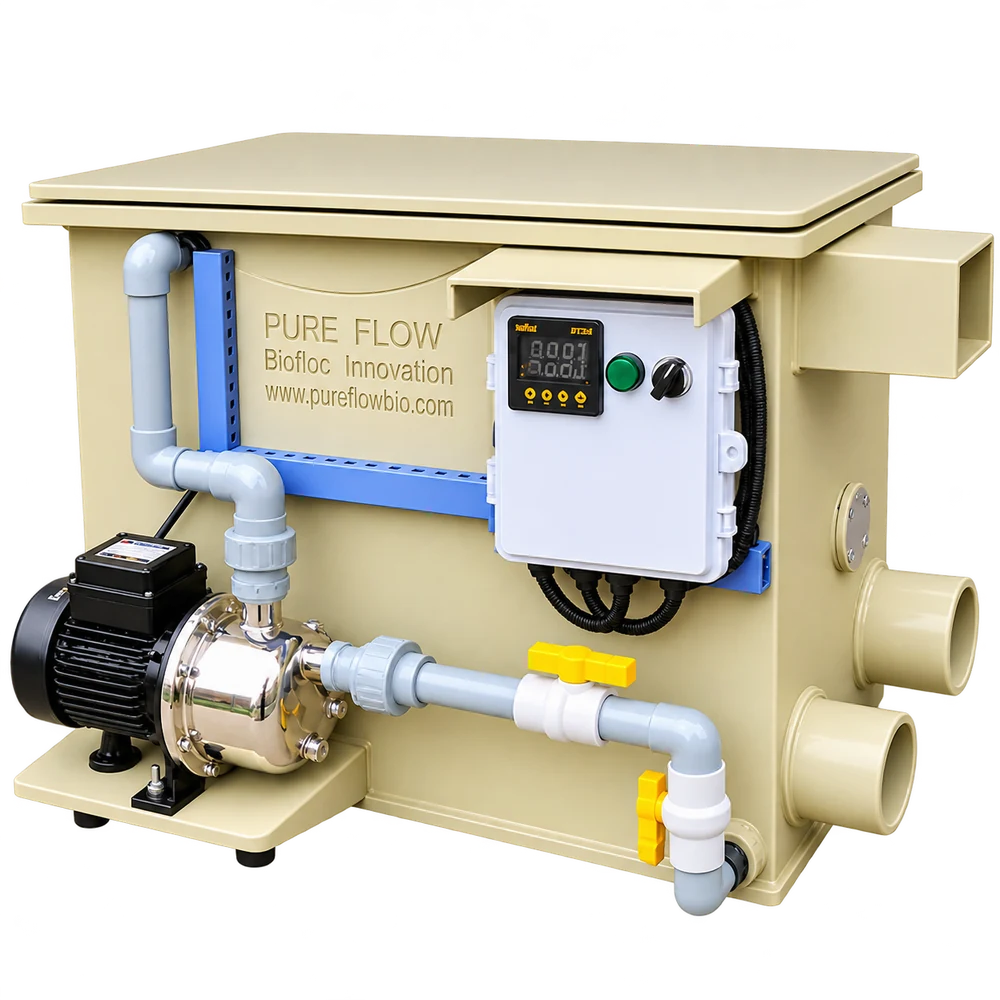
- A control box runs the cycleOne control box switches the rinse pump, the drive motor and the sensor, so the whole sequence is automatic.
Benefits of a rotary drum filter
The gains show up in the water, in the biofilter and in your weekly routine.
Confirm the hydraulic duty
Use these questions to prepare a project brief or an operating review. Check an item only when the information has been recorded for your installation.
This checklist is a working aid in the current page session, not a saved maintenance record.
Where a rotary drum filter is used
Wherever water carries solids that you want out before they decay, a drum filter fits. Open each application to see what it does there.
Koi ponds
Takes out waste, leaves and algae so water stays clear and the weekly clean disappears. Koi are heavy feeders, so the drum filter is often the single most useful stage in the system. See koi pond filters.
Natural swimming ponds
Removes organic debris so the plant zone has less to process, and keeps the water inviting to swim in. See swimming pond filters.
Fish farms and RAS
The first stage of solids removal at high stocking densities, protecting the biofilter and the oxygen supply. See drum filter for aquaculture.
Hatcheries
Keeps rearing water clean with gentle, continuous screening that does not stress young fish. See aquaculture filtration.
Aquaponics and hydroponics
Filters drain water or fish solids instead of a settling tank, which protects emitters and pumps. See drum filter for hydroponics.
Large aquariums
A compact unit replaces sump socks and filter pads in big displays and fish rooms. See aquarium drum filter.
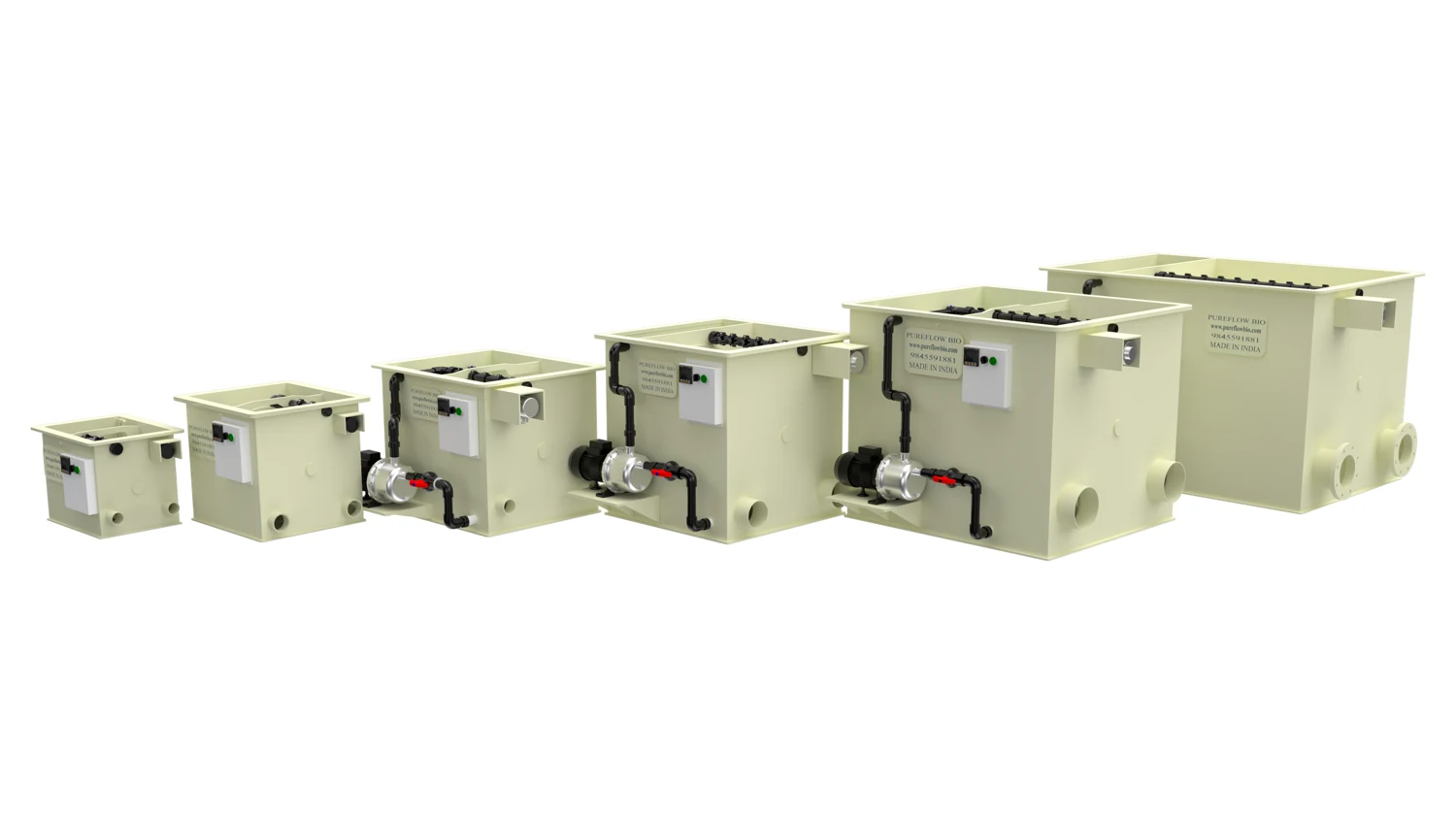
Which drum filter size do I need?
Size a drum filter on flow. All of the water has to pass through the screen in a set time, so the pond volume on its own tells you very little.
Divide the water volume by the turnover time to get the flow. A koi pond should turn over at least once every two hours, about every 1.5 hours with normal stocking and every hour when heavily stocked. Natural swimming ponds turn over every two to four hours. Fish farms and RAS are sized on flow and on daily feed. Our drum filter sizing guide works through each case.
Example: a 36 m³ koi pond with normal stocking needs 36 ÷ 1.5 = 24 m³/h. A Standard RDF-30, with a catalogue maximum of 30 m³/h, then runs at 80 percent of that maximum. With heavy stocking the same pond needs 36 m³/h and moves up to the RDF-50.
| Standard model | Catalogue maximum flow | Length x width x height (mm) |
|---|---|---|
| RDF-3 | 3 m³/h | About 430 x 330 x 370 |
| RDF-10 | 10 m³/h | 500 x 450 x 500 |
| RDF-20 | 20 m³/h | 655 x 555 x 590 |
| RDF-30 | 30 m³/h | 660 x 655 x 725 |
| RDF-50 | 50 m³/h | 955 x 855 x 850 |
| RDF-100 | 100 m³/h | 1280 x 930 x 910 |
Catalogue figures. The maximum flow is not a guaranteed duty at every mesh size, so confirm it against your solids load before you order. Models up to 300 m³/h are available.
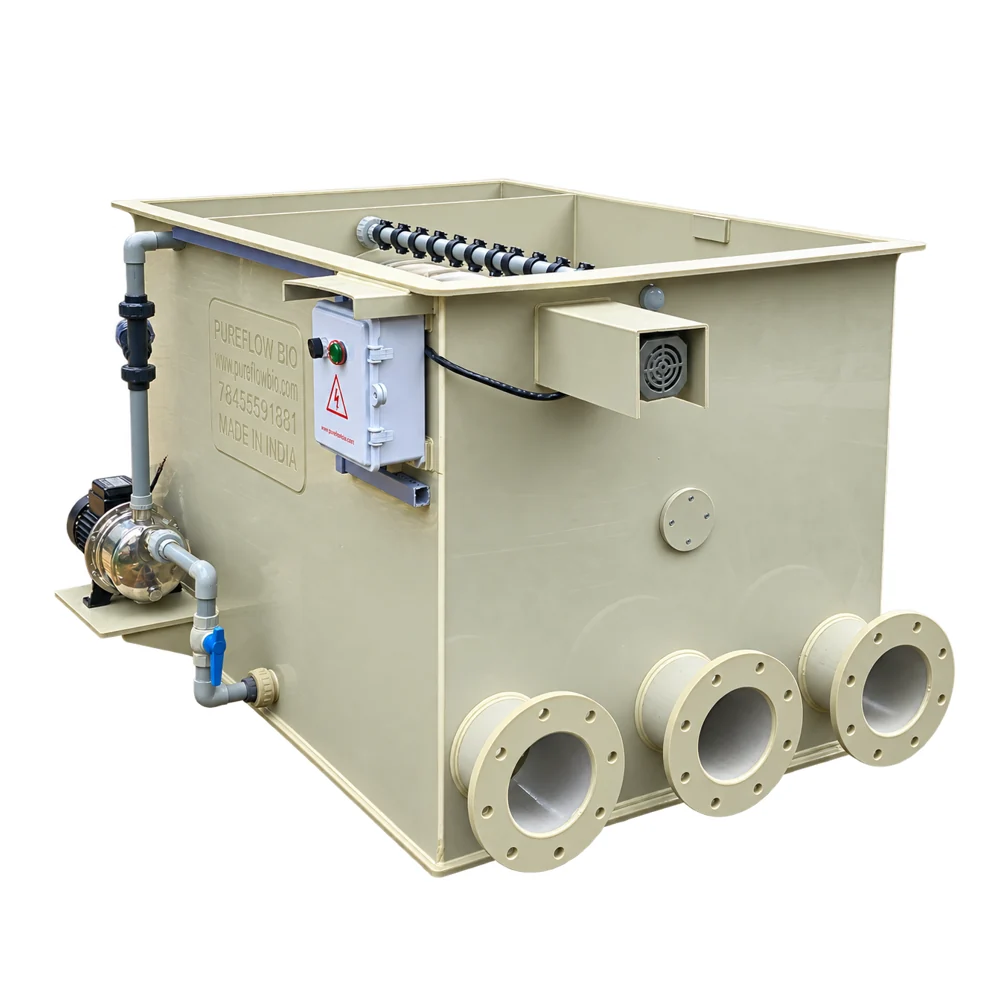
On a gravity-fed pond, plan roughly one 110 mm line for every 10 to 12 m³/h of flow, and read the bottom drain guide for the layout.
Flow = water volume divided by turnover time, then multiplied by the safety margin. The catalogue maximum is not a guaranteed duty at every mesh size, so confirm it against your solids load and head before you order. Above 300 m³/h, use several units in parallel.
Screen size and filter panels
The screen is the heart of the machine, and its opening decides what is caught and how often the drum rinses. Our standard panel is 75 micron stainless steel, which suits most ponds and farms.
Our mesh size guide compares 20, 40, 70, 100 and 120 micron panels and includes a rinse water estimator.
What biological load means
Biological load is the amount of waste your fish and your feeding put into the water. It decides how much solid matter reaches the screen and how much ammonia the biofilter must convert. A pond with a few small fish has a light load. A heavily fed koi pond or a farm tank has a heavy one.
A drum filter lowers the load on the biofilter by taking solids out before they dissolve. It cannot remove dissolved ammonia or nitrite, so the biological stage still has to be sized for the feed. For the numbers, see feed conversion ratio and waste load and moving bed biofilters.
Gravity-fed or pump-fed installation
A drum filter can be fed in two ways, and the choice shapes the pond design. In a gravity-fed system the water flows from a bottom drain to the filter under its own head, which keeps the flow gentle and the energy use low. In a pump-fed system a pump lifts the water into the filter, which gives more freedom in where the filter stands. Our gravity-fed or pump-fed comparison sets out the trade-offs.
Do and avoid
Most drum filter problems we are asked about trace back to a handful of avoidable mistakes. Here is the short version.
Mistakes that cost you clear water
- Sizing from the pond volume alone instead of the flow.
- Choosing a finer screen than the system needs.
- Letting large leaves reach the inlet.
- Forgetting frost protection on the waste line and rinse pump.
- Treating the drum filter as a biofilter.
Habits that keep the water clear
- Size by flow and keep a margin of at least ten percent.
- Start with the 75 micron standard screen.
- Fit a net or skimmer ahead of the inlet in leafy gardens.
- Protect pipes and the drain through winter.
- Add a biofilter sized for the feed after the drum.
Looking after a drum filter
A drum filter is low maintenance, not no maintenance. A short routine keeps it reliable for years.
Weekly
Five minutes.
- Watch one full rinse cycle.
- Check the waste drain flows freely.
- Listen for new noises.
Monthly
Fifteen minutes.
- Clean the level sensor and nozzle tips.
- Check the rinse pump strainer.
- Inspect the screen for fat or damage.
Every season
Longer check.
- Deep clean the panel and gutter.
- Check seals and fasteners.
- Protect the unit and waste line before frost.
If something looks wrong, our troubleshooting guide gives a fault-finding path, and the maintenance schedule lists the full yearly plan.
Standard or Pro with UV
Pureflow makes two drum filter ranges. The Standard RDF is a mechanical filter. The Pro RDF is the same drum filter with UV lamps built into the unit, so screening and a first disinfection step share one housing.
| Standard RDF | Pro RDF | |
|---|---|---|
| Job | Solids removal | Solids removal plus UV treatment |
| Best for | Clear ponds, farms, aquariums | Green water, hatcheries, quarantine, clear low-microbe water |
| Screen | 75 µm SS 316 | 75 µm SS 316 |
| Rinse | Level-sensor automatic | Level-sensor automatic |
| Models | RDF-3 to RDF-300 | Same sizes with UV lamps |
The lamp wattage in the catalogue is a listing and not a disinfection rating. Judge the UV stage by contact time and water clarity.
For the UV side, read UV lamp sizing and dose.
Pureflow equipment for clear, stable water
Standard RDF drum filterSelf-cleaning SS 316 screen, 75 µm, sizes from 3 to 300 m³/h.Pro RDF with UVThe separate Pro RDF range includes model-specific UV equipment; confirm the supplied configuration and treatment duty.Moving bed biofilter (MBBR)Biological stage that converts ammonia and nitrite.UV disinfection systemsTreatment for free swimming algae and microbes.rotary drum filter FAQ
How does a rotary drum filter work?
Water enters a rotating drum covered with a fine screen. The screen holds back solids while the water passes through. A level sensor starts a rinse when the screen loads up, and spray nozzles wash the dirt into a waste gutter.
What does a rotary drum filter remove?
Fish waste, uneaten feed, string algae, leaf fragments and other particles larger than the screen openings, which are 75 micron as standard.
Does a drum filter replace a biofilter?
No. A drum filter is mechanical. It takes out solids, while a biofilter converts dissolved ammonia and nitrite. The two work in sequence.
How often does a drum filter need cleaning?
The screen cleans itself. You check the nozzles, the screen and the waste line from time to time, usually monthly, and replace worn parts when needed.
How do I size a rotary drum filter?
Divide the water volume by the turnover time to get the flow in cubic metres per hour, then choose a model whose catalogue flow covers it with some margin. Heavier stocking needs a shorter turnover time.
Can a drum filter run through winter?
Yes. Keep the filter running and protect pipes, the rinse line and the waste outlet against frost, because a frozen drain stops the rinse cycle.
Is a drum filter suitable for ponds with leaves?
It handles leaf fragments well, but large leaves should be stopped by a net or a skimmer first so they do not block the inlet.
What is the difference between a drum filter and a bead filter?
A bead filter must be backwashed and builds back pressure as it loads. A drum filter cleans itself continuously, keeps a constant flow and does not need backwashing.
How much water does the rinse use?
A small share of the flow. It grows with the solids load and with a finer screen.
What is the difference between Standard and Pro?
The Standard RDF is mechanical only. The Pro RDF adds UV lamps inside the same unit for disinfection.
More guides related to rotary drum filter
Discuss your system with Pureflow.
Share your application, operating volume, actual flow, loading and the question you are trying to resolve.