
Drum Filter Mesh SizeWhich Micron Panel to Choose
Drum filter mesh size explained: micron versus mesh, how 20, 40, 70, 100 and 120 micron panels compare, the rinse water trade-off, and why 70 micron suits most koi ponds.
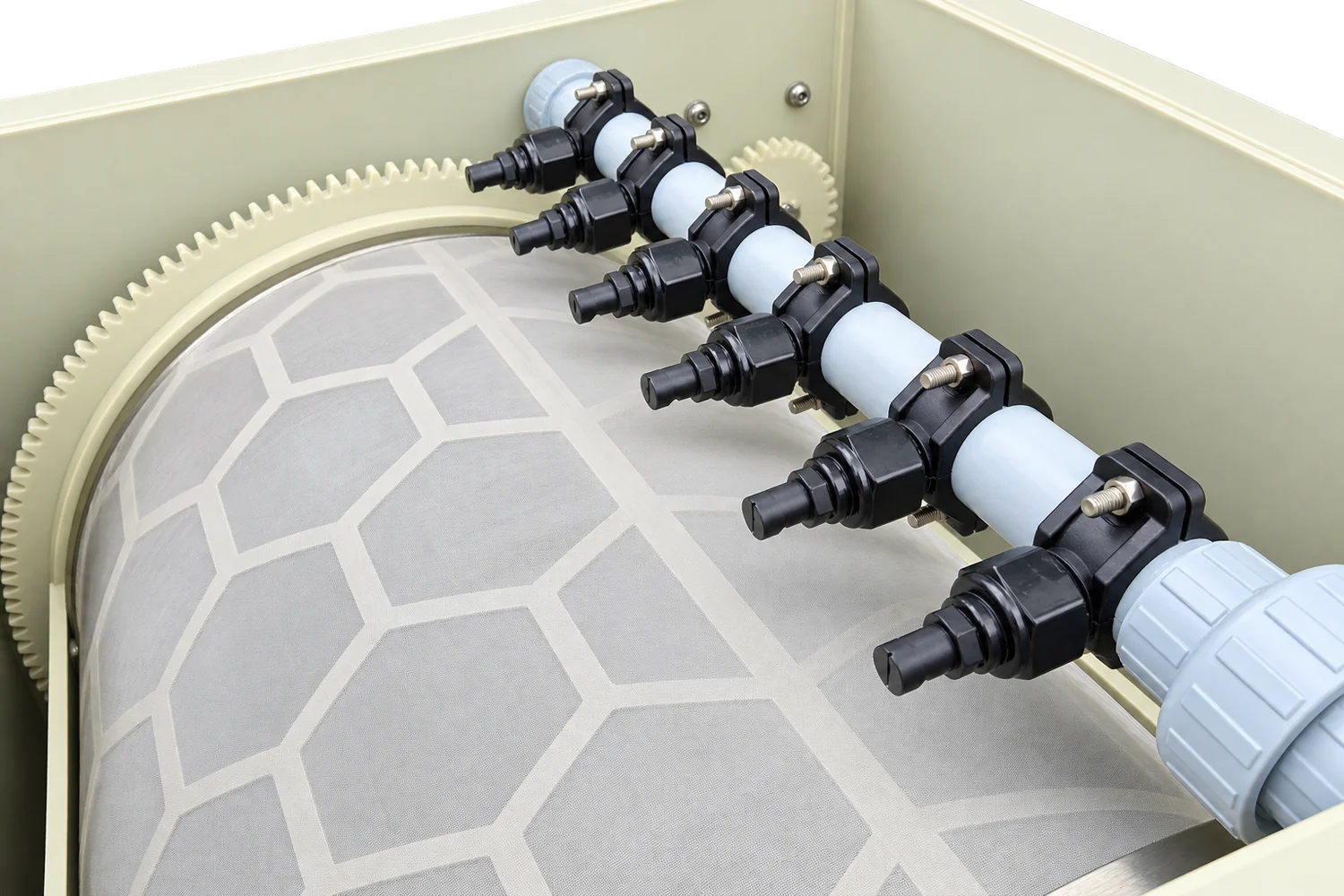 EQUIPMENT REFERENCE
See the mechanism.
Understand the duty.
Select a route or a stage to inspect the process. The cutaway explains the equipment and water environment; it is a teaching illustration, not a project drawing.
Capture solids
Use actual flow, screen opening and solids duty.
Particles are retained as water crosses the screen. Dissolved contaminants require other treatment stages.
- Use actual flow, screen opening and solids duty.
- Confirm approved levels, wash supply and waste drainage.
- Observe a complete guarded cycle before changing settings.
Key takeaways
- For most koi ponds and water gardens, 70 to 75 micron is the balanced starting point, and it is the standard Pureflow screen.
- Finer panels catch haze and silt but rinse more often. Coarser panels rinse less but let fine particles through.
- Micron is the size of one opening, so a smaller number means a finer screen. Mesh count works the other way round.
- Start with the standard panel, run a full season, and change only when the rinse pattern gives you a reason.
Which micron drum filter do you need?
For most koi ponds and water gardens, a panel of 70 to 75 micron is the right place to start. It catches visible waste, haze and debris, and it rinses at a steady, sensible rate. Pureflow Standard drum filters ship with a 75 micron stainless steel screen for exactly this reason.
Go finer, to 40 micron, only when the load is light and you want the last bit of clarity. Go coarser, to 100 or 120 micron, when the load is heavy, leaves are a problem, or the drum is rinsing so often that it cannot keep up. The rest of this guide shows how to decide, and the rotary drum filter guide explains the machine itself.
Work with your own numbers.
Use the tools below to explore the relevant arithmetic. Enter measured values or declared assumptions. An estimate does not establish equipment capacity, biological performance or a safe operating limit.
Measured wash-water use
Use measurements across complete wash cycles and the recorded daily cycle count.
Assumptions and limits
Identify whether you measured wash supply or total waste discharge. No default litres per Pureflow wash cycle are assumed.
Flow & turnover planner
Relate a measured water volume to a selected turnover time. Confirm the time from the application and hydraulic design.
Assumptions and limits
A planning allowance is your assumption. This calculation does not choose a filter, prove treatment capacity or account for pump head.
Convert units before you calculate
Planning arithmetic · inputs remain visible for review · example values are not operating recommendations
What is a micron, and is it the same as mesh?
A micron, written µm, is one thousandth of a millimetre. On a drum filter it is the size of each opening in the screen. A 70 micron panel has openings 0.07 mm across, so particles larger than that stay on the inside, and smaller ones can pass through.
Mesh count is a different measure. It counts openings per inch, so a higher mesh number means a finer screen, the opposite of microns. Drum filter panels are specified in microns because that is the number that tells you what will be caught.
| Term | What it measures | Finer screen means |
|---|---|---|
| Micron (µm) | Size of each opening | A smaller number |
| Mesh count | Openings per inch | A larger number |
To get a feel for the scale, compare these everyday sizes. They are approximate and vary widely.
| Item | Approximate size | Caught by |
|---|---|---|
| Leaf fragment, feed crumb | Over 500 µm | Every panel |
| Fine sand grain | 60 to 250 µm | 70 µm and finer, often 100 µm too |
| Human hair width | 50 to 100 µm | Most panels |
| Fine silt and algae clumps | 10 to 60 µm | 40 and 20 µm |
| Single-cell green algae | 2 to 20 µm | Mostly passes through, even 20 µm |
Sizes are typical ranges for orientation, not exact values for your water.
The last row matters. Free-floating green water algae are smaller than any practical drum filter panel, so a drum filter alone does not clear green water. That is the job of a UV stage, covered in UV lamp sizing and dose.
20, 40, 70, 100 or 120 micron compared
Each step in panel size trades clarity against rinse frequency. Use the table first, then read the notes under it.
| Panel | Catches | Rinse rate | Typical use |
|---|---|---|---|
| 20 µm | Very fine silt and algae clumps | Constant | Special polishing, clean supply water only |
| 40 µm | Fine particles and some green haze | High | Clear show ponds with a light solids load |
| 70 to 75 µm | Visible haze, waste and debris | Balanced | Most koi ponds and water gardens |
| 100 µm | Larger particles and flakes | Low | Heavy leaf load or lightly stocked ponds |
| 120 µm | Coarse solids only | Very low | Pre-screening ahead of another stage |
Ranges are guidance. Confirm which panels fit your model before you order.
Clearer water against more rinses
A finer panel clogs sooner, so the level sensor trips more often and the drum rinses more often. Each rinse uses water from the rinse pump, and the waste water goes to the drain or a settling tank. Use the estimator to see what a given rinse rate means for you.
Rinse water per day = rinses per hour x seconds per rinse x pump flow in litres per second x 24. The starting rates for each panel are illustrations only. Your solids load, feeding and season decide the real rate, so read it from the drum itself.
Read the result in context. A drum that rinses a few times an hour uses a very small share of the flow it treats. A drum that rinses constantly uses a lot more, and it also wears faster. If your waste line, settling tank or sewer connection limits the water you can discharge, that argues for a coarser panel.
Why most koi ponds run 70 micron, and when to change
Koi are heavy feeders and produce a steady stream of fine waste. A 70 micron panel catches the particles that cloud the water and feed algae, without clogging every few minutes. That balance is why it is the common choice. Change it only when your system gives you a clear reason.
40 or 20 micron when the load is light
- Lightly stocked ponds where maximum clarity matters.
- Show ponds and quarantine systems with careful feeding.
- Water that arrives already clean, such as a treated supply.
- Only if the waste line can take the extra rinse water.
100 or 120 micron when the load is heavy
- Heavy leaf fall or string algae that blinds a fine screen.
- Large fish stocks that foul a fine panel within minutes.
- A drum that rinses almost non-stop and cannot catch up.
- Pre-screening ahead of a second, finer stage.
Start with 70 micron, change the panel later
Choosing a panel does not need guesswork. Follow the same short path each time and let the drum tell you what it needs.
- Start with the standard panelFit the 70 to 75 micron screen. It is the right answer for most systems, and it gives you a reference.
- Run a full seasonWatch the drum through feeding peaks, leaf fall and warm weather. One week of data is not enough, because loads change.
- Decide with real dataCount rinses per hour and how long each takes. A drum that rarely rinses has room to go finer. A drum that rinses all day needs a coarser panel.
- Change at the next serviceSwap the panel when the drum is already open for routine care, and test again for a few weeks.
- Add the right partner stageIf haze remains, add UV or a better biofilter rather than a finer screen that clogs.
Mesh size through the seasons
A panel that is perfect in April can be wrong in October. The load on the screen follows feeding, temperature and weather, and the drum shows it.
The maintenance schedule lays out the seasonal checks.
Reading the rinse pattern
The rinse pattern is the most honest signal you have. It tells you whether the panel suits the system long before the water changes.
| What you see | What it usually means | What to do |
|---|---|---|
| Rinses every few minutes, all day | Panel too fine, or a very heavy load | Check feed rate, then move to a coarser panel |
| Rinses rarely, water slightly hazy | Panel too coarse for the fine fraction | Try a finer panel or add UV |
| Rinse starts but the level stays high | Screen blinded by grease or biofilm | Deep clean the screen and check the nozzles |
| Steady, short rinses at a balanced rate | Panel suits the load | Leave it alone |
Always rule out blocked nozzles and a weak rinse pump before changing the panel. Our troubleshooting guide covers both.
If the pattern looks wrong, the troubleshooting guide gives a fault-finding path.
Screen material and why it matters
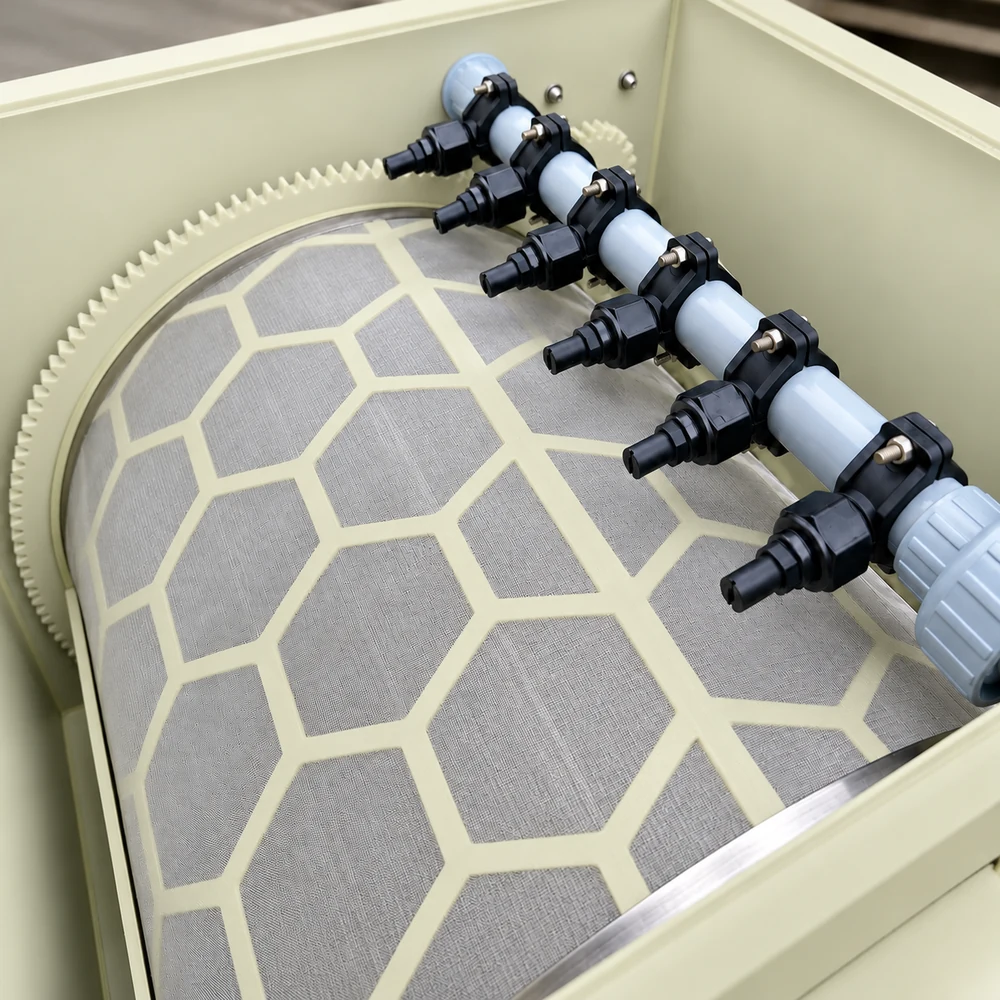
The panel is only as good as the material it is made from. Pureflow drum filters use 316 stainless steel screens because stainless holds its opening size under repeated high-pressure rinsing and resists corrosion in pond and farm water. A screen that stretches or frays changes the micron rating you chose, and the filter slowly stops doing the job.
Mistakes to avoid when choosing a panel
Most panel problems come from the same handful of choices.
Choices that cause trouble
- Choosing the finest panel in the hope of clearer water.
- Expecting a drum filter to remove green water algae.
- Changing the panel before checking nozzles and pump.
- Judging the panel on one week of data.
Habits that work
- Start at 70 to 75 micron and watch the rinse rate.
- Use UV for green water and a drum for solids.
- Check the nozzles and pump first, then the panel.
- Change panels at the next scheduled service.
Pureflow equipment for clear, stable water
Standard RDF drum filterSelf-cleaning SS 316 screen, 75 µm, sizes from 3 to 300 m³/h.Pro RDF with UVThe separate Pro RDF range includes model-specific UV equipment; confirm the supplied configuration and treatment duty.Moving bed biofilter (MBBR)Biological stage that converts ammonia and nitrite.UV disinfection systemsTreatment for free swimming algae and microbes.Confirm the hydraulic duty
Use these questions to prepare a project brief or an operating review. Check an item only when the information has been recorded for your installation.
This checklist is a working aid in the current page session, not a saved maintenance record.
drum filter mesh size FAQ
What micron drum filter is best for a koi pond?
70 to 75 micron is the usual choice. It catches visible waste and haze and rinses at a balanced rate. Pureflow Standard drum filters use a 75 micron stainless steel screen.
Is 40 micron better than 70 micron?
Only when the solids load is light. A 40 micron panel catches finer particles but rinses far more often, uses more rinse water, and can blind on a heavily fed pond.
How small is 70 micron?
70 micron is 0.07 mm, about the width of a fine human hair. Anything larger stays on the screen.
What is the difference between micron and mesh?
Micron is the size of each opening, so a smaller number is finer. Mesh count is the number of openings per inch, so a larger number is finer.
Can a drum filter remove green water?
Not on its own. Single-cell algae are smaller than any practical panel. Use a UV stage, such as the Pro RDF, to clear green water.
Can I change the micron size of my drum filter?
Yes. The panel can be swapped for another micron size. Do it at a scheduled service and check which sizes fit your model.
What micron drum filter is used in aquaculture?
Often 70 to 100 micron for the main loop. The best choice depends on feed rate, fish size and how fine the solids are.
Does a finer filter panel use more water?
Yes. A finer panel clogs sooner, so the drum rinses more often and uses more rinse water.
How do I know my panel is wrong?
Read the rinse pattern. Constant rinsing points to a panel that is too fine, and persistent haze with rare rinsing points to one that is too coarse.
Will a coarser panel damage my biofilter?
It can add fine solids to the biofilter, which decay and raise ammonia. Use the coarser panel only when the load demands it, and keep the biofilter sized for the feed.
More guides related to drum filter mesh size
Discuss your system with Pureflow.
Share your application, operating volume, actual flow, loading and the question you are trying to resolve.