
Drum Filter Maintenance ScheduleDaily to Yearly
A practical drum filter maintenance schedule: what to check daily, weekly, monthly and yearly, and which spares to keep.
 EQUIPMENT REFERENCE
See the mechanism.
Understand the duty.
Select a route or a stage to inspect the process. The cutaway explains the equipment and water environment; it is a teaching illustration, not a project drawing.
Capture solids
Use actual flow, screen opening and solids duty.
Particles are retained as water crosses the screen. Dissolved contaminants require other treatment stages.
- Use actual flow, screen opening and solids duty.
- Confirm approved levels, wash supply and waste drainage.
- Observe a complete guarded cycle before changing settings.
Key takeaways
- Daily, in under a minute: Look at the water level in the drum, listen for odd noises and check that nothing is overflowing.
- Weekly: Look at the spray nozzles while the filter washes.
- Monthly: Check the seals for gaps, the drive and bearings for noise or heat, and the level sensor for slime.
- Every year: Inspect every screen panel for tears, stretching or hardened biofilm.
Daily, in under a minute
Look at the water level in the drum, listen for odd noises and check that nothing is overflowing. If you see a change in how often it washes, write it down.
Weekly
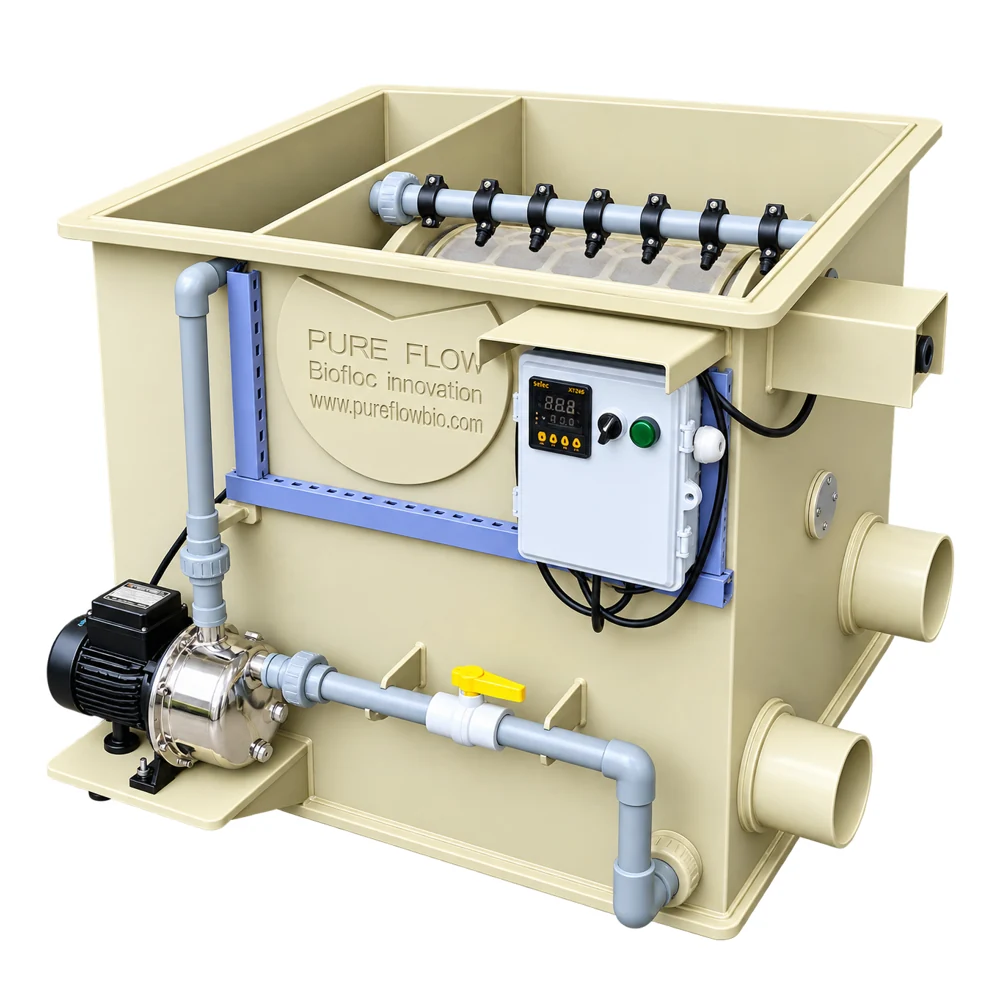
Look at the spray nozzles while the filter washes. A blocked nozzle leaves a stripe of dirty screen. Clean the wash pump strainer.
Work with your own numbers.
Use the tools below to explore the relevant arithmetic. Enter measured values or declared assumptions. An estimate does not establish equipment capacity, biological performance or a safe operating limit.
Measured wash-water use
Use measurements across complete wash cycles and the recorded daily cycle count.
Assumptions and limits
Identify whether you measured wash supply or total waste discharge. No default litres per Pureflow wash cycle are assumed.
Pump or equipment energy cost
Estimate electrical use from measured input power and a declared daily operating schedule.
Assumptions and limits
Use electrical input, not hydraulic power or the pump’s flow rating. Starting load, variable duty, taxes and demand charges are not included.
Convert units before you calculate
Planning arithmetic · inputs remain visible for review · example values are not operating recommendations
Monthly
Check the seals for gaps, the drive and bearings for noise or heat, and the level sensor for slime. Wipe the sensor.
Every year
Inspect every screen panel for tears, stretching or hardened biofilm. Replace the panels that need it. Check the drum rollers and drive wear, and test the controller and alarms.
Spares worth keeping
A spare screen panel, a set of seals, a level sensor and a spare spray nozzle or two. They are cheap, and they turn a long outage into a short one.
What to avoid
Harsh brushes and pressure washers on the screen, and any chemical the maker does not approve. See the troubleshooting article for what to do when something goes wrong.
Pureflow Bio equipment for this
Standard drum filters (RDF) →Automatic solids removal.Pro drum filters →Compact pump-fed drum filters.Confirm the hydraulic duty
Use these questions to prepare a project brief or an operating review. Check an item only when the information has been recorded for your installation.
This checklist is a working aid in the current page session, not a saved maintenance record.
Drum Filter Maintenance Schedule FAQ
How long do screen panels last?
It depends on water, cleaning and handling. Check them yearly and replace them when they show wear.
Can I stop daily checks if I have alarms?
Alarms help, but they do not catch slow problems like a partly blocked nozzle.
More guides related to drum filter maintenance schedule
Discuss your system with Pureflow.
Share your application, operating volume, actual flow, loading and the question you are trying to resolve.