
Standard Drum Filter · Pureflow Bio · Made in India
Standard Drum Filters
Automatic microscreen filtration for koi ponds, aquaculture, hatcheries and aquarium life support systems. Compare all ten Standard RDF models from Pureflow Bio, a drum filter manufacturer in Karnataka, India.
A clear starting point
What is a Standard Drum Filter?
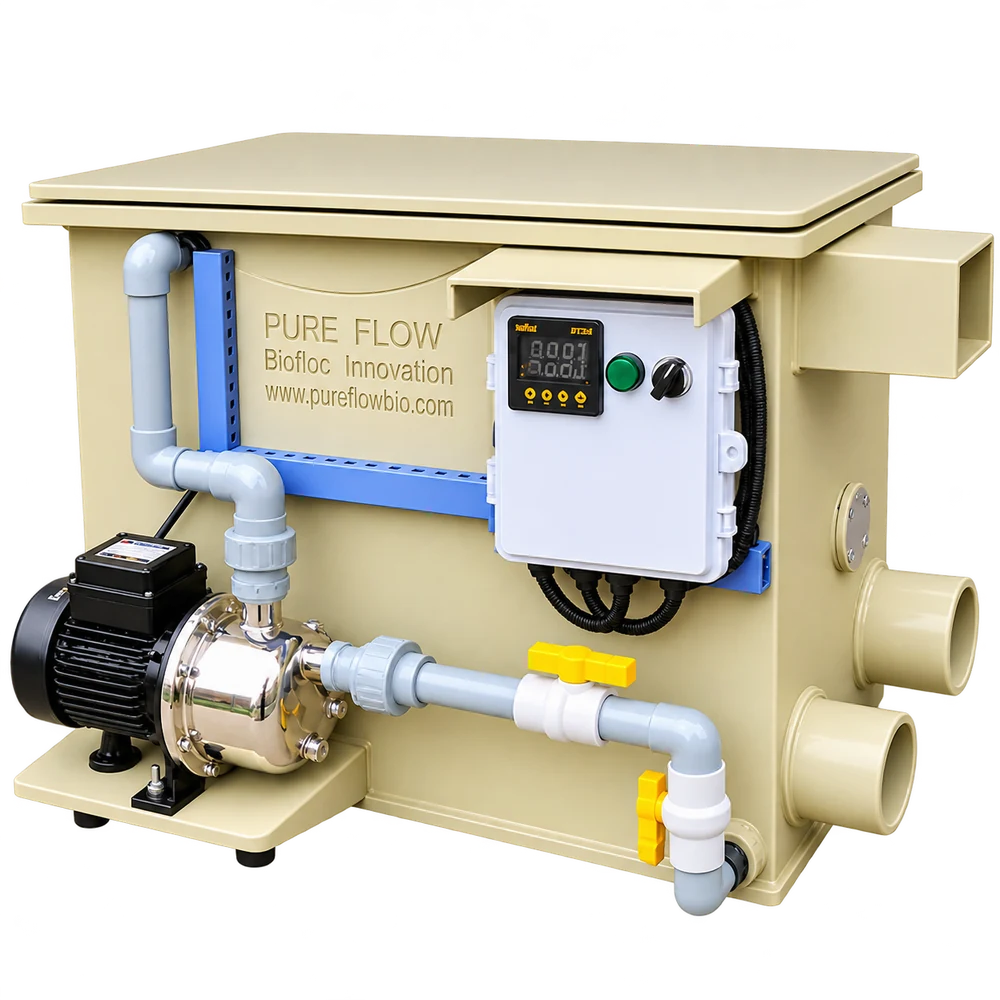
A Standard Drum Filter is an automatic mechanical filter. Water passes through a fine drum screen; retained solids are washed into a separate waste drain. It helps remove suspended material before downstream biological treatment.
Standard RDF or a UV model?
This page covers the Standard RDF range. If your project needs integrated UV equipment, compare the separate Pro with UV models and confirm their treatment duty.
Explore Drum Filter With UV →The Standard RDF range
Compare Standard Drum Filter models
Each model lists its catalogue maximum flow and connection sizes. Final operating capacity depends on the selected mesh, solids load and hydraulic conditions.
Standard rotary drum filter
RDF-3
3 m³/hCatalogue maximum flow
The smallest Standard RDF in the range, with a 430 × 330 mm footprint for layouts where equipment space needs careful planning.
- L × W × H (mm)
- 430 × 330 × 370
- Inlet (mm × qty)
- 32 × 1
- Outlet (mm × qty)
- 50 × 2
Standard rotary drum filter
RDF-10
10 m³/hCatalogue maximum flow
A compact screening unit with a 500 × 450 mm footprint, one 50 mm inlet and two 63 mm outlets.
- L × W × H (mm)
- 500 × 450 × 500
- Inlet (mm × qty)
- 50 × 1
- Outlet (mm × qty)
- 63 × 2
Standard rotary drum filter
RDF-20
20 m³/hCatalogue maximum flow
A 20 m³/h catalogue model with twin 50 mm inlets and twin 63 mm outlets. Compare its operating duty with your actual filter flow.
- L × W × H (mm)
- 655 × 555 × 590
- Inlet (mm × qty)
- 50 × 2
- Outlet (mm × qty)
- 63 × 2
Standard rotary drum filter
RDF-30
30 m³/hCatalogue maximum flow
A mid-range Standard RDF with twin 63 mm inlets, twin 75 mm outlets and a 660 × 655 mm footprint.
- L × W × H (mm)
- 660 × 655 × 725
- Inlet (mm × qty)
- 63 × 2
- Outlet (mm × qty)
- 75 × 2
Standard rotary drum filter
RDF-50
50 m³/hCatalogue maximum flow
A larger screening configuration with twin 90 mm inlets and twin 110 mm outlets for a defined filter-branch duty.
- L × W × H (mm)
- 955 × 855 × 850
- Inlet (mm × qty)
- 90 × 2
- Outlet (mm × qty)
- 110 × 2
Standard rotary drum filter
RDF-100
100 m³/hCatalogue maximum flow
The 100 m³/h catalogue configuration, with a 1280 × 930 mm footprint and twin 160 mm outlets.
- L × W × H (mm)
- 1280 × 930 × 910
- Inlet (mm × qty)
- 110 × 2
- Outlet (mm × qty)
- 160 × 2
Standard rotary drum filter
RDF-150
150 m³/hCatalogue maximum flow
A high-flow Standard RDF configuration with a 1650 × 1050 mm footprint and twin 160 mm connections.
- L × W × H (mm)
- 1650 × 1050 × 1000
- Inlet (mm × qty)
- 160 × 2
- Outlet (mm × qty)
- 160 × 2
Standard rotary drum filter
RDF-200
200 m³/hCatalogue maximum flow
A 200 m³/h catalogue model with twin 200 mm inlet and outlet connections. Allow space for service and waste drainage.
- L × W × H (mm)
- 1850 × 1150 × 1100
- Inlet (mm × qty)
- 200 × 2
- Outlet (mm × qty)
- 200 × 2
Standard rotary drum filter
RDF-250
250 m³/hCatalogue maximum flow
A high-flow configuration with twin 220 mm inlets and outlets and a 2050 × 1250 mm footprint.
- L × W × H (mm)
- 2050 × 1250 × 1150
- Inlet (mm × qty)
- 220 × 2
- Outlet (mm × qty)
- 220 × 2
Standard rotary drum filter
RDF-300
300 m³/hCatalogue maximum flow
The largest listed Standard RDF, with twin 250 mm connections and a 2350 × 1450 mm footprint. Discuss multi-unit layouts above this range.
- L × W × H (mm)
- 2350 × 1450 × 1350
- Inlet (mm × qty)
- 250 × 2
- Outlet (mm × qty)
- 250 × 2
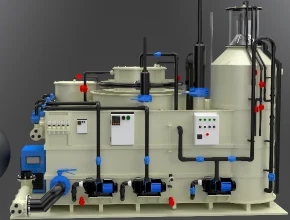
For RDF-100 to RDF-300, the catalogue series illustration is representative because a separate, clearly identified image for every model was not supplied. The confirmed drawing defines the final assembly.
Dimensions and connections
Standard Drum Filter specifications
Compare every Standard RDF model below. On smaller screens, scroll the table sideways.
| Model | L × W × Hmm | Maximum flowm³/h | Listed water volumem³ | Inletmm × quantity | Outletmm × quantity |
|---|---|---|---|---|---|
| RDF-3 | 430 × 330 × 370 | 3 | 3 | 32 × 1 | 50 × 2 |
| RDF-10 | 500 × 450 × 500 | 10 | 10 | 50 × 1 | 63 × 2 |
| RDF-20 | 655 × 555 × 590 | 20 | 20 | 50 × 2 | 63 × 2 |
| RDF-30 | 660 × 655 × 725 | 30 | 30 | 63 × 2 | 75 × 2 |
| RDF-50 | 955 × 855 × 850 | 50 | 50 | 90 × 2 | 110 × 2 |
| RDF-100 | 1280 × 930 × 910 | 100 | 100 | 110 × 2 | 160 × 2 |
| RDF-150 | 1650 × 1050 × 1000 | 150 | 150 | 160 × 2 | 160 × 2 |
| RDF-200 | 1850 × 1150 × 1100 | 200 | 200 | 200 × 2 | 200 × 2 |
| RDF-250 | 2050 × 1250 × 1150 | 250 | 250 | 220 × 2 | 220 × 2 |
| RDF-300 | 2350 × 1450 × 1350 | 300 | 300 | 250 × 2 | 250 × 2 |
Useful selection guidance
Which Standard RDF should you discuss?
Enter the actual peak flow through this filter branch. If your design starts with water volume and a specified turnover time, use Q = V ÷ T, with volume in m³ and time in hours.
The tool compares flow with the published maximum. Mesh performance, solids loading and biological treatment duty need a separate technical review.
- Confirm screen opening and particle characteristics.
- Review inlet and outlet water levels and available head.
- Check solids load, feed input and wash frequency.
- Agree waste drainage, wash supply and service access.
Screen. Wash. Discharge.
How a Standard Drum Filter works
Separate suspended solids
Water passes through the selected SS 316 mesh. Particles retained by the screen remain on the drum until the wash cycle removes them.
Start automatic washing
The level-sensor arrangement starts cleaning as operating conditions change. The drive turns the drum while high-pressure nozzles rinse the screen.
Send collected solids to waste
Wash water carries retained solids into a separate drain. Screened water continues to the next selected treatment stage.
Built for accessible solids management
Standard RDF features and benefits
SS 316 screening options
The supplied catalogue specifies SS 316 grade 75-micron mesh. Review the solids load, operating water levels and wash arrangement when selecting the model.
Automatic wash arrangement
The level-sensor and spray-nozzle arrangement starts cleaning as operating conditions change, reducing the need to initiate every wash cycle manually.
Polypropylene drive gear
The PP drive gear will not rust. Plan routine checks of the gear, drive and screen as part of the equipment maintenance schedule.
A closer look
Standard RDF equipment gallery
Open an image for a larger view. These are equipment illustrations; supplied components and dimensions are confirmed in your quotation.
Plan the complete treatment process
For koi ponds, aquaculture and aquarium systems
Koi and ornamental ponds
Plan mechanical screening around circulation flow, fish load, feeding and an accessible waste route.
Explore pond filtration →Fish farms and hatcheries
Coordinate solids management with the species, production conditions, biofilter and operating plan.
Explore aquaculture systems →Aquarium life support
Review water chemistry, service access and materials as part of each exhibit’s life support equipment brief.
Explore aquarium systems →Before ordering
Installation and maintenance essentials
Confirm the installation duty
- Agree gravity-fed or pump-fed arrangement and operating levels.
- Check the actual peak flow, pipe sizes and available head.
- Define the wash-water source, pressure, flow and waste-drain capacity.
- Confirm electrical supply, control interfaces, foundation and service clearances.
Make routine care practical
- Inspect the screen, nozzles, level sensors, drive and drain.
- Check for deposits, wear and unusual cleaning frequency.
- Isolate the equipment before maintenance and follow its operating instructions.
- Confirm replacement screens, spare parts and service arrangements for your location.
Talk to the manufacturer
Request a Standard Drum Filter quotation
Choose a model above or add your selection brief. Share your flow, screen opening, water conditions and project location so our team can review the configuration.
Straight answers
Standard Drum Filter FAQs
What is a Standard Drum Filter?
It is our self-cleaning rotary drum filter without UV. Water passes through a 75-micron SS 316 screen, a level sensor starts a wash when the screen loads up, and high-pressure nozzles rinse the dirt into a waste channel. There are ten models, RDF-3 to RDF-300, covering 3 to 300 m³/h.
Which Standard RDF model do I need?
Take the peak flow that will pass through the filter in m³/h and choose the model rated above it. A koi pond turning its volume over every hour or two usually sits in the lower half of the range, while fish farm and RAS loops often need RDF-100 and above.
Can one drum filter handle a whole fish farm?
Sometimes, but large farms often run two or more drum filters in parallel. That way one can be serviced while the others keep running, and you are never relying on a single machine for all your solids removal.
Does the drum filter replace my biofilter?
No. It removes solid waste, but ammonia dissolved in the water still needs a biological filter such as an MBBR, trickle filter or Bakki shower. What a drum filter does is make that biofilter work much better, because it isn't clogged with sludge.
How much water goes to waste when it washes?
Each wash uses a short burst of water, and how often it washes depends on how much dirt is coming in. A lightly stocked pond washes far less often than a heavily fed fish farm. Feeding carefully cuts the number of washes, and the waste water makes good fertiliser for plants.
What do I need to tell you for a quotation?
Tell us the flow rate, whether the filter is gravity- or pump-fed, the pipe sizes you plan to use, what you keep (koi, farm species or aquarium) and roughly how much you feed per day. Site photos or a sketch of the plant room also help us check fit and levels.
Connect the treatment stages
Related filtration equipment
Planning the whole filtration system?
Coordinate Standard RDF screening with biofiltration, pumps, tanks and water treatment in one project brief.
Engineering & procurement
100 m³/h drum-filter selection: start with the actual branch flow
RDF-100 has a 100 m³/h catalogue maximum-flow listing. Use that figure to compare the model, then confirm operation at the selected screen, solids loading and available head.
What the RDF-100 catalogue establishes
The Standard RDF catalogue lists 1280 × 930 × 910 mm overall dimensions, two 110 mm inlets and two 160 mm outlets. The quoted drawing confirms installation clearances, connection levels and the supplied assembly.
What still needs a project duty
Confirm clean and loaded head loss, wash-water pressure and demand, operating levels, drive and pump loads, waste route and control response. A catalogue maximum is not guaranteed throughput under every condition.
| Selection item | Specify or verify | Why it changes the selection |
|---|---|---|
| Screening duty | Actual peak flow, 75-micron mesh and expected solids load | Screen loading and available head affect operation. |
| Wash and utilities | Measured L/wash, cycles at stated loading, pressure and electrical schedule | Cleaning requirements contribute to operating cost and site demand. |
| Separate treatment stages | Biological loading, gas management and any UV duty | A mechanical drum filter does not establish ammonia removal or UV disinfection. |
For the full Standard/Pro comparison use the rotary drum filter range guide; open the RDF-100 model page for its supplied images and specification table.
Discuss the technical requirements →