
Gravity-Fed or Pump-Fed FiltersWhich Is Better?
Gravity-fed or pump-fed filter installations: how each works, setup diagrams, advantages, when to choose which for ponds and fish systems.
 EQUIPMENT REFERENCE
See the mechanism.
Understand the duty.
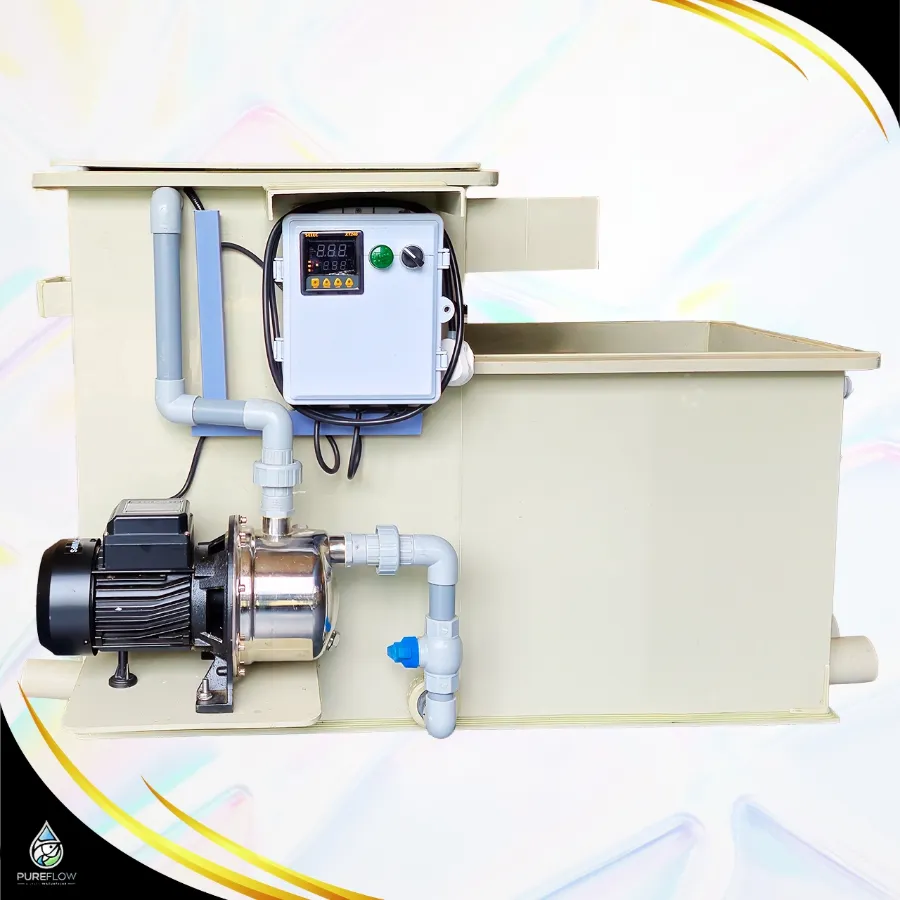
Select a route or a stage to inspect the process. The cutaway explains the equipment and water environment; it is a teaching illustration, not a project drawing.
Supply the pump
Check the complete pump and system duty.
Maintain the approved suction arrangement and avoid dry running or air ingress.
- Check the complete pump and system duty.
- Use internal pipe dimensions and measured operating flow.
- Review supply conditions, protection and service isolation.
Key takeaways
- Gravity-fed: water flows to the filter by its own weight, then a pump returns it.
- Pump-fed: a pump pushes water through the filter.
- Gravity-fed is gentler on solids. Pump-fed is more flexible.
- Choose by site levels, pond type and budget of space.
Pump-fed systems
A pump takes water from the pond (often via a skimmer or drain), pushes it through the filter and returns it. Easy to retrofit and place, but solids pass through the pump and may break up.

Gravity-fed systems
Water flows from the bottom drain to a filter placed below water level. A pump after the filter returns clean water. Solids reach the filter whole, which makes removal easier.
Work with your own numbers.
Use the tools below to explore the relevant arithmetic. Enter measured values or declared assumptions. An estimate does not establish equipment capacity, biological performance or a safe operating limit.
Pipe velocity check
Calculate mean velocity using actual flow and the pipe’s internal diameter.
Assumptions and limits
Internal diameter differs from nominal outside size. Velocity alone does not prove gravity capacity, solids transport, pressure loss or freedom from air locks.
Flow & turnover planner
Relate a measured water volume to a selected turnover time. Confirm the time from the application and hydraulic design.
Assumptions and limits
A planning allowance is your assumption. This calculation does not choose a filter, prove treatment capacity or account for pump head.
Convert units before you calculate
Planning arithmetic · inputs remain visible for review · example values are not operating recommendations
Comparison
| Gravity-fed | Pump-fed | |
|---|---|---|
| Solids | Reach filter whole | May break up in pump |
| Layout | Needs filter below water level | Flexible |
| Best for | New builds, koi ponds | Retrofits, tight spaces |
| Pump position | After the filter, on clean water | Before the filter |
Which one should you choose?
If you can place the filter below water level with a bottom drain, gravity is the cleaner design. Otherwise pump-fed works well. See gravity-feed pipework and sump design.
Pureflow Bio equipment for this
Standard drum filters (RDF) →Automatic solids removal.Pro drum filters →Compact pump-fed drum filters.Coordinate the levels and losses
Use these questions to prepare a project brief or an operating review. Check an item only when the information has been recorded for your installation.
This checklist is a working aid in the current page session, not a saved maintenance record.
Gravity-Fed or Pump-Fed Filters FAQ
Which is better, gravity or pump-fed?
Gravity-fed for cleanliness, pump-fed for flexibility.
Can I switch later?
With plumbing changes, yes.
Do both need a pump?
Yes, to return water.
More guides related to gravity-fed or pump-fed filters
Discuss your system with Pureflow.
Share your application, operating volume, actual flow, loading and the question you are trying to resolve.