
Gravity-Feed Pipework DesignSlopes, Levels and Air Locks
How to design gravity-fed pipework for filters: pipe size, fall, avoiding air locks and keeping solids moving.
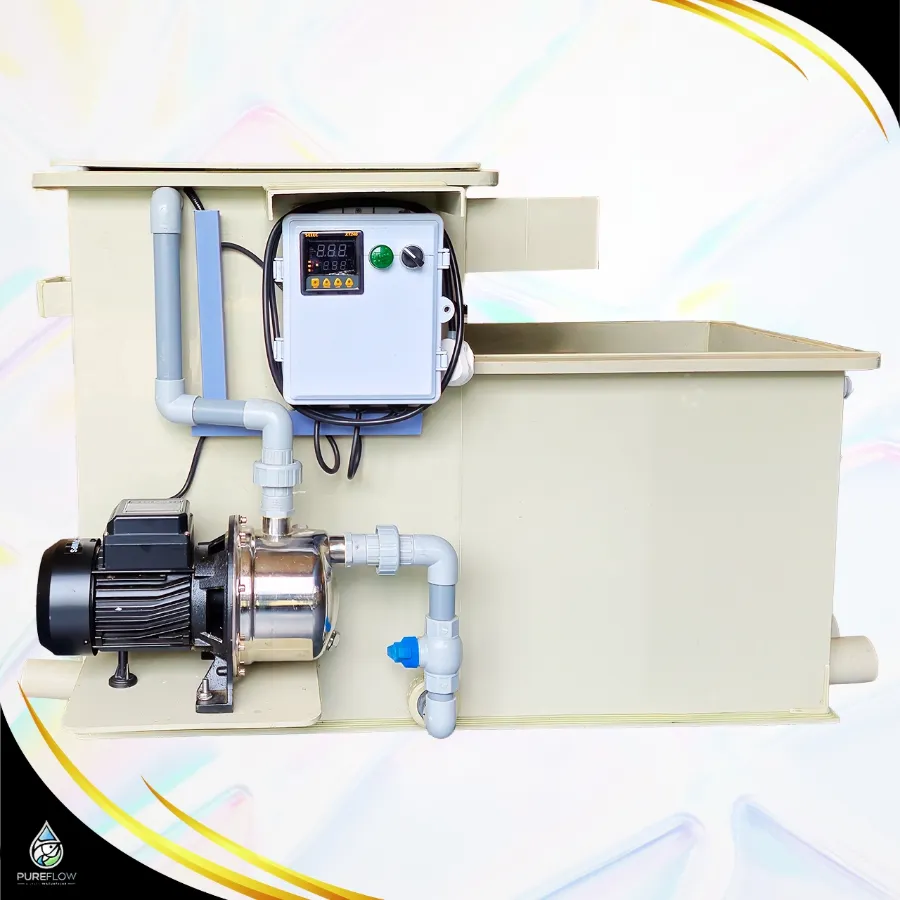 EQUIPMENT REFERENCE
See the mechanism.
Understand the duty.
Select a route or a stage to inspect the process. The cutaway explains the equipment and water environment; it is a teaching illustration, not a project drawing.
Supply the pump
Check the complete pump and system duty.
Maintain the approved suction arrangement and avoid dry running or air ingress.
- Check the complete pump and system duty.
- Use internal pipe dimensions and measured operating flow.
- Review supply conditions, protection and service isolation.
Key takeaways
- Set the levels: Draw the water level in the tank, the filter inlet and the outlet.
- Pipe size: Use larger pipe for gravity lines so velocity stays low and friction is small.
- Avoid air locks: Slope pipes continuously, avoid high points and use a vent where needed.
- Keep solids moving: Provide enough velocity to carry solids without settling, and avoid long flat runs.
Set the levels
Draw the water level in the tank, the filter inlet and the outlet. The filter inlet must sit below the tank water level with enough head to push the flow through.

Pipe size
Use larger pipe for gravity lines so velocity stays low and friction is small. Narrow pipe limits flow and raises the tank level.
Work with your own numbers.
Use the tools below to explore the relevant arithmetic. Enter measured values or declared assumptions. An estimate does not establish equipment capacity, biological performance or a safe operating limit.
Pipe velocity check
Calculate mean velocity using actual flow and the pipe’s internal diameter.
Assumptions and limits
Internal diameter differs from nominal outside size. Velocity alone does not prove gravity capacity, solids transport, pressure loss or freedom from air locks.
Flow & turnover planner
Relate a measured water volume to a selected turnover time. Confirm the time from the application and hydraulic design.
Assumptions and limits
A planning allowance is your assumption. This calculation does not choose a filter, prove treatment capacity or account for pump head.
Convert units before you calculate
Planning arithmetic · inputs remain visible for review · example values are not operating recommendations
Avoid air locks
Slope pipes continuously, avoid high points and use a vent where needed. Keep bends smooth.
Keep solids moving
Provide enough velocity to carry solids without settling, and avoid long flat runs. See installation checklist.
Add overflow protection
An emergency overflow protects the tank if a pipe blocks.
Pureflow Bio equipment for this
Standard drum filters (RDF) →Automatic solids removal.Pro drum filters →Compact pump-fed drum filters.Coordinate the levels and losses
Use these questions to prepare a project brief or an operating review. Check an item only when the information has been recorded for your installation.
This checklist is a working aid in the current page session, not a saved maintenance record.
Gravity-Feed Pipework Design FAQ
How much slope do I need?
Enough for steady flow without standing water. Ask your supplier for guidance for your pipe size.
Can I mix gravity and pump?
Yes. Many systems gravity-feed the filter and pump the clean water back.
More guides related to gravity-feed pipework design
Discuss your system with Pureflow.
Share your application, operating volume, actual flow, loading and the question you are trying to resolve.