
Aquarium Drum FilterWhen and How to Use One
Aquarium drum filters: automatic central filtration for large tanks and fish rooms, why they beat socks and sponges, which setups need one and how to size.
 EQUIPMENT REFERENCE
See the mechanism.
Understand the duty.
Select a route or a stage to inspect the process. The cutaway explains the equipment and water environment; it is a teaching illustration, not a project drawing.
Capture solids
Use actual flow, screen opening and solids duty.
Particles are retained as water crosses the screen. Dissolved contaminants require other treatment stages.
- Use actual flow, screen opening and solids duty.
- Confirm approved levels, wash supply and waste drainage.
- Observe a complete guarded cycle before changing settings.
Key takeaways
- An aquarium drum filter removes solids automatically, so there are no socks to wash and no sponges to squeeze.
- It suits large and public aquariums, rack systems, breeding rooms, quarantine lines and marine systems.
- Size it by flow: the volume multiplied by the turnovers per hour, with a margin.
- It is a mechanical stage. It works in front of a biofilter, not instead of one.
What is an aquarium drum filter?
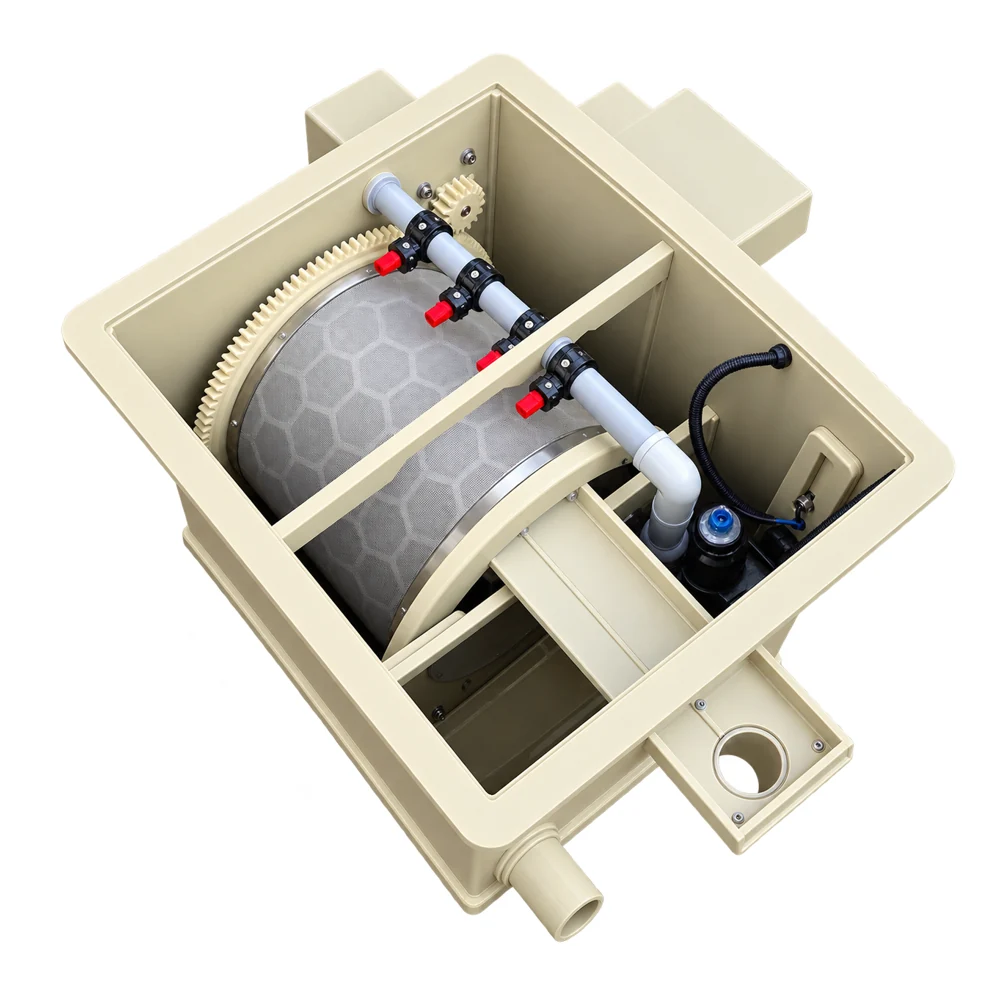
An aquarium drum filter is a self-cleaning mechanical filter for large tanks and fish rooms. Water from the aquarium overflows into a rotating drum wrapped in a fine screen of 316 stainless steel. Solids stay on the screen, clean water passes through, and a level sensor starts a spray that washes the dirt into a waste channel. The filtering carries on while the rinse runs, and nobody has to touch anything.
It is the same machine that is used on koi ponds and fish farms, in sizes that suit aquarium flows. Our rotary drum filter guide explains the machine in full.
Work with your own numbers.
Use the tools below to explore the relevant arithmetic. Enter measured values or declared assumptions. An estimate does not establish equipment capacity, biological performance or a safe operating limit.
Water-change volume planner
Calculate the volume changed per event and the original-water fraction remaining after repeated equal changes.
Assumptions and limits
Assumes complete mixing between equal changes. Match replacement-water chemistry and temperature; this is not a safe-change prescription or a treatment guarantee.
Flow & turnover planner
Relate a measured water volume to a selected turnover time. Confirm the time from the application and hydraulic design.
Assumptions and limits
A planning allowance is your assumption. This calculation does not choose a filter, prove treatment capacity or account for pump head.
Convert units before you calculate
Planning arithmetic · inputs remain visible for review · example values are not operating recommendations
Why a drum filter instead of filter socks or sponges?
Socks and sponges work, but they ask you to keep working. A drum filter changes what happens to the dirt and how much of your week it takes.
For the honest comparison with a sump and its filter socks, see drum filter vs sump.
Which aquariums and fish rooms need a drum filter?
Any aquarium that carries a lot of fish, feeds heavily or is hard to service can benefit. These are the most common cases.
| System | Why a drum filter helps |
|---|---|
| Large and public aquariums | High stocking and constant public view; clear water matters and downtime does not |
| Rack systems | Many small tanks on one shared filter; one screen serves the lot |
| Breeding rooms | Heavy feeding of fry and brood stock produces a lot of solids |
| Discus and other demanding species | Clean, stable water with fewer swings in nitrate |
| Quarantine systems | Reliable, easy-to-clean filtration without cross-contamination from socks |
| Marine and reef systems | Removes particles before they dissolve and feed algae; used alongside a skimmer |
If your system is not on this list, the same logic applies: a lot of waste and a wish for less manual work.
Which drum filter size does your aquarium or fish room need?
Choose the drum filter from the flow it will treat, not from the tank size. Take the total water volume of the system, multiply by the turnovers per hour you plan to run, and add a margin of about a quarter.
For example, a fish room with 4,000 litres of water at five turnovers an hour needs 4 x 5 = 20 m³/h, or 25 m³/h with a margin. That points to an RDF-30.
| Model | Catalogue flow | Good for |
|---|---|---|
| RDF-3 | 3 m³/h | Small systems, nurseries, quarantine |
| RDF-10 | 10 m³/h | Large home aquariums, breeding rooms |
| RDF-20 | 20 m³/h | Fish rooms and small displays |
| RDF-30 | 30 m³/h | Public displays and small racks |
| RDF-50 | 50 m³/h | Large displays and big rack systems |
| RDF-100 | 100 m³/h | Very large public aquariums |
Catalogue flows are maximums and not a guaranteed duty at every mesh size, so check the final choice with us.
Our sizing guide goes through the same method for ponds and farms, and the estimator in drum filter vs sump works for aquarium flows.
How an aquarium drum filter system is built
A drum filter is usually one part of a short chain. The usual aquarium layout is straightforward.
The drum filter
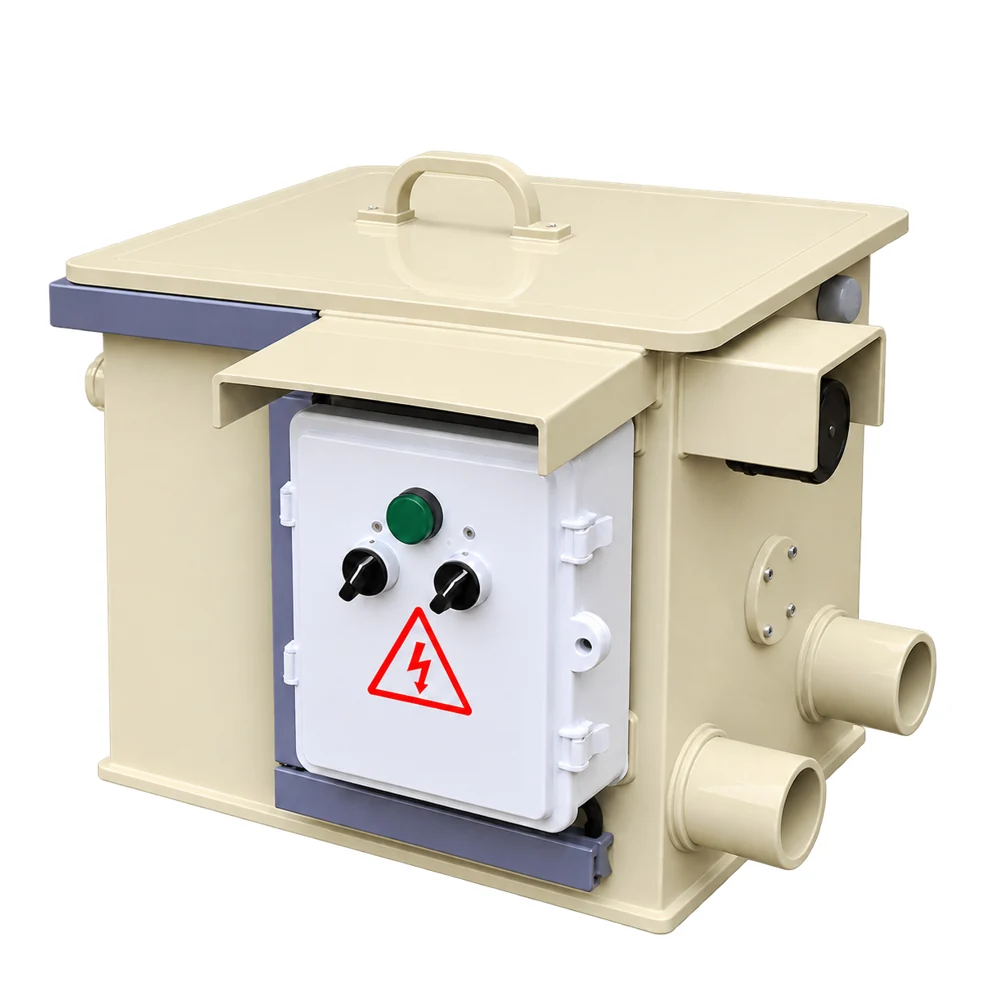
The screen, the rinse and the waste channel sit in one body. Choose the Standard range for mechanical filtration, or the Pro range if you also want UV lamps in the same housing for clear, low-microbe water.
The biological stage
After the drum filter the water goes to a moving bed biofilter, where bacteria on the media convert ammonia and nitrite. Our moving bed biofilter guide explains how it works and how to size it.
- OverflowThe aquarium drains by gravity to the drum filter.
- ScreenSolids are caught and rinsed to waste.
- BiofilterThe clean water passes through the moving bed.
- ReturnA pump lifts the treated water to the aquarium.
Working with biology and UV
A drum filter does not remove dissolved ammonia, nitrite or nitrate, and it is not a disinfectant. It prepares the water so that the other stages work well.
- Biofilter: converts ammonia and nitrite, and it is always needed.
- Protein skimmer: in marine systems, removes dissolved organics a screen cannot.
- UV: treats free swimming algae and microbes. A Pro RDF puts the lamps in the same unit.
- Water changes: still needed to keep nitrate and minerals in balance.
What changes in the water once the dirt leaves
Owners who move from socks and sponges to a drum filter tend to notice the same things within a month. Understanding why helps you judge whether your system is working as it should.
None of this removes the need for good husbandry. Feeding sensibly and testing regularly still matter. It simply gives you a calmer system to manage.
Common mistakes with aquarium drum filters
- Sizing from tank volume only. Choose by flow and keep a margin.
- Skipping the biofilter. A drum filter cannot convert ammonia.
- No drain plan. The waste has to go somewhere, and an overflowing bucket is not a plan.
- Pipes that are too small. A restricted overflow backs water up into the tank.
- Forgetting salt. In marine systems, check materials and rinse exposed metal with fresh water.
- Never looking at it. A weekly glance catches blocked nozzles before they cause trouble.
Setting it up: the practical points
Aquarium drum filters are simple to run, but they do need a few things planned from the start.
- A reliable gravity route from the overflow to the filter, with correctly sized pipes.
- A waste line to a drain or a collection tank.
- Power for the drive, the rinse pump and the sensor.
- Space for the unit and for easy access to the nozzles and screen.
- For salt water, tell us at the start so materials and fixings can be chosen with care.
Our installation checklist lists the steps in order.
Species and system notes
Different livestock produce different loads, so the settings can differ slightly.
| Livestock | Typical load | Note |
|---|---|---|
| Discus and angelfish | Moderate, steady | Keep flow gentle and temperature stable |
| Large cichlids and catfish | Heavy | Plan a larger model and a strong biofilter |
| Koi and goldfish indoors | Heavy | Treat like a small pond system |
| Reef and marine fish | Moderate | Use alongside a skimmer |
| Breeding and fry rooms | Very high feeding | Size for the feeding peak |
Match the model to the load, not only to the water volume.
Looking after it
The routine is light. A quick look at the rinse cycle each week, a monthly clean of the nozzles and sensor, and a yearly review of seals and the screen are enough for most systems. The maintenance schedule has the full list.
Pureflow equipment for aquarium filtration
Standard RDF drum filterSelf-cleaning SS 316 screen, 75 µm, sizes from 3 to 300 m³/h.Pro RDF with UVThe separate Pro RDF range includes model-specific UV equipment; confirm the supplied configuration and treatment duty.Moving bed biofilter (MBBR)Biological stage that converts ammonia and nitrite.Plan around the collection
Use these questions to prepare a project brief or an operating review. Check an item only when the information has been recorded for your installation.
This checklist is a working aid in the current page session, not a saved maintenance record.
Aquarium drum filter FAQ
What is an aquarium drum filter?
A self-cleaning mechanical filter with a rotating stainless steel screen that removes solids from aquarium water and flushes them away automatically. For a specific tank or fish room, send us the volume, the stock and the flow you run today and we will suggest a model.
Do I still need a biofilter?
Yes. The drum filter removes solids, and a biofilter converts ammonia and nitrite. For a specific tank or fish room, send us the volume, the stock and the flow you run today and we will suggest a model.
Which size drum filter do I need?
Work out flow from the water volume and turnovers per hour, add a margin and pick the model that covers it. For a specific tank or fish room, send us the volume, the stock and the flow you run today and we will suggest a model.
Is a drum filter suitable for a marine tank?
Yes, as a pre-filter before the biofilter and skimmer. Tell us about salt water so the materials and fixings suit your site. For a specific tank or fish room, send us the volume, the stock and the flow you run today and we will suggest a model.
Does it replace a protein skimmer?
No. A skimmer removes dissolved organics, which a screen cannot. For a specific tank or fish room, send us the volume, the stock and the flow you run today and we will suggest a model.
How much water does the rinse use?
A small share of the flow, and it grows with the load and with a finer screen. For a specific tank or fish room, send us the volume, the stock and the flow you run today and we will suggest a model.
Is it suitable for a rack system?
Yes. One drum filter can serve many tanks on a shared circuit. For a specific tank or fish room, send us the volume, the stock and the flow you run today and we will suggest a model.
Can I add UV to it?
Yes. The Pro RDF range has UV lamps built into the unit. For a specific tank or fish room, send us the volume, the stock and the flow you run today and we will suggest a model.
How much work does it need?
A short weekly look and a monthly clean of the nozzles and sensor. For a specific tank or fish room, send us the volume, the stock and the flow you run today and we will suggest a model.
More guides related to Aquarium drum filter
Discuss your system with Pureflow.
Share your application, operating volume, actual flow, loading and the question you are trying to resolve.