
The Aquarium Nitrogen CycleA Plain Guide for New Keepers
What the nitrogen cycle is, how to cycle a new aquarium and what to do when ammonia or nitrite appears.
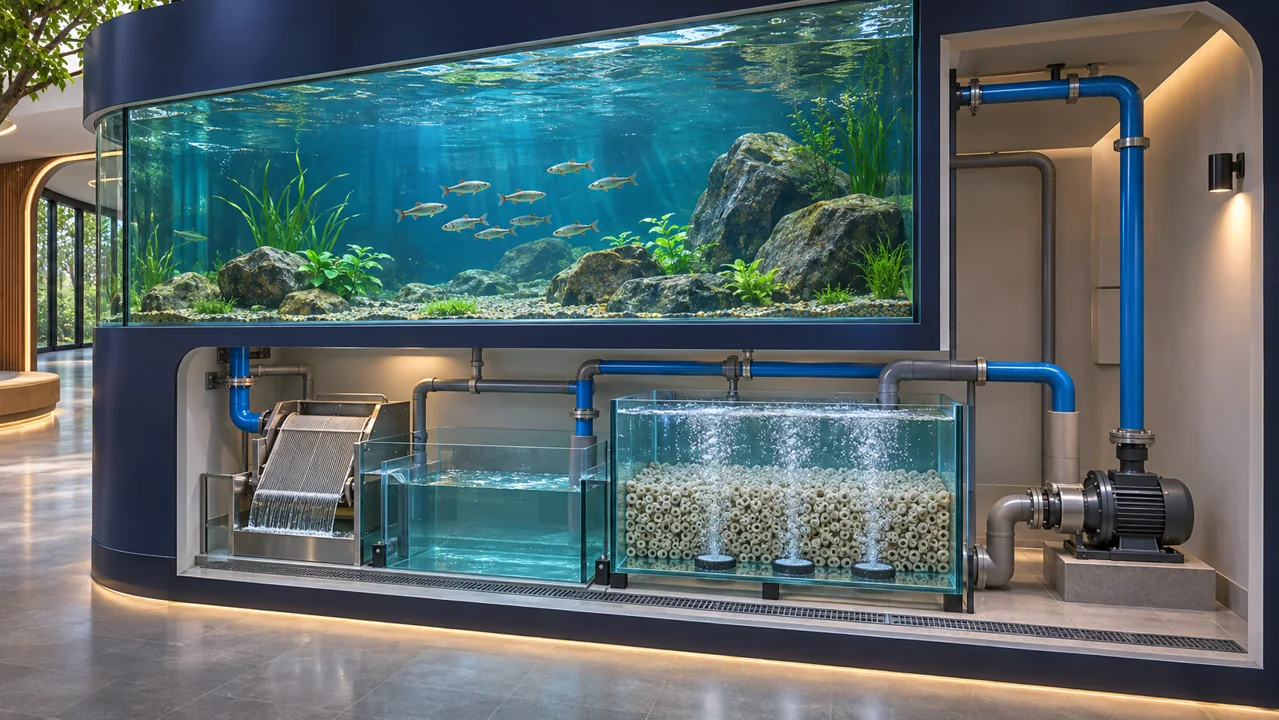 SYSTEM CONCEPT
See the mechanism.
Understand the duty.
Select a route or a stage to inspect the process. The cutaway explains the equipment and water environment; it is a teaching illustration, not a project drawing.
Manage the display
Record the stock, feeding and operating water volume.
Use the actual operating water volume, stock and feeding programme to establish the life-support review.
- Record the stock, feeding and operating water volume.
- Keep mechanical, biological and gas duties distinct.
- Review quarantine, maintenance access and safe water replacement.
Key takeaways
- The cycle in short: Fish and food produce ammonia.
- A new tank has no bacteria: So ammonia can rise to dangerous levels.
- If you see ammonia or nitrite: Do a water change, reduce feeding, and keep the filter running.
- Keeping it healthy: Stock gradually, feed lightly and do regular partial water changes.
The cycle in short
Fish and food produce ammonia. One group of bacteria turns it into nitrite, another turns nitrite into nitrate. Nitrate is far less harmful and is removed by water changes or plants.

A new tank has no bacteria
So ammonia can rise to dangerous levels. Cycle the tank first, with no fish or just a few hardy ones, and test often. See biofilter start-up.
Work with your own numbers.
Use the tools below to explore the relevant arithmetic. Enter measured values or declared assumptions. An estimate does not establish equipment capacity, biological performance or a safe operating limit.
Water-change volume planner
Calculate the volume changed per event and the original-water fraction remaining after repeated equal changes.
Assumptions and limits
Assumes complete mixing between equal changes. Match replacement-water chemistry and temperature; this is not a safe-change prescription or a treatment guarantee.
Flow & turnover planner
Relate a measured water volume to a selected turnover time. Confirm the time from the application and hydraulic design.
Assumptions and limits
A planning allowance is your assumption. This calculation does not choose a filter, prove treatment capacity or account for pump head.
Convert units before you calculate
Planning arithmetic · inputs remain visible for review · example values are not operating recommendations
If you see ammonia or nitrite
Do a water change, reduce feeding, and keep the filter running. Do not clean the media in tap water.
Keeping it healthy
Stock gradually, feed lightly and do regular partial water changes.
Pureflow Bio equipment for this
Aquariums and oceanariums →Large display life support.Standard drum filters (RDF) →Automatic solids removal.Plan around the collection
Use these questions to prepare a project brief or an operating review. Check an item only when the information has been recorded for your installation.
This checklist is a working aid in the current page session, not a saved maintenance record.
The Aquarium Nitrogen Cycle FAQ
How do I know the tank is cycled?
Ammonia and nitrite both read zero while you add a little ammonia source.
Can I speed it up?
Seeding with media from an established tank helps a lot.
More guides related to the aquarium nitrogen cycle
Discuss your system with Pureflow.
Share your application, operating volume, actual flow, loading and the question you are trying to resolve.