
Koi Pond Filter SizeHow to Size a Filter for Your Pond
How to size a koi pond filter: volume, turnover, stocking, mechanical and biological stages, pump and a worked example with a sizing table.
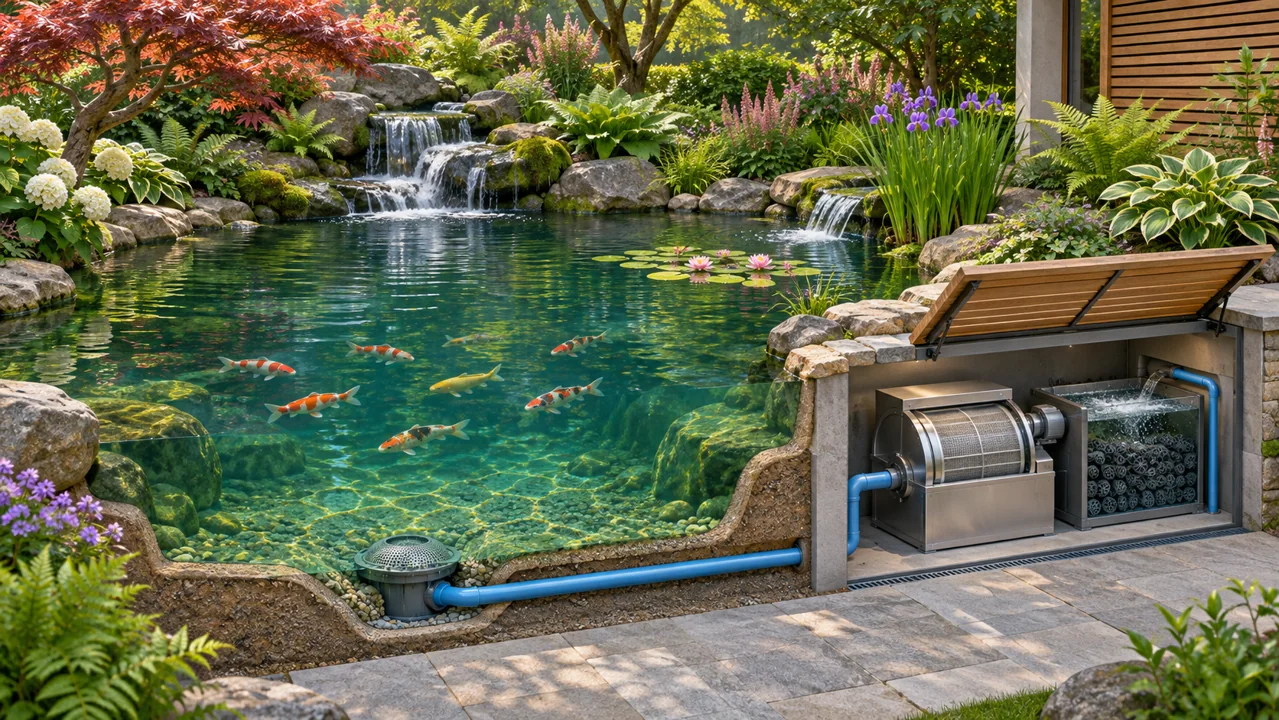 SYSTEM CONCEPT
See the mechanism.
Understand the duty.
Select a route or a stage to inspect the process. The cutaway explains the equipment and water environment; it is a teaching illustration, not a project drawing.
Collect surface debris
Use the operating pond volume and actual loading.
A skimmer can collect floating debris. Its duty and position depend on the pond layout.
- Use the operating pond volume and actual loading.
- Review collection, filtration, oxygen and return distribution.
- Record water chemistry and changes in fish behaviour.
Key takeaways
- Start from water volume, then choose how fast the pond should turn over: every 2 hours for light stocking, 1.5 for normal, 1 for heavy.
- Size both stages. Mechanical filtration must carry the full flow. The biofilter must carry the ammonia load.
- Plan for the koi you will have in three years, not the ones you bought.
- Extra biofilter capacity is cheap insurance. Extra flow beyond the filter’s rating is not.
The short answer
Pond volume divided by your target turnover time gives the flow the filter must handle. A 20,000 litre pond turned over every 1.5 hours needs about 13,300 litres per hour (13.3 m³/h). Then choose a filter rated for at least that flow, with biological capacity matched to the fish.
1. Measure volume properly. 2. Choose turnover from stocking, not habit. 3. Size mechanical and biological stages separately. 4. Leave capacity for growth.
Step 1: work out the water volume
Length × width × average depth in metres gives cubic metres, multiplied by 1,000 for litres. For an irregular pond, split it into shapes, calculate each and add them. A deep drain area counts, so use the average depth rather than the deepest spot. If the shape is hard, fill from a metered supply and read the volume directly.
Work with your own numbers.
Use the tools below to explore the relevant arithmetic. Enter measured values or declared assumptions. An estimate does not establish equipment capacity, biological performance or a safe operating limit.
Flow & turnover planner
Relate a measured water volume to a selected turnover time. Confirm the time from the application and hydraulic design.
Assumptions and limits
A planning allowance is your assumption. This calculation does not choose a filter, prove treatment capacity or account for pump head.
Pond or tank volume
Estimate a rectangular water volume from internal wetted dimensions and average operating depth.
Assumptions and limits
Irregular shapes, sloping walls, freeboard and displaced equipment change the usable water volume. Confirm with a fill meter where practical.
Convert units before you calculate
Planning arithmetic · inputs remain visible for review · example values are not operating recommendations
Step 2: pick a turnover time
Light stocking can run on a two-hour turnover. A typical koi pond uses about 1.5 hours. A heavily stocked or show pond should aim for one hour or faster. See the turnover rate guide for the reasoning.
| Pond volume | Light (2 h) | Normal (1.5 h) | Heavy (1 h) |
|---|---|---|---|
| 10,000 L | 5,000 L/h | 6,700 L/h | 10,000 L/h |
| 20,000 L | 10,000 L/h | 13,300 L/h | 20,000 L/h |
| 30,000 L | 15,000 L/h | 20,000 L/h | 30,000 L/h |
| 50,000 L | 25,000 L/h | 33,300 L/h | 50,000 L/h |
| 100,000 L | 50,000 L/h | 66,700 L/h | 100,000 L/h |
Required filter flow. Pick a filter rated for at least this at your working head.
Six factors that move the answer
The table above is a start. Adjust for the following.
Size both stages
A filter is two jobs: remove solids and convert ammonia. Mechanical filtration is sized for flow. Biological filtration is sized for load.
| Stage | What it handles | How to size |
|---|---|---|
| Mechanical | Solids and debris | Match full pond flow. See drum filter sizing. |
| Biological | Ammonia and nitrite | Size from daily feed. See biofilter sizing. |
| Pump | Moves water to both | Choose for flow at real head. See pipe sizing. |
A worked example
A pond measures 6 m × 4 m with an average depth of 1.5 m: 36 m³, or 36,000 litres. You plan about 20 mid-sized koi, so you choose the normal 1.5 hour turnover: 36,000 ÷ 1.5 = 24,000 L/h, or 24 m³/h. Choose a filter rated for at least 24 m³/h, and a pump that delivers it at the real head, perhaps 30 percent higher on paper. Check biofilter capacity against peak daily feed.
Which filter system fits?
Gravity-fed systems use the pond level to push water through the filter and then a pump returns it, while pump-fed designs push water directly through. See gravity or pump-fed. For ponds with a bottom drain, a gravity system with a drum filter is the cleanest design.
Why spare biofilter capacity is cheap insurance
Bacteria take weeks to grow. A pond that sits close to the biofilter limit has no buffer for a warm spell, a new fish, or one heavy feed. A larger biofilter costs little more at the start and saves emergency purchases later.
Start with the operating pond
Use these questions to prepare a project brief or an operating review. Check an item only when the information has been recorded for your installation.
This checklist is a working aid in the current page session, not a saved maintenance record.
Koi Pond Filter Size FAQ
How big should my koi pond filter be?
Divide pond volume by your target turnover time to get the flow, then check capacity against stocking and feeding.
Can a filter be too big?
In practice no. Extra capacity adds stability if pumps and pipes match.
Do I need a bottom drain?
It makes life easier because waste leaves the pond rather than rotting on the floor.
Should the filter handle the whole pond flow?
Mechanical stage yes. Biological stage can run in parallel in some designs.
More guides related to koi pond filter size
Discuss your system with Pureflow.
Share your application, operating volume, actual flow, loading and the question you are trying to resolve.