
Cloudy Pond WaterCauses and Fixes
Cloudy pond water explained by colour: milky white bacterial bloom, grey fine particles, brown tannins and foam, plus what to test and when UV helps.
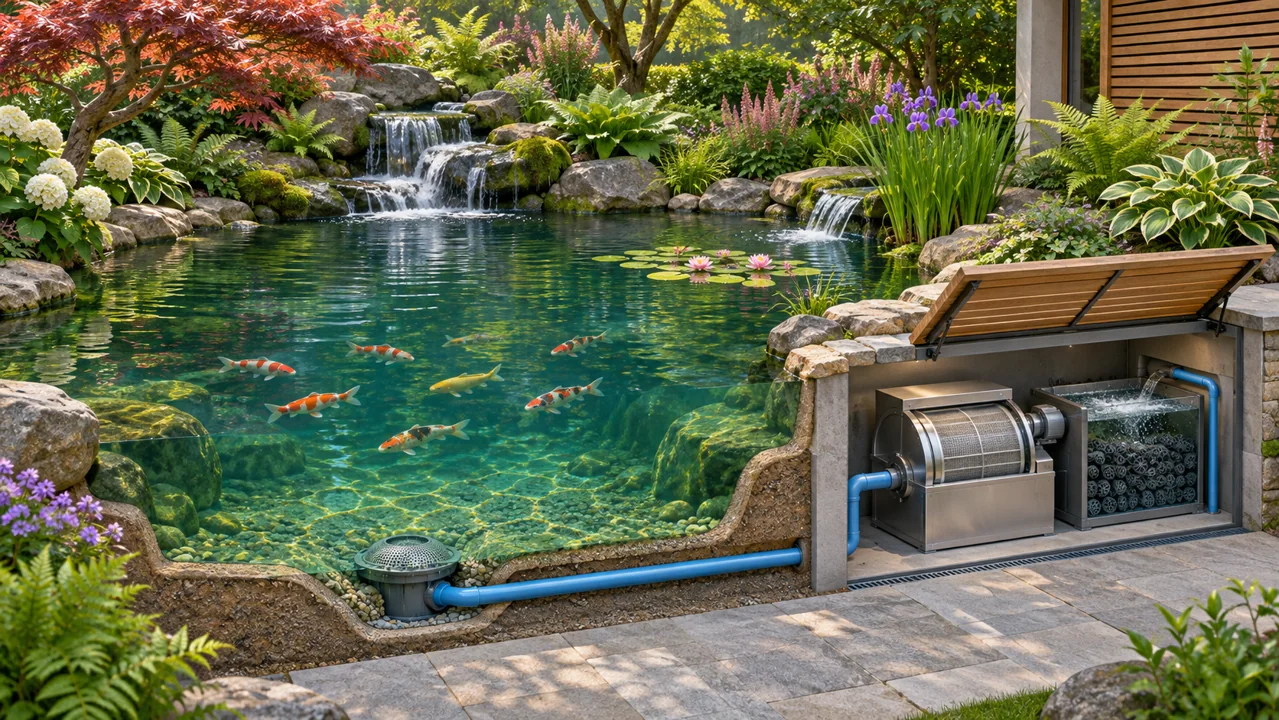 SYSTEM CONCEPT
See the mechanism.
Understand the duty.
Select a route or a stage to inspect the process. The cutaway explains the equipment and water environment; it is a teaching illustration, not a project drawing.
Collect surface debris
Use the operating pond volume and actual loading.
A skimmer can collect floating debris. Its duty and position depend on the pond layout.
- Use the operating pond volume and actual loading.
- Review collection, filtration, oxygen and return distribution.
- Record water chemistry and changes in fish behaviour.
The glass test
Fill a clear glass of pond water and let it stand for an hour. If it stays green, it is algae. If it clears and sediment settles, it is suspended particles. If it stays milky, it may be a bacterial bloom. Then compare with the table below.

Diagnose by colour
| What you see | Likely cause | Common triggers | UV helps? |
|---|---|---|---|
| Green, pea soup | Floating algae | Sun, warm water, nutrients | Yes |
| Milky white haze | Bacterial bloom | New pond, overfeeding, filter cleaned too hard, medication, a dead fish | No |
| Grey or murky | Fine suspended particles | Stirred sediment, weak mechanical filtration | No |
| Brown or tea-coloured | Tannins from leaves or wood | Leaf litter, bog wood | No |
| Foam at the surface | Dissolved proteins | Heavy feeding, dead matter | No |
Work with your own numbers.
Use the tools below to explore the relevant arithmetic. Enter measured values or declared assumptions. An estimate does not establish equipment capacity, biological performance or a safe operating limit.
Flow & turnover planner
Relate a measured water volume to a selected turnover time. Confirm the time from the application and hydraulic design.
Assumptions and limits
A planning allowance is your assumption. This calculation does not choose a filter, prove treatment capacity or account for pump head.
Pond or tank volume
Estimate a rectangular water volume from internal wetted dimensions and average operating depth.
Assumptions and limits
Irregular shapes, sloping walls, freeboard and displaced equipment change the usable water volume. Confirm with a fill meter where practical.
Convert units before you calculate
Planning arithmetic · inputs remain visible for review · example values are not operating recommendations
Milky white water: a bacterial bloom
Free-living bacteria multiply when there is a surge of nutrients with too little established biofilter. It is common in new ponds.
- Test ammonia and nitriteThese tell you whether the biofilter is coping.
- Feed less or pauseLess food means less load.
- Add aerationOxygen supports good bacteria.
- Leave the biofilter aloneDo not wash or disturb it.
- Change water little and oftenGentle, dechlorinated changes.

Grey or murky water: fine particles
Particles that stay suspended do not settle in the pond and do not stay in a coarse filter. A fine mechanical stage, such as a drum filter with a fine screen, catches much of it. See drum filter mesh size.
What a micron rating means
A micron rating is the size of the opening in the screen. A smaller opening catches finer particles, but clogs sooner and needs more washing. A 70 micron screen is a common pond choice. Going much finer can be hard to keep clean.
Brown water and foam
Tannins
Leaves and some wood release tannins that tint water brown. It is harmless to fish. Remove leaf litter or use activated carbon if you want it clear.
Foam
Foam is dissolved protein, often after heavy feeding. A protein skimmer or more frequent water changes help.
When uv-c helps, and when it does not
- Helps: green water from algae.
- Does not help: milky bloom, silt, tannins, foam.
Start with the operating pond
Use these questions to prepare a project brief or an operating review. Check an item only when the information has been recorded for your installation.
This checklist is a working aid in the current page session, not a saved maintenance record.
Cloudy Pond Water FAQ
Why is my new pond cloudy?
New ponds often have a bacterial bloom because the biofilter has not established yet.
Will a UV clear milky water?
No. UV only treats algae.
How long until it clears?
Silt can clear in days, a bloom in a few weeks.
More guides related to cloudy pond water
Discuss your system with Pureflow.
Share your application, operating volume, actual flow, loading and the question you are trying to resolve.