
Koi PondsDesign, Filtration and Water Quality Guide
A complete koi pond guide: how big to build, water values, seasonal feeding, common diseases and the filtration choices that matter.
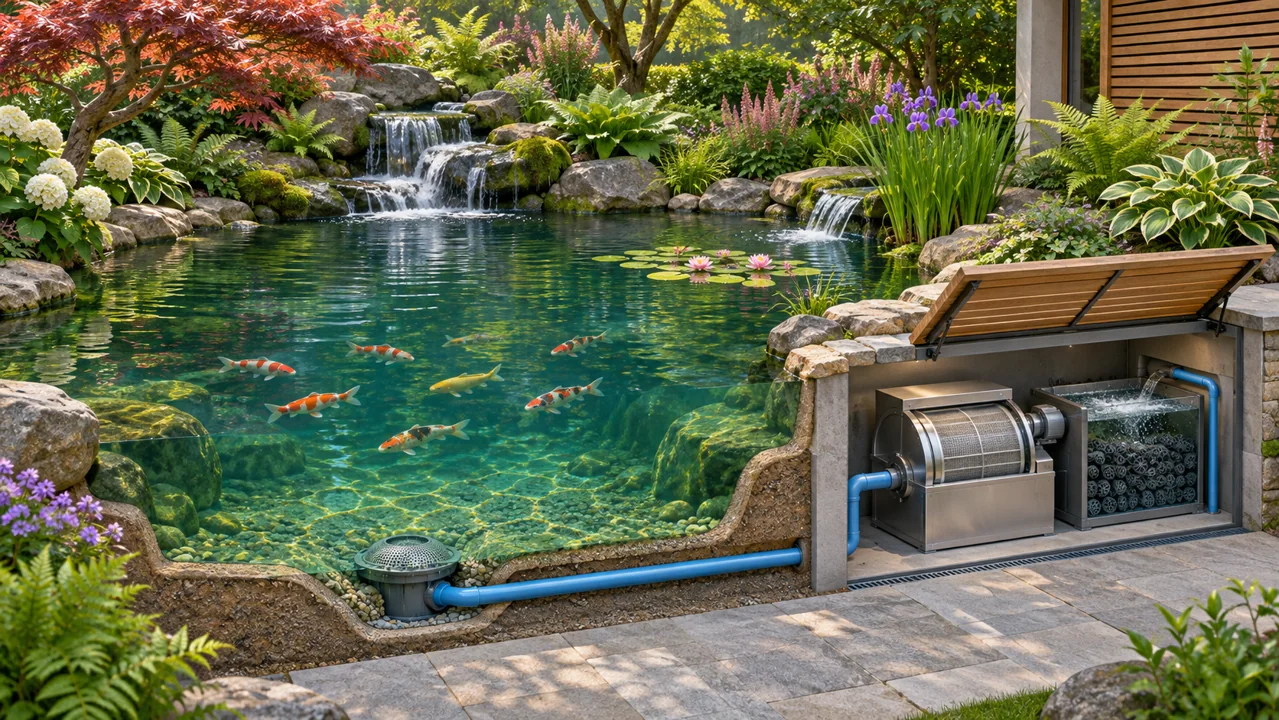 SYSTEM CONCEPT
See the mechanism.
Understand the duty.
Select a route or a stage to inspect the process. The cutaway explains the equipment and water environment; it is a teaching illustration, not a project drawing.
Collect surface debris
Use the operating pond volume and actual loading.
A skimmer can collect floating debris. Its duty and position depend on the pond layout.
- Use the operating pond volume and actual loading.
- Review collection, filtration, oxygen and return distribution.
- Record water chemistry and changes in fish behaviour.
Key takeaways
- Koi need volume, depth and a filter sized for fully grown fish.
- Keep ammonia and nitrite at zero, and pH stable. Stable values matter more than perfect ones.
- Feeding depends on temperature, not the calendar.
- Quarantine every new fish. Most disease arrives with a new koi.
Koi Ponds: why a koi pond is different
Goldfish ponds can get away with a basic filter. Koi cannot. An adult koi can reach 60 to 90 cm and produce as much waste as several smaller fish, so the same volume of water holds far more load. Add feeding, summer heat and a long life span, and filtration becomes the single most important part of the build.
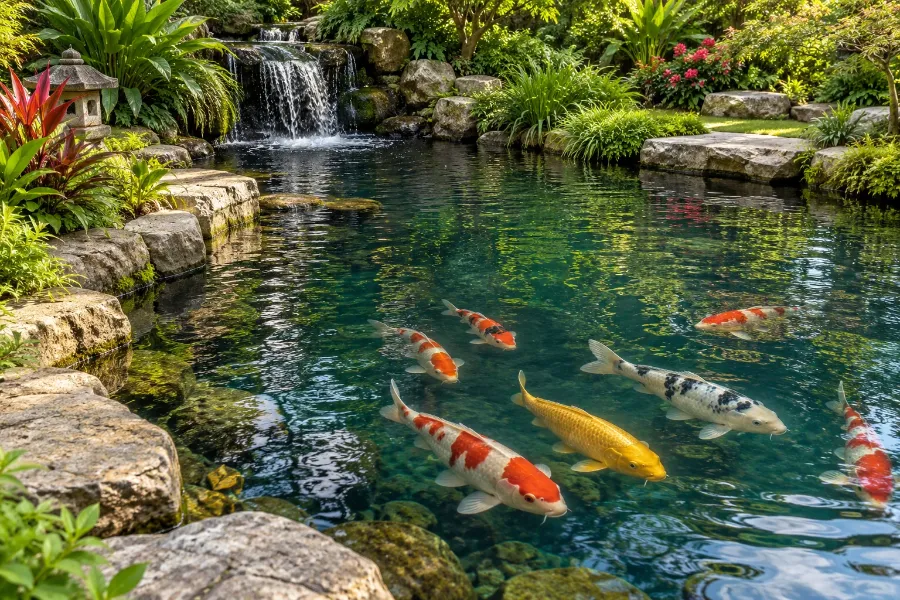
Koi Ponds: how big should the pond be?
Rules of thumb vary, but most keepers aim for at least 10,000 litres for a small group and 20,000 or more for a serious collection. Depth matters as much as volume: 1.2 to 1.5 m gives stable temperature and a refuge in winter or summer. Build bigger than you think you need. See how to build a koi pond.
Work with your own numbers.
Use the tools below to explore the relevant arithmetic. Enter measured values or declared assumptions. An estimate does not establish equipment capacity, biological performance or a safe operating limit.
Flow & turnover planner
Relate a measured water volume to a selected turnover time. Confirm the time from the application and hydraulic design.
Assumptions and limits
A planning allowance is your assumption. This calculation does not choose a filter, prove treatment capacity or account for pump head.
Pond or tank volume
Estimate a rectangular water volume from internal wetted dimensions and average operating depth.
Assumptions and limits
Irregular shapes, sloping walls, freeboard and displaced equipment change the usable water volume. Confirm with a fill meter where practical.
Convert units before you calculate
Planning arithmetic · inputs remain visible for review · example values are not operating recommendations
Koi Ponds: inside a gravity-fed koi pond
The cleanest designs let waste leave the pond by gravity. A bottom drain collects solids at the lowest point, pipes them to a settlement chamber or drum filter, then the water passes through a biofilter and is pumped back through a return. Skimmers clear the surface. See bottom drains and koi pond filters.
Koi Ponds: water values for koi
| Parameter | Target | Act when |
|---|---|---|
| Temperature | 18 to 25 °C | Changes by more than 3 °C a day |
| Ammonia | 0 mg/L | Any reading above 0.25 mg/L |
| Nitrite | 0 mg/L | Any reading |
| Nitrate | Below 50 mg/L | Rising week after week |
| pH | 6.8 to 8.2, stable | Below 6.5, above 8.5 or swinging |
| KH (alkalinity) | 5 to 15 dKH | Below 5 dKH |
| Chlorine | None | Any reading |
| Oxygen | Above 6 mg/L | Koi gasping at the surface |
Practical targets. See the water quality guide.
Koi Ponds: read the thermometer, not the calendar
Koi digestion follows temperature, not dates.
Koi Ponds: keeping koi healthy
Koi herpesvirus (KHV)
A serious viral disease that appears in a narrow temperature window. There is no cure, so prevention (quarantine, clean equipment, no mixing sources) matters.
Bacterial ulcers
Open sores, often linked to poor water quality or injury. Improve water first, then treat as advised by a vet.
Parasites
Flukes and other parasites cause flashing and rubbing. Regular checks and quarantine help catch them early.
Winter problems
Fish are weakened by cold. Keep the pond clean, avoid overfeeding and do not disturb them.
Quarantine every new koi
Hold new fish in a separate tank for several weeks before they join the pond. See quarantine systems.
Koi Ponds: six decisions you only make once
- Depth: at least 1.2 m.
- Bottom drain: in the deepest point, at least one per 15 m².
- Filter size: for the final fish, with room to grow.
- Pumps: sized for the real head.
- Pipe diameter: big enough to keep velocity low.
- Access: enough space to service the filter.
Start with the operating pond
Use these questions to prepare a project brief or an operating review. Check an item only when the information has been recorded for your installation.
This checklist is a working aid in the current page session, not a saved maintenance record.
Koi Ponds FAQ
How deep should a koi pond be?
At least 1.2 metres. Deeper water is steadier in temperature.
How many koi per litre?
Stocking depends on fish size and filtration. A common guide is fewer fish than you think, with a strong filter.
Do koi need a drum filter?
Not strictly, but a drum filter removes solids automatically and makes the biofilter’s job much easier.
When should I feed koi?
When water is above about 10 to 15 °C, matching food type to temperature.
More guides related to koi ponds
Discuss your system with Pureflow.
Share your application, operating volume, actual flow, loading and the question you are trying to resolve.