
Koi Pond MaintenanceA Schedule for Every Season
A complete koi pond maintenance schedule: seasonal calendar, daily, weekly, monthly and yearly checklists, water testing, feeding by temperature, filter and UV care, leaf netting and winter running.
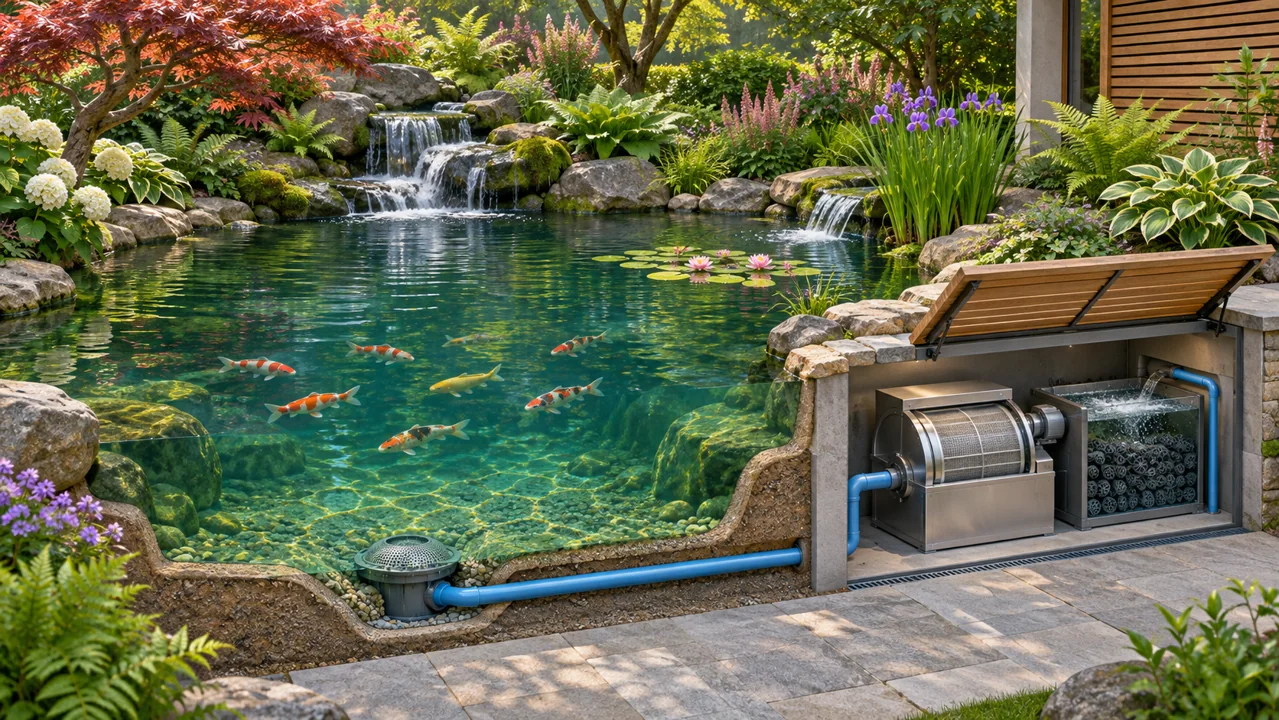 SYSTEM CONCEPT
See the mechanism.
Understand the duty.
Select a route or a stage to inspect the process. The cutaway explains the equipment and water environment; it is a teaching illustration, not a project drawing.
Collect surface debris
Use the operating pond volume and actual loading.
A skimmer can collect floating debris. Its duty and position depend on the pond layout.
- Use the operating pond volume and actual loading.
- Review collection, filtration, oxygen and return distribution.
- Record water chemistry and changes in fish behaviour.
Key takeaways
- Let the water temperature set your timetable. The fish, the filter bacteria and the algae all speed up and slow down with it.
- Think in four layers: a look every day, tests every week, a part water change every month or so and a handful of jobs each season.
- Avoid stacking big tasks. A filter clean, a large water change and a medication in the same week can overload the biology.
- Do not switch the filter off for the winter. A biofilter left idle for weeks has to be rebuilt from scratch.
How much work is it really?
Less than newcomers expect, as long as the pond is well designed and filtered. Most of the effort falls into four rhythms: watching the fish daily, testing weekly, changing part of the water monthly and doing a few jobs as the seasons turn.
The biggest swing factor is how the pond removes solids. With brushes, mats or screens you clean by hand, sometimes several times a week in summer, and every hour the debris sits there it breaks down and feeds the next ammonia peak. A drum filter flushes that waste out within minutes, so your weekly visit turns into a quick inspection.
Koi are cold-blooded, so what counts is the water temperature, not the month. Their appetite, their immunity and the bacteria in the filter all move with it, and the plan below does too. To plan a pond from scratch, start with our koi pond guide.
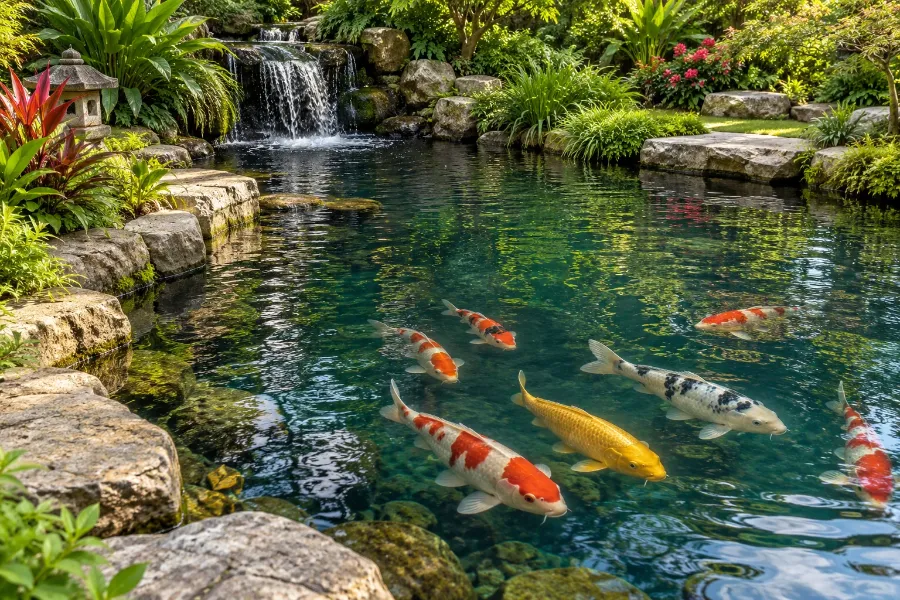
Koi pond maintenance calendar: what to do each season
Match the jobs to the thermometer rather than the calendar. A cold May can hold everything back by a few weeks.
Spring
Water 8 to 18 °C and risingWater
- Test ammonia and nitrite twice a week while the filter bacteria wake up. They trail behind the fish.
- Make the first partial change once the pond holds about 10 °C.
Filter and UV-C
- Inspect the drum filter: spray nozzles, screen, rinse pump and waste pipe.
- Clean the quartz sleeve, fit a new UV lamp if the old one has run its hours, and switch it on before the first green haze.
- Confirm the air supply to the biofilter is working.
Koi
- Offer a little wheatgerm food once the water has stayed above 8 to 10 °C.
- Hold off on new fish. The 7 to 15 °C stretch is risky.
Summer
Water above 18 °CWater
- Replace 10 to 20 percent every two to four weeks and top up evaporation with dechlorinated water.
- Oxygen dips at night in warm water, so keep air and circulation running around the clock.
Filter and UV-C
- Look at rinse frequency and the waste outlet once a week.
- Descale the spray nozzles when white deposits appear.
- Do not turn the pump off overnight.
Koi
- Feed once or twice daily, only what is finished in a few minutes. Move to a growth food from around 21 °C.
- Lift out string algae by hand.
Autumn
Water falling from 18 to 8 °CWater
- Spread a leaf net before the first leaves drop and empty the skimmer every day.
- Make the last bigger water change while the weather is still mild.
Filter and UV-C
- Give the filter a full inspection and insulate pipes and waste lines against frost.
- Decide whether the UV stays on. Algae barely grow in cold water.
Koi
- Move to wheatgerm food below roughly 12 to 15 °C and feed less often.
- Stop altogether once the water is under about 8 °C.
Winter
Water below 8 °CWater
- Keep part of the surface open so gases can leave. Melt a hole with warm water, never hammer the ice.
- Test once a month and avoid large changes in cold water.
Filter
- Let the filter run, at a lower flow if you wish.
- Aim returns at the surface so the warmer water at depth is left undisturbed.
- During frost, check every day that the drum filter rinses and the waste pipe is clear.
Koi
- No feeding. The fish settle near the bottom, where the water stays warmest.
- A pond cover reduces heat loss and steadies the temperature.
Work with your own numbers.
Use the tools below to explore the relevant arithmetic. Enter measured values or declared assumptions. An estimate does not establish equipment capacity, biological performance or a safe operating limit.
Lamp operating-hour planner
Use the manufacturer’s stated service life and an operating-hours record to plan a review date.
Assumptions and limits
Lamp intensity, fouling, UVT and reactor validation still govern UV performance. A glowing lamp or an hours counter alone does not prove effective treatment.
Water-change volume planner
Calculate the volume changed per event and the original-water fraction remaining after repeated equal changes.
Assumptions and limits
Assumes complete mixing between equal changes. Match replacement-water chemistry and temperature; this is not a safe-change prescription or a treatment guarantee.
Convert units before you calculate
Planning arithmetic · inputs remain visible for review · example values are not operating recommendations
Koi pond maintenance checklists: daily, weekly, monthly and yearly
The same work again, grouped by how often it comes round. Daily and weekly jobs take minutes. The yearly ones fit into a single spring afternoon.
Daily
Five minutes, best done when you feed
- Watch behaviour: appetite, swimming, clamped fins, gasping or flashing.
- Make sure water is coming out of every return.
- Glance at the filter. It should rinse now and then, not nonstop.
- Scoop out any food left after a few minutes.
Weekly
During the growing season
- Test ammonia, nitrite, pH and KH.
- Empty the skimmer basket (daily in autumn).
- Top up evaporated water with dechlorinated water.
- Check the waste outlet and the drum filter inspection window.
- Check the bubbles in the biofilter.
- Confirm the UV lamp is lit.
Every 2 to 4 weeks
Growing season
- Replace 10 to 20 percent of the water.
- Measure nitrate, plus phosphate if algae is a problem.
- Clean the drum filter nozzles in hard water areas.
- Rinse the pump strainer basket.
- Check the airflow in the biofilter.
Yearly
Mostly in spring
- Change the UV lamp when it reaches its rated hours.
- Clean the quartz sleeve and inspect the seals.
- Inspect the screen and replace it when worn.
- Service the air pump if its output drops.
- Remove sludge from the pond floor.
- Have the wiring and the RCD tested.
Koi pond water testing and water changes
A clear pond can still be unhealthy. A few minutes with a test kit shows what your eyes cannot.
A water change takes out what no filter removes: nitrate, phosphate and dissolved organic matter. In the growing season replace 10 to 20 percent every two to four weeks, using dechlorinated water close to pond temperature. Keep the temperature step under about 3 °C a day, and keep winter changes small.
A drum filter contributes a little as well. Every rinse sends some water to the drain with the dirt, so topping up supplies a steady trickle of fresh water.
Re-test on the same day after anything that disturbs the pond: new fish, medicine, a heatwave, a pump outage or filter work. Our water quality guide explains each value and what to do when one drifts.
| Test | Aim for | During the season | In winter |
|---|---|---|---|
| Ammonia | 0 mg/L | Weekly | Monthly |
| Nitrite | 0 mg/L | Weekly | Monthly |
| pH | 7.0 to 8.5, steady | Weekly | Monthly |
| KH | 6 dKH or higher | Weekly | Monthly |
| Nitrate | Under 20 mg/L | Every 2 to 4 weeks | Not needed |
| Temperature | 18 to 25 °C is ideal | Daily | Weekly |
Feeding koi by water temperature
Uneaten food is the biggest contributor of waste in a koi pond, so feeding is part of maintenance. Let the thermometer decide the amount.
Treat these ranges as a guide, and when unsure give less. Between 7 and 15 °C the bacteria are already active while the koi’s defences are still sluggish, so avoid handling, stress and new arrivals.
Measure the portion once and use the same scoop every time. A common starting point in warm water is about one percent of the fish weight per day, split into two meals, then adjust. If pellets are still floating after five minutes, the portion was too big, and the surplus will be in your filter by tomorrow.
How often to clean a koi pond filter
It depends on the mechanical stage. Here is the typical summer workload for the common designs.
| Mechanical stage | The job | Summer frequency | If neglected |
|---|---|---|---|
| Brushes and mats | Lift out and rinse | Weekly or more | Waste rots inside and flow falls |
| Static screen | Clear and rinse | Daily to every few days | The screen clogs and water bypasses it |
| Vortex or settling chamber | Drain the settled sludge | Weekly or more | Sludge breaks down into ammonia and phosphate |
| Bead or sand filter | Backwash | Every few days to weekly | Pressure climbs and flow drops |
| Automatic drum filter | Inspect nozzles and screen | Once a month | Dirt still leaves the pond within minutes |
Looking after a drum filter
- Watch the rinse rhythmA level sensor starts a rinse when the screen loads up. Far more rinses than usual point to a blocked nozzle, a worn screen or a sudden surge of dirt.
- Keep the nozzles openHard water leaves lime in the spray nozzles. Take them out, descale them and replace worn ones.
- Check the screenLook for tears, scale and stretched mesh. A damaged screen lets dirt through.
- Check the waste lineMake sure it drains freely and, in winter, that it is not frozen.
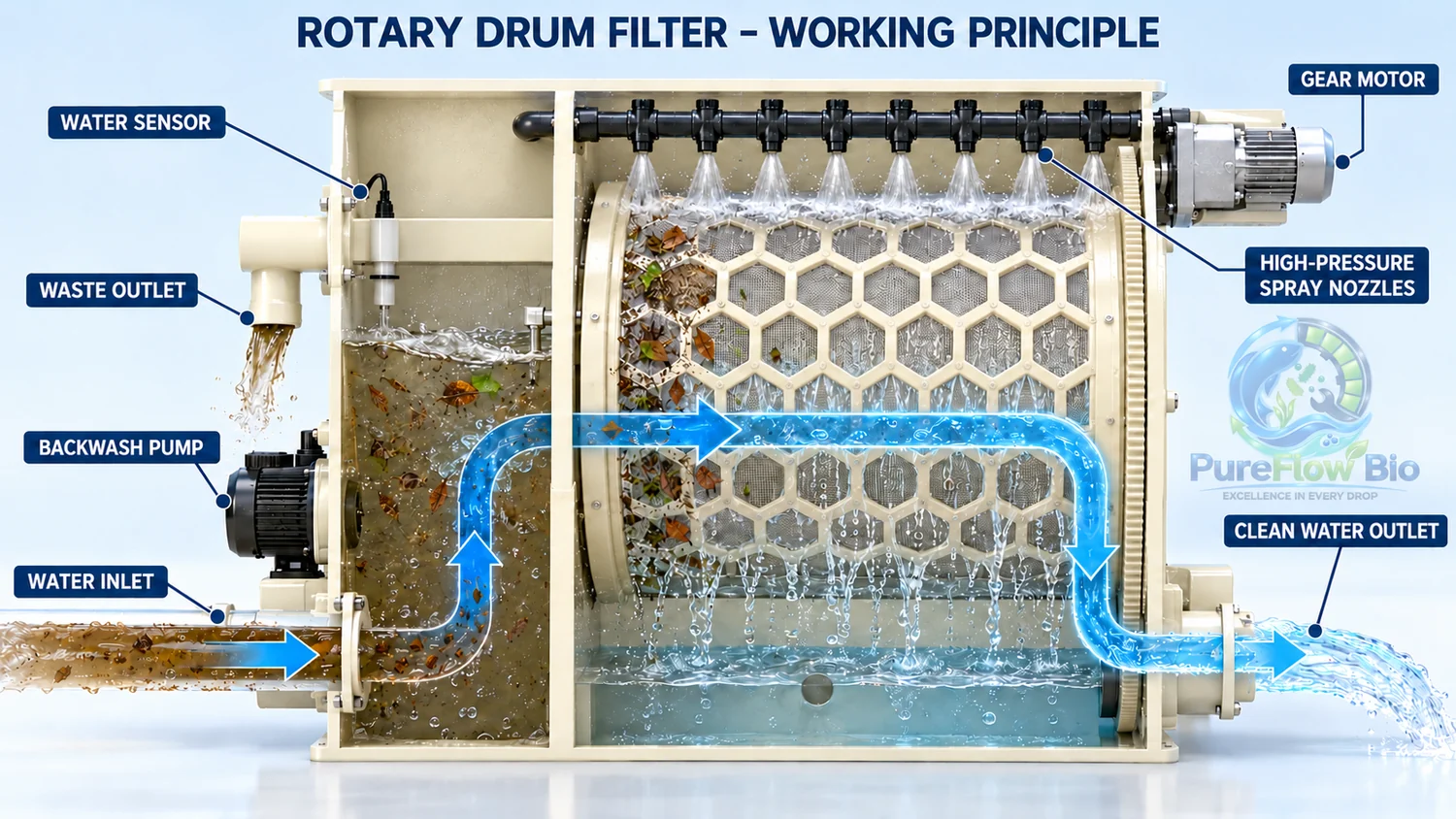
If rinsing still looks wrong, work through our drum filter troubleshooting guide.
Keep a simple log. Write the date of each filter clean on the pump house door or in your phone. A filter that needs attention every three days in July but only weekly in September is telling you about feeding and water temperature, not about faulty equipment.
And the biofilter?
Leave it alone as much as you can. Moving bed media clean themselves through their own movement, so check the airflow and the bubble pattern instead of rinsing. If you ever must rinse biological media, use pond water, never tap water, so the chlorine does not kill the bacteria.
UV-C, pump and air pump care for koi ponds
UV-C does not remove waste from the water. It treats the water that passes the lamp, which stops free-floating algae and many germs, and that is why green water clears and the pond looks brighter. The dose depends on lamp power and flow, so the wattage has to suit both the pond volume and the flow through the unit. Too much flow through a small lamp gives a weak dose. The equipment around the filter needs little attention, but the little it needs matters, so always switch off and unplug before you open anything.
UV-C lamp
A UV-C lamp loses output long before it stops glowing, so change it when the rated hours are used up, not when it fails. Most lamps are rated for 8,000 to 9,000 hours, about a year of continuous use, and long-life lamps last longer. Wipe the quartz sleeve every few weeks and clear deposits off in spring. See our UV-C systems.
Pump
Clean the strainer basket regularly and check the impeller for debris once a year. Listen for bearing noise and keep a spare seal kit. A pump with adjustable flow can be turned down in winter and back up in spring. Our water circulation pump guide explains the sizing.
Air pump
The air pump on a moving bed biofilter runs day and night. Look at the bubble pattern every few weeks, and when the output drops, replace the diaphragms or membranes as the pump manual describes. A weak air supply starves the biofilter of oxygen. Read more about moving bed biofilters.
Running hours per year = months in use x 730. Lamp life = rated hours divided by running hours per year, rounded down to whole seasons so the lamp is changed before its output has fallen away. Avoid switching the lamp on and off often, because every start wears it. If you are unsure of the rating, check the manual: many standard pond lamps are rated for far fewer hours than long-life lamps.
Leaf netting and running the koi pond filter through winter
How a koi pond comes through autumn and winter decides how easy spring will be. Keep the leaves out now and keep the filter running, and the next season starts clean.
Keep the leaves out
Leaves are a double problem: they sink and rot, feeding algae and souring the water, and they jam skimmers and screens. Each leaf caught on the net is one less piece of sludge to clear in spring.
- Stretch the net tight before the first leaves drop so they roll off instead of sagging into the water.
- Empty the net and the skimmer basket daily while the trees are shedding.
- Take the net off once the trees are bare, before snow can push it into the pond.
- Vacuum the pond floor after the last leaves are down.
- Fragments that slip through end up in the drum filter, which flushes them out.
Keep the filter running
A filter that keeps running stays alive and is ready the moment spring arrives. Switch it off for weeks and the bacteria die and rot, so the new season starts with a toxic pond.
- Run the filter at reduced flow if you like, but never stop it.
- Aim the returns at the surface and keep air stones off the bottom so the deep water stays warm.
- Protect pipes, waste lines and the drum filter outlet from freezing, and check them after every hard frost.
- Keep part of the surface open, and stop feeding below about 8 °C.
- Brush heavy snow off the net, and use a floating de-icer instead of hammering the ice.
Koi pond maintenance equipment that cuts the work
Good equipment shortens the list above. These are the products most koi keepers ask us about.
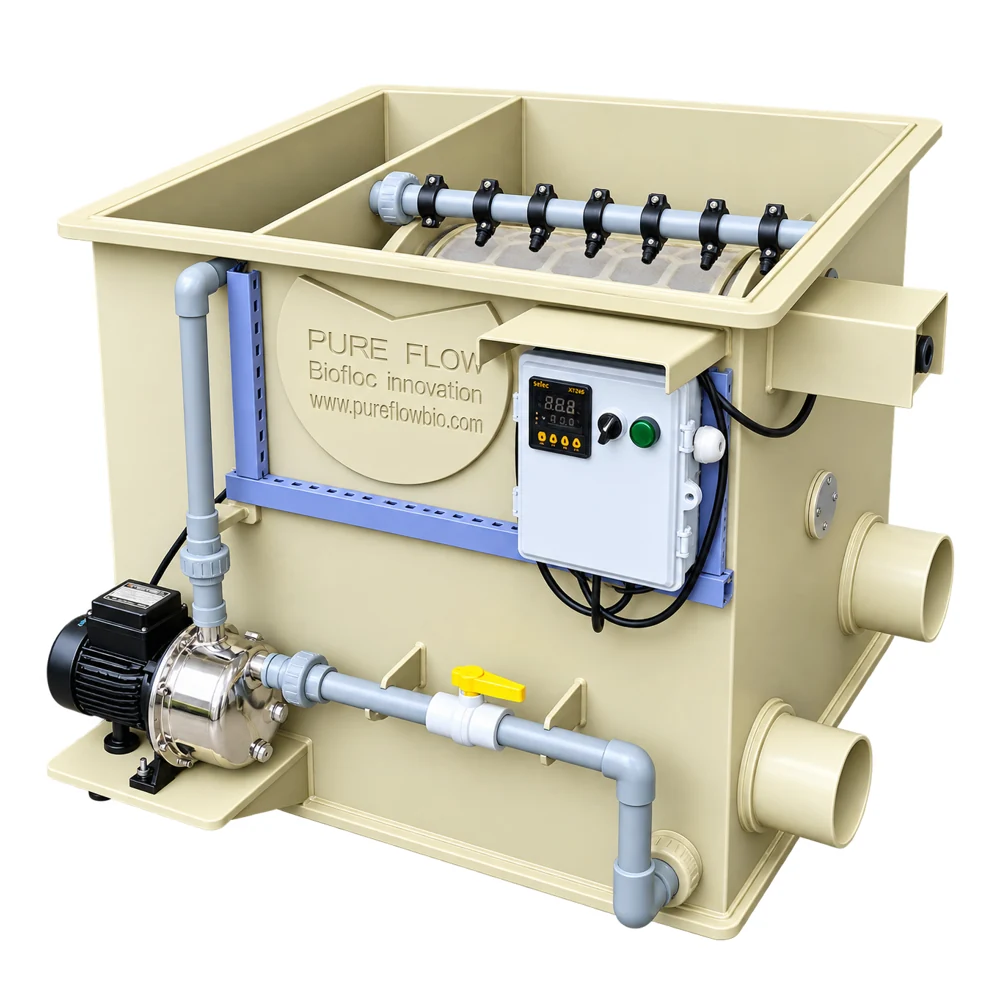
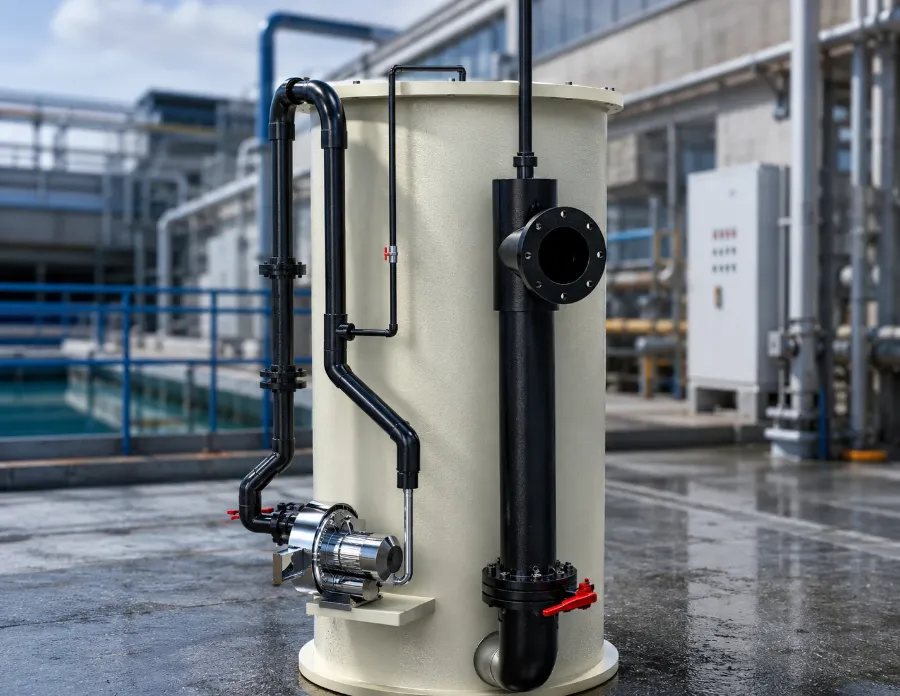
Pick the filter first, because the rest follows its flow. The drum filter takes out the solids, the biofilter handles ammonia and nitrite, and the UV-C unit and pump are then sized to the same flow.

Start with the operating pond
Use these questions to prepare a project brief or an operating review. Check an item only when the information has been recorded for your installation.
This checklist is a working aid in the current page session, not a saved maintenance record.
Koi pond maintenance FAQ
How often should I clean my koi pond filter?
With brushes, mats or screens, usually weekly and sometimes more in summer. With an automatic drum filter a monthly inspection of nozzles and screen is normally enough.
What does a good koi pond maintenance schedule look like?
Look at the fish daily, test the water weekly, change 10 to 20 percent of it every two to four weeks in the growing season, and add a short list of jobs for each season: a start-up in spring, a leaf net in autumn and a frost check in winter.
How often should I change the water?
Replace 10 to 20 percent every two to four weeks during the growing season, with dechlorinated water close to pond temperature. Keep changes small in winter.
Should I switch the filter off in winter?
No. A running filter keeps its bacteria alive. You can lower the flow, but stopping it for weeks means starting the biology again in spring.
When should I replace the UV-C lamp?
Most lamps are rated for 8,000 to 9,000 hours, which is about a year of continuous use. Change it yearly, ideally in spring, because output drops well before the lamp fails.
When should I stop feeding koi in autumn?
Move to a wheatgerm food once the water falls below roughly 12 to 15 °C, feed less often, and stop altogether when it stays under about 8 °C.
How do I prepare a koi pond for winter?
Net the pond before the leaves fall, make the last larger water change while it is mild, check the filter and protect pipes and waste lines from frost, stop feeding at the right temperature and keep part of the surface open.
What should I do in the pond in spring?
Check the filter, nozzles and screen, clean the UV sleeve and fit a new lamp, test ammonia and nitrite twice a week, make the first partial water change at about 10 °C and restart feeding with small amounts of wheatgerm food.
Do I need to clean the bottom of the pond?
Remove sludge once a year, usually in spring, and after leaf fall. A bottom drain that leads to the filter takes most of the waste away between those cleans.
More koi pond guides
Discuss your system with Pureflow.
Share your application, operating volume, actual flow, loading and the question you are trying to resolve.