HydroponicsSystems, Nutrients and Water Treatment
Hydroponics explained: systems, nutrients, pH and EC, water treatment, filtering and disinfecting recirculated solution, what to grow and common problems.
 SYSTEM CONCEPT
See the mechanism.
Understand the duty.
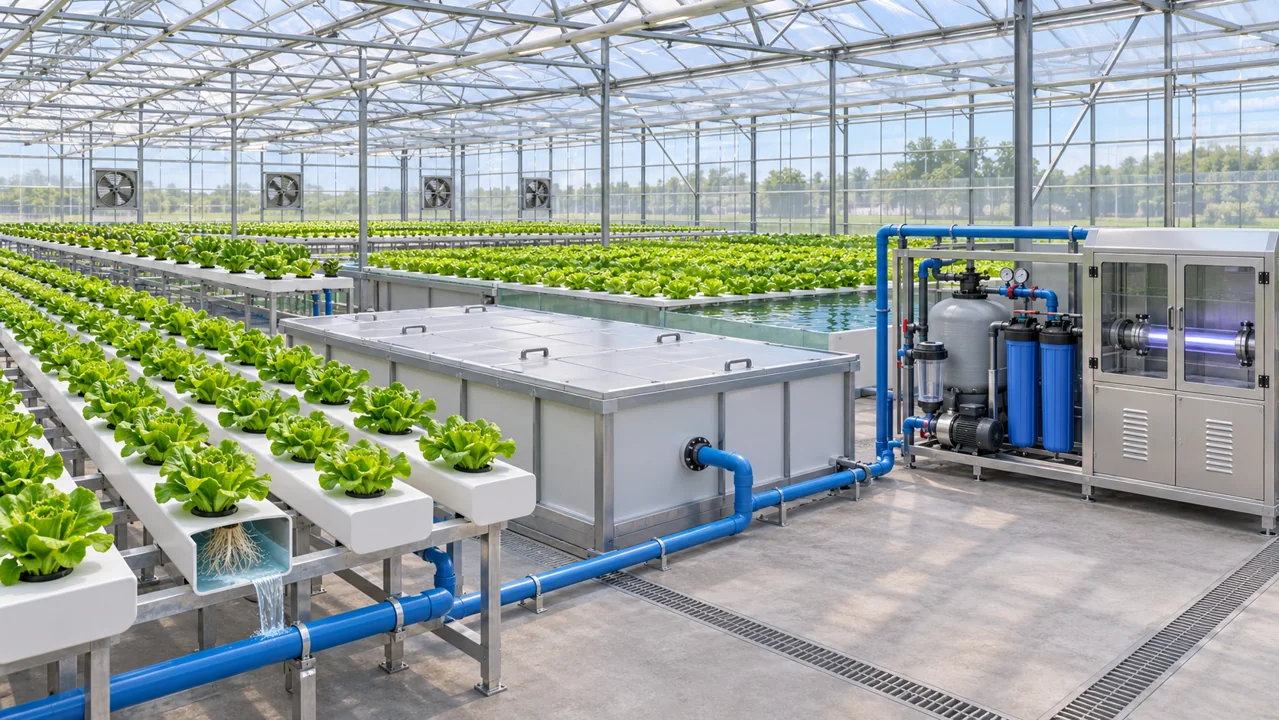
Select a route or a stage to inspect the process. The cutaway explains the equipment and water environment; it is a teaching illustration, not a project drawing.
Supply the roots
Use measured irrigation and peak return duty.
A managed nutrient solution reaches the growing system at a flow suited to its design.
- Use measured irrigation and peak return duty.
- Record nutrient chemistry, temperature and root-zone conditions.
- Coordinate treatment with the growing method and crop programme.
Key takeaways
- Plants take nutrients from a dissolved solution. You control EC, pH and temperature.
- Main systems: NFT, deep water culture, drip, ebb and flow.
- Recirculated solution needs filtering and disinfection to stop disease.
- Cool, oxygenated water protects roots.
What is hydroponics?
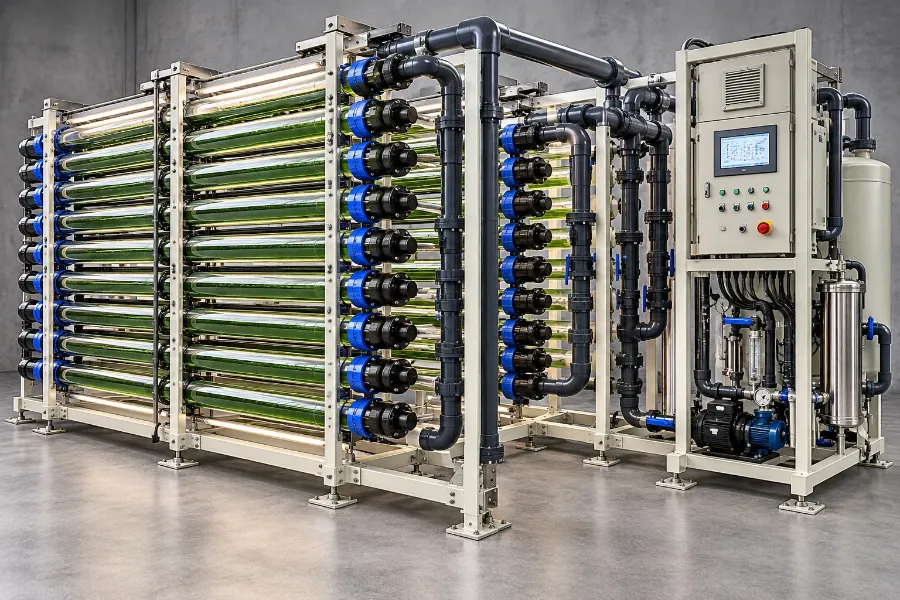
A way of growing crops with roots in nutrient solution, or in an inert medium fed with it. It uses far less water than soil farming and works in any climate when the environment is controlled. Because the grower supplies every nutrient, the crop responds quickly to good management and to mistakes alike.

The main systems
| System | How it works | Best for | Watch out for |
|---|---|---|---|
| NFT | A thin film of solution runs past roots | Lettuce, herbs | Fails fast if the pump stops |
| Deep water culture | Roots hang in aerated solution | Leafy greens | Needs cool, oxygenated water |
| Drip | Drippers feed each plant | Tomatoes, cucumbers | Emitters clog without clean water |
| Ebb and flow | Beds flood and drain | Mixed crops | Timers and drainage must be reliable |
See NFT vs DWC vs drip.
Work with your own numbers.
Use the tools below to explore the relevant arithmetic. Enter measured values or declared assumptions. An estimate does not establish equipment capacity, biological performance or a safe operating limit.
Hydroponic return-flow scenario
Convert a daily irrigation plan and drainage fraction into an average return flow.
Assumptions and limits
Average flow can be far below short irrigation peaks. Measure the peak and account for solids, chemistry and disinfection before selecting equipment.
Pond or tank volume
Estimate a rectangular water volume from internal wetted dimensions and average operating depth.
Assumptions and limits
Irregular shapes, sloping walls, freeboard and displaced equipment change the usable water volume. Confirm with a fill meter where practical.
Convert units before you calculate
Planning arithmetic · inputs remain visible for review · example values are not operating recommendations
Nutrients, ec and ph
EC (electrical conductivity) measures total dissolved nutrients. pH controls how well roots can take them up. Leafy greens run at lower EC than fruiting crops. See nutrient solution EC and pH.
Why water treatment matters
In a recirculating system one infected plant can spread disease to all. Filtering solids and disinfecting the solution protects the whole crop.
The loop is described in recirculating hydroponics.
What to grow
| Crop group | Examples | Difficulty |
|---|---|---|
| Leafy greens | Lettuce, pak choi, kale | Easy |
| Herbs | Basil, mint, coriander | Easy |
| Fruiting crops | Tomato, cucumber, pepper, strawberry | Demanding |
Pumps and reservoirs
A larger reservoir changes slowly and forgives mistakes. Pumps must deliver flow at real head. See pump and reservoir sizing.
Common problems
Use the real irrigation return
Use these questions to prepare a project brief or an operating review. Check an item only when the information has been recorded for your installation.
This checklist is a working aid in the current page session, not a saved maintenance record.
Hydroponics FAQ
Is hydroponics hard?
Easier than it looks if you check pH and EC daily.
Does hydroponic water need treatment?
In recirculating systems, yes. Filtration and UV protect the crop.
How much water does it save?
Often a large share compared with soil, because water is recycled.
More guides related to hydroponics
Discuss your system with Pureflow.
Share your application, operating volume, actual flow, loading and the question you are trying to resolve.