NFT vs Deep Water Culture vs DripWhich Hydroponic System to Choose
Compare the main hydroponic systems on crops, cost, risk and filtration needs to choose the right one.
 SYSTEM CONCEPT
See the mechanism.
Understand the duty.
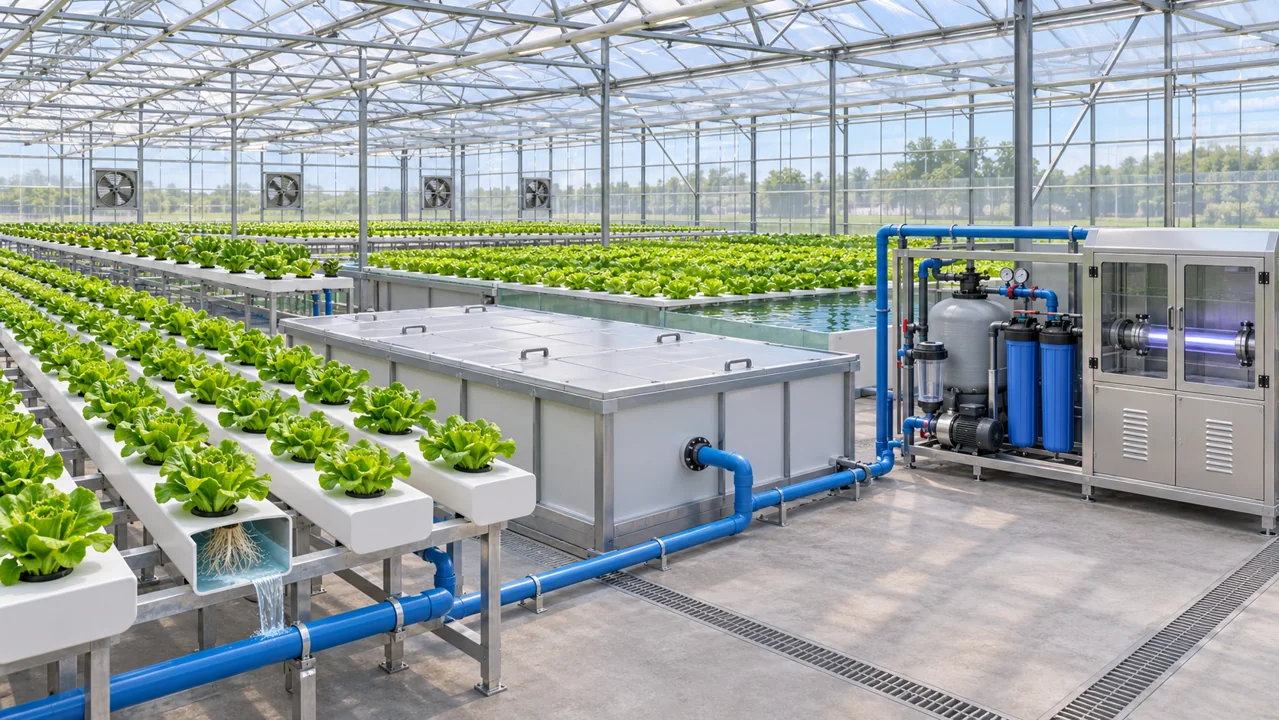
Select a route or a stage to inspect the process. The cutaway explains the equipment and water environment; it is a teaching illustration, not a project drawing.
Supply the roots
Use measured irrigation and peak return duty.
A managed nutrient solution reaches the growing system at a flow suited to its design.
- Use measured irrigation and peak return duty.
- Record nutrient chemistry, temperature and root-zone conditions.
- Coordinate treatment with the growing method and crop programme.
Key takeaways
- NFT: A thin film of solution runs along channels past the roots.
- Deep water culture: Roots sit in aerated solution under rafts.
- Drip: Drippers deliver solution to each plant, good for tall fruiting crops such as tomatoes and cucumbers.
- Water treatment for all three: Whichever you pick, filter and disinfect recirculated solution.

Nft
A thin film of solution runs along channels past the roots. It is water-efficient and good for lettuce and herbs, but it fails quickly if the pump stops, because roots dry out.
Deep water culture
Roots sit in aerated solution under rafts. It is forgiving, thermally stable and a good starter. It needs good aeration and cool water. See deep water culture.
Work with your own numbers.
Use the tools below to explore the relevant arithmetic. Enter measured values or declared assumptions. An estimate does not establish equipment capacity, biological performance or a safe operating limit.
Hydroponic return-flow scenario
Convert a daily irrigation plan and drainage fraction into an average return flow.
Assumptions and limits
Average flow can be far below short irrigation peaks. Measure the peak and account for solids, chemistry and disinfection before selecting equipment.
Pond or tank volume
Estimate a rectangular water volume from internal wetted dimensions and average operating depth.
Assumptions and limits
Irregular shapes, sloping walls, freeboard and displaced equipment change the usable water volume. Confirm with a fill meter where practical.
Convert units before you calculate
Planning arithmetic · inputs remain visible for review · example values are not operating recommendations
Drip
Drippers deliver solution to each plant, good for tall fruiting crops such as tomatoes and cucumbers. Emitters can clog, so clean water matters.
Water treatment for all three
Whichever you pick, filter and disinfect recirculated solution. See filters for hydroponics.
A simple rule
Leafy greens: NFT or DWC. Fruiting crops: drip. Learning: DWC.
Pureflow Bio equipment for this
Standard drum filters (RDF) →Automatic solids removal.UV disinfection systems →UV-C chambers.Use the real irrigation return
Use these questions to prepare a project brief or an operating review. Check an item only when the information has been recorded for your installation.
This checklist is a working aid in the current page session, not a saved maintenance record.
NFT vs Deep Water Culture vs Drip FAQ
Which is cheapest to start?
DWC is usually simplest and cheap to start.
Which uses least water?
NFT and drip are very efficient when well managed.
More guides related to nft vs deep water culture vs drip
Discuss your system with Pureflow.
Share your application, operating volume, actual flow, loading and the question you are trying to resolve.