
How to Start a Fish FarmPlanning Steps for India
How to start a fish farm in India: choose a market and species, permits and site, design around feed, pilot and biofilter start-up, stocking, budget and mistakes.
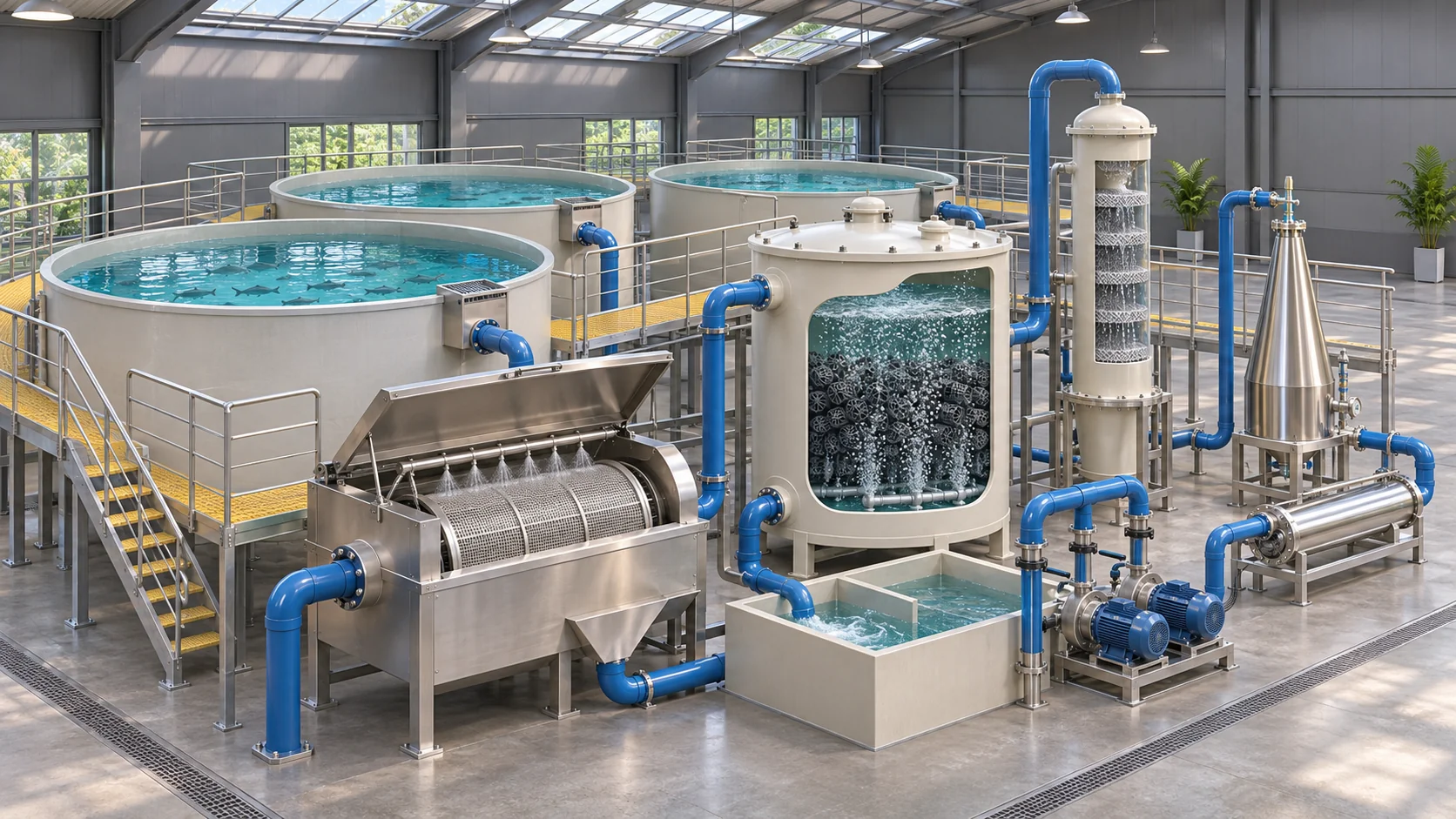 SYSTEM CONCEPT
See the mechanism.
Understand the duty.
Select a route or a stage to inspect the process. The cutaway explains the equipment and water environment; it is a teaching illustration, not a project drawing.
Culture tanks
Collect waste before it settles.
The culture tank is both an animal environment and a hydraulic vessel. The return flow should distribute oxygenated water and move settleable waste toward the intended outlet. Tank shape, drain arrangement and the behaviour of the stock determine how well this happens.
- Confirm the operating water volume and peak feed.
- Check circulation, drain capture and access for inspection.
- Record oxygen at the animal zone, not only in the return pipe.
Key takeaways
- Start with the market, then choose the species.
- Design the system around daily feed. That is what sets filter size, oxygen and power.
- Run a pilot first and mature the biofilter before fish arrive.
- Budget for running costs and for a reserve, not just construction.
The ten steps
- Study the marketWho buys, in what size, at what volume.
- Choose the speciesMatch species to market and climate.
- Check permits and siteLand, water, power and licences.
- Design around feedSet tank volume, filters and oxygen from daily feed.
- Plan power and backupSee RAS power backup.
- Build a pilotOne small unit to learn.
- Mature the biofilterBefore any fish.
- Stock fingerlingsGradually.
- Feed and monitorDaily routine.
- Harvest and sellPlan the cold chain.

Start with the market, then choose the species
| Species | Typical RAS temperature | Why farmers choose it | Watch out for |
|---|---|---|---|
| Nile tilapia | About 28 °C | Hardy, fast-growing in warm water | Heating in cool climates, all-male stock |
| African catfish | About 28 °C | Breathes air, tolerates high density | Market demand varies |
| Rainbow trout | 13 to 17 °C | Premium cold-water fish | Chilling, oxygen demand |
| Whiteleg shrimp | 28 to 30 °C | High value | Disease control, salinity |
Match the fish to your climate and buyers.
Work with your own numbers.
Use the tools below to explore the relevant arithmetic. Enter measured values or declared assumptions. An estimate does not establish equipment capacity, biological performance or a safe operating limit.
Feed & loading scenario
Translate a selected feeding rate and assumed waste yield into a planning load.
Assumptions and limits
The feeding rate and TAN yield are supplied assumptions. Use the species, feed, growth stage and verified process design; the estimate is not a Pureflow capacity rating.
Biomass & observed density
Convert a known count and mean fish weight into biomass and current loading per water volume.
Assumptions and limits
This describes the inputs; it does not establish a safe stocking density or the system’s oxygen, filtration or welfare capacity.
Convert units before you calculate
Planning arithmetic · inputs remain visible for review · example values are not operating recommendations
Permits, site, water and power
Licences and permits
Check local fisheries, environment and land-use rules for aquaculture, and any water or power connection permits.
What a good site needs
- Reliable, clean water supply.
- Stable power with backup space.
- Level ground and road access for feed and harvest.
- Space for sludge handling and expansion.
Design the system around the feed
Daily feed drives waste and oxygen demand, so size filters from it. See feed conversion and waste load and biofilter sizing.
At an FCR of about 1.5, producing 10 tonnes needs around 15 tonnes of feed a year, or about 41 kg a day on average. Peak feed is higher, so design for peak, not average.
Start with a pilot, then mature the biofilter
- Run the systemTest pumps, aeration and alarms before fish.
- Feed the bacteriaAdd an ammonia source.
- Seed the filterUse media from a healthy system.
- Test, then stockWait for ammonia and nitrite to fall to zero.
See biofilter start-up.
Fingerlings, the daily routine and your first harvest
Buy healthy fingerlings from a reliable hatchery. Stock gradually, feed several small meals, and record temperature, oxygen, feed and mortality every day. Plan harvest and sales before the fish reach size.
What to budget for, and the mistakes that sink new farms
Investment
Tanks, filters, pumps, oxygen, power backup, buildings and working capital.
Running costs
Feed, power, labour, fingerlings, maintenance and water.
Common mistakes
- No market before building.
- Undersized filters and no backup power.
- Stocking too fast.
- No pilot.
Where our equipment fits
Drum filters, biofilters, UV, ozone, oxygen cones and pumps cover the main treatment steps. See aquaculture filtration systems.
Pureflow Bio equipment for this
All aquaculture equipment →Tanks, pumps, oxygen, ozone and filtration for RAS.Standard drum filters (RDF) →Gravity-fed rotary drum filters that remove solids before they break down.MBBR biofilters →Moving bed reactors for steady ammonia and nitrite removal.Oxygen cones →Dissolve oxygen efficiently into tank water.Review the design at peak load
Use these questions to prepare a project brief or an operating review. Check an item only when the information has been recorded for your installation.
This checklist is a working aid in the current page session, not a saved maintenance record.
How to Start a Fish Farm FAQ
How much money do I need to start a fish farm?
It depends on scale and species. A pilot costs far less than a commercial unit, which is why we suggest starting small.
Which fish is best for beginners?
Tilapia and catfish are hardy and a common first choice in warm climates.
Do I need RAS?
Not always. Ponds and flow-through are cheaper, but RAS gives the most control and uses the least water.
More guides related to how to start a fish farm
Discuss your system with Pureflow.
Share your application, operating volume, actual flow, loading and the question you are trying to resolve.