
Tilapia FarmingWater, Tanks and Filtration
Tilapia farming in RAS: ideal water values, growth time, stocking density, feeding rates, all-male fingerlings, breeding, filtration and aquaponics use.
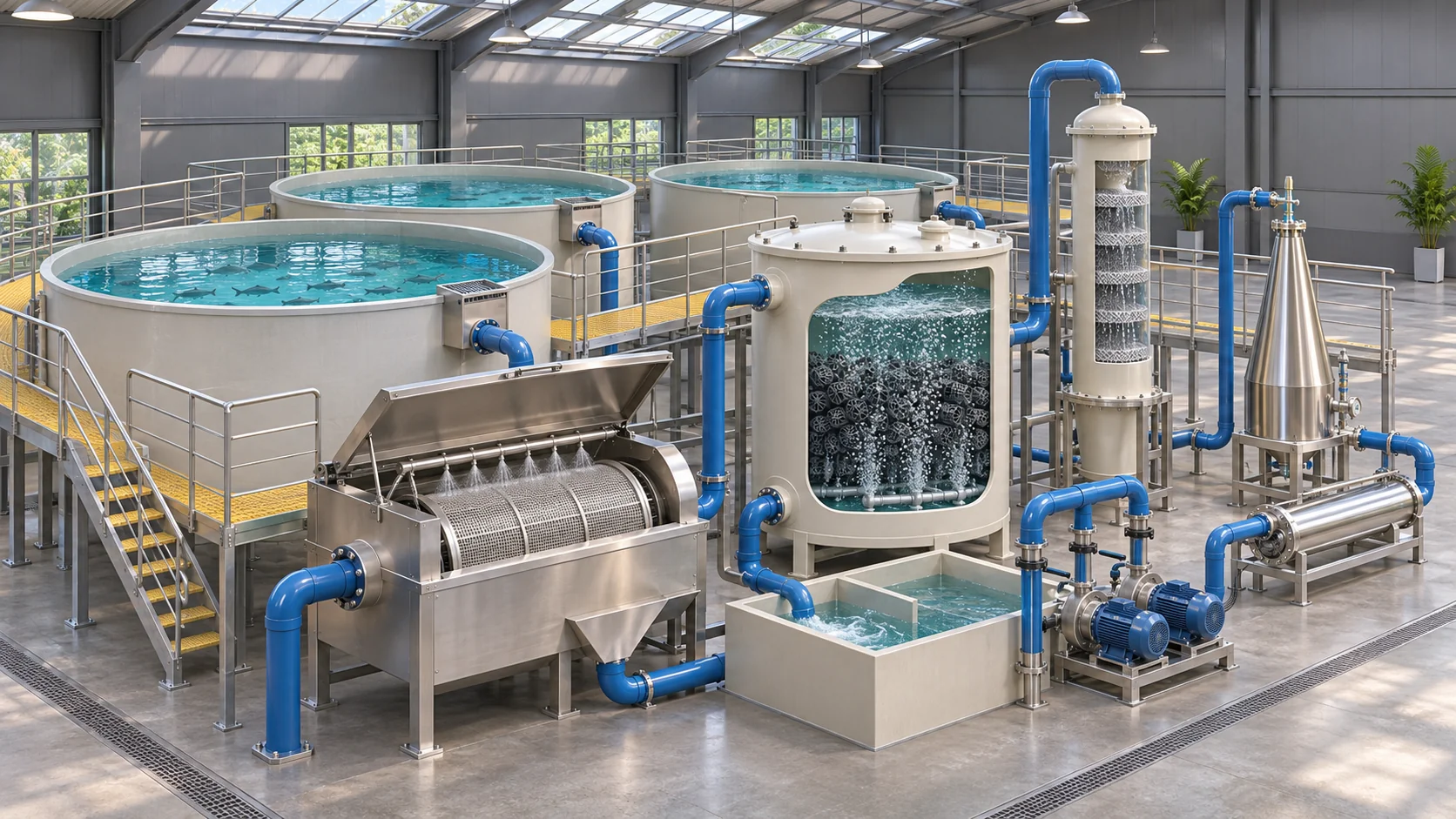 SYSTEM CONCEPT
See the mechanism.
Understand the duty.
Select a route or a stage to inspect the process. The cutaway explains the equipment and water environment; it is a teaching illustration, not a project drawing.
Culture tanks
Collect waste before it settles.
The culture tank is both an animal environment and a hydraulic vessel. The return flow should distribute oxygenated water and move settleable waste toward the intended outlet. Tank shape, drain arrangement and the behaviour of the stock determine how well this happens.
- Confirm the operating water volume and peak feed.
- Check circulation, drain capture and access for inspection.
- Record oxygen at the animal zone, not only in the return pipe.
Key takeaways
- Best temperature is 27 to 30 °C. Appetite drops below 20 °C.
- Keep oxygen above 5 mg/L, pH 6.8 to 8.0, ammonia low.
- Use all-male fingerlings to stop breeding and stunting.
- Feed rates fall as fish grow: from 10 percent of body weight for fry to about 1.5 percent for large fish.

Ideal water values for tilapia
| Parameter | Target | Notes |
|---|---|---|
| Temperature | 27 to 30 °C | Acceptable 25 to 32 °C; feeding stops near 16 °C |
| Dissolved oxygen | 5 to 8 mg/L | Feed less at 3 to 5; stop below 3 |
| pH | 6.8 to 8.0 | Tolerates 6 to 9 |
| Total ammonia | Below 2 to 3 mg/L | Depends on pH and temperature |
| Nitrite | Below 1 mg/L | Add salt to protect fish |
How long does tilapia take to grow?
From fry to 500 g takes about six to eight months at the right temperature. Colder water slows it a lot. Heating costs matter in cool climates.
Work with your own numbers.
Use the tools below to explore the relevant arithmetic. Enter measured values or declared assumptions. An estimate does not establish equipment capacity, biological performance or a safe operating limit.
Feed & loading scenario
Translate a selected feeding rate and assumed waste yield into a planning load.
Assumptions and limits
The feeding rate and TAN yield are supplied assumptions. Use the species, feed, growth stage and verified process design; the estimate is not a Pureflow capacity rating.
Biomass & observed density
Convert a known count and mean fish weight into biomass and current loading per water volume.
Assumptions and limits
This describes the inputs; it does not establish a safe stocking density or the system’s oxygen, filtration or welfare capacity.
Convert units before you calculate
Planning arithmetic · inputs remain visible for review · example values are not operating recommendations
How many tilapia per cubic metre?
| System | Typical density |
|---|---|
| Aerated tank | About 30 kg/m³ |
| Oxygenated RAS | 60 to 120 kg/m³ |
See stocking density.
Feeding tilapia: rates, protein and fcr
| Fish size | Feed per day (% body weight) | Meals |
|---|---|---|
| 0 to 1 g | 30 to 10% | 8 to 10 a day, or continuous |
| 1 to 5 g | 10 to 6% | At least 4 a day |
| 5 to 20 g | 6 to 4% | At least 4 a day |
| 20 to 100 g | 4 to 3% | 3 to 4 a day |
| Over 100 g | 3 to 1.5% | 2 to 4 a day |
Typical rates at 28 °C. Adjust to appetite.
Protein needs fall from about 40 percent for fry to about 30 percent for grow-out feed. FCR is often 1.3 to 1.8.
All-male fingerlings, and the basics of breeding
Mixed-sex tilapia breed in the tank and stunt. Most farms buy all-male fingerlings, produced by hormone treatment or genetic methods.
How tilapia breed
Males build nests, females lay eggs, and the female holds them in her mouth (mouthbrooding) until they hatch.
Broodstock, spawning and collecting
Keep broodstock in separate tanks at a good male-to-female ratio. Collect eggs or fry from the mouth or the tank.
Filtration for a tilapia ras
Tilapia are messy. A drum filter and a biofilter sized from feed are the core. See filtration systems.
Tilapia in aquaponics
Tilapia suit aquaponics because they tolerate variable water and high nutrient output. See best fish for aquaponics.
Review the design at peak load
Use these questions to prepare a project brief or an operating review. Check an item only when the information has been recorded for your installation.
This checklist is a working aid in the current page session, not a saved maintenance record.
Tilapia Farming FAQ
What is the best temperature for tilapia?
27 to 30 °C.
Do I need all-male tilapia?
Yes in most farms, to prevent stunting from breeding.
Can tilapia live in cold water?
Not well. Below about 12 °C they die.
More guides related to tilapia farming
Discuss your system with Pureflow.
Share your application, operating volume, actual flow, loading and the question you are trying to resolve.