
Koi Pond FiltersTypes, Stages and What to Choose
Koi pond filter types compared: settlement chambers, drum filters, bead and brush filters, moving bed and trickle biofilters, and how to combine them.
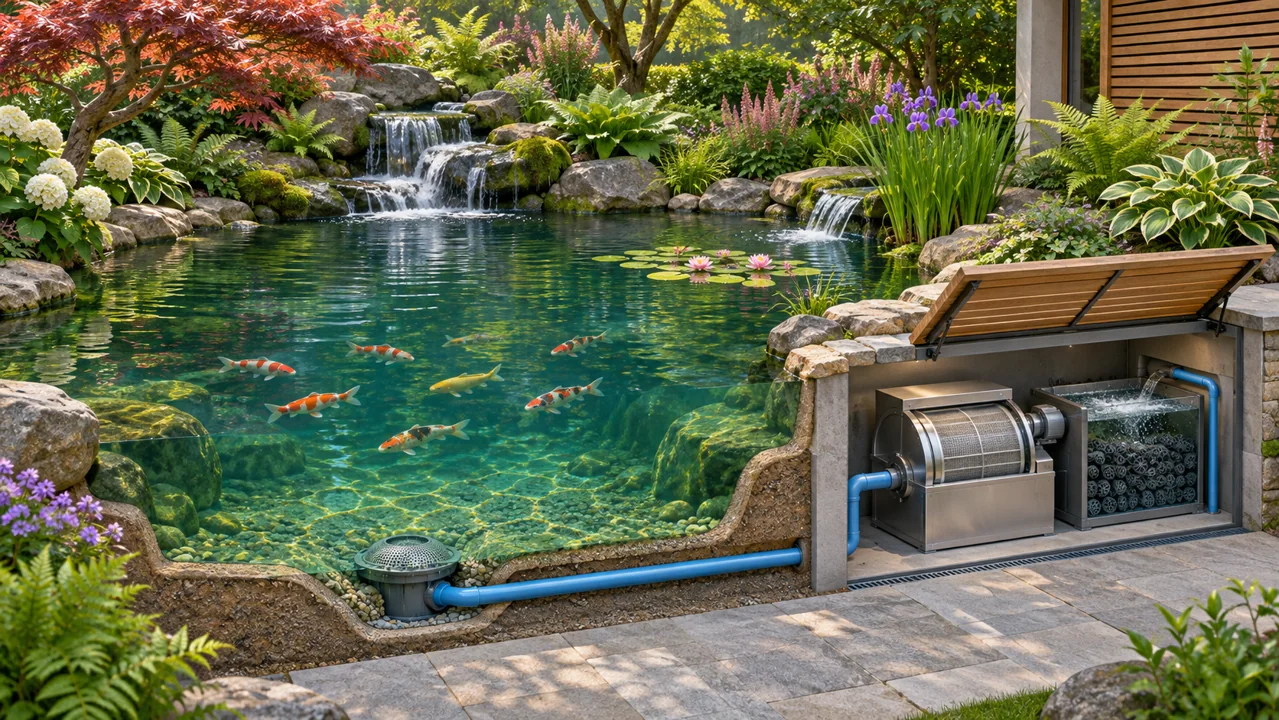 SYSTEM CONCEPT
See the mechanism.
Understand the duty.
Select a route or a stage to inspect the process. The cutaway explains the equipment and water environment; it is a teaching illustration, not a project drawing.
Collect surface debris
Use the operating pond volume and actual loading.
A skimmer can collect floating debris. Its duty and position depend on the pond layout.
- Use the operating pond volume and actual loading.
- Review collection, filtration, oxygen and return distribution.
- Record water chemistry and changes in fish behaviour.
Key takeaways
- Always take solids out first, then convert ammonia, then polish.
- A drum filter removes solids before they break down, which protects the biofilter.
- Moving bed and trickle biofilters handle ammonia and nitrite.
- UV is an add-on for green water, not a replacement for filtration.
The order matters
Water should meet the filters in this order: solids removal, then biological conversion, then optional polish such as UV. Put biology first and it clogs. Put UV before mechanical and it wastes lamp power on cloudy water.
- Collect wasteBottom drain and skimmer carry debris away.
- Remove solidsSettlement chamber, brush tank or drum filter.
- Biological filtrationMoving bed, trickle or fixed media.
- Polish and steriliseUV for algae or pathogens, if needed.
- ReturnPump back through a waterfall or venturi for oxygen.

Mechanical filter types compared
| Type | How it works | Strengths | Limits |
|---|---|---|---|
| Settlement chamber | Slows flow so solids drop out | Simple, no power | Needs manual cleaning, takes space |
| Brush or foam tank | Solids stick on fibres | Cheap, easy | Clogs and needs hand-washing |
| Bead filter | Water through plastic beads, backwashed | Compact | Backwash uses water, beads can compact |
| Rotary drum filter | Fine mesh screen, automatic spray cleaning | Removes solids fast, automatic | Needs power and a drain |
| Static screen | Sloped screen, water slides over | No moving parts | Limited fine filtration |
Choose by pond size, stocking and how much cleaning you want to do.
For a deeper comparison see drum filter vs other pond filters.
Work with your own numbers.
Use the tools below to explore the relevant arithmetic. Enter measured values or declared assumptions. An estimate does not establish equipment capacity, biological performance or a safe operating limit.
Flow & turnover planner
Relate a measured water volume to a selected turnover time. Confirm the time from the application and hydraulic design.
Assumptions and limits
A planning allowance is your assumption. This calculation does not choose a filter, prove treatment capacity or account for pump head.
Pond or tank volume
Estimate a rectangular water volume from internal wetted dimensions and average operating depth.
Assumptions and limits
Irregular shapes, sloping walls, freeboard and displaced equipment change the usable water volume. Confirm with a fill meter where practical.
Convert units before you calculate
Planning arithmetic · inputs remain visible for review · example values are not operating recommendations
Biological filter types
Moving bed (MBBR)
Plastic carriers tumble in aerated water, giving large surface for bacteria. Compact, self-cleaning and widely used. See moving bed biofilters.
Trickle filter
Water is sprinkled over media in open air. Very good oxygenation and degassing. See trickle filters.
Fixed media
Static foam or plastic blocks. Simple but need regular cleaning, and can clog.
Uv and other add-ons
UV clarifiers kill algae cells floating in the water, clearing green water. They do not remove dissolved nutrients. See UV clarifier vs sterilizer and green pond water.
Putting a system together
| Pond type | Suggested train |
|---|---|
| Small garden pond | Skimmer, settlement chamber, simple biofilter |
| Medium koi pond | Bottom drain, drum filter, moving bed, pump return, UV if needed |
| Large show pond | Multiple drains, drum filters, moving bed plus trickle, UV, aeration |
Common mistakes
- Choosing a filter by pond volume alone, ignoring fish and feeding.
- Letting solids reach the biofilter.
- Running pumps against narrow pipes.
- Not leaving room to service the equipment.
Start with the operating pond
Use these questions to prepare a project brief or an operating review. Check an item only when the information has been recorded for your installation.
This checklist is a working aid in the current page session, not a saved maintenance record.
Koi Pond Filters FAQ
What is the best koi pond filter?
A system with solids removal first, then a biofilter, sized for your fish. A drum filter plus moving bed is a common strong combination.
Do I need UV?
Only if you struggle with green water. It is an extra, not a replacement for filtration.
Can I use a pressure filter?
They work for small ponds but clog quickly in heavily stocked ones.
More guides related to koi pond filters
Discuss your system with Pureflow.
Share your application, operating volume, actual flow, loading and the question you are trying to resolve.