
Drum Filter vs SumpWhich Suits Your Aquarium?
Drum filter vs sump for a large aquarium: what each does, an honest comparison with filter socks and sponges, when a sump is enough, and combining both.
 EQUIPMENT REFERENCE
See the mechanism.
Understand the duty.
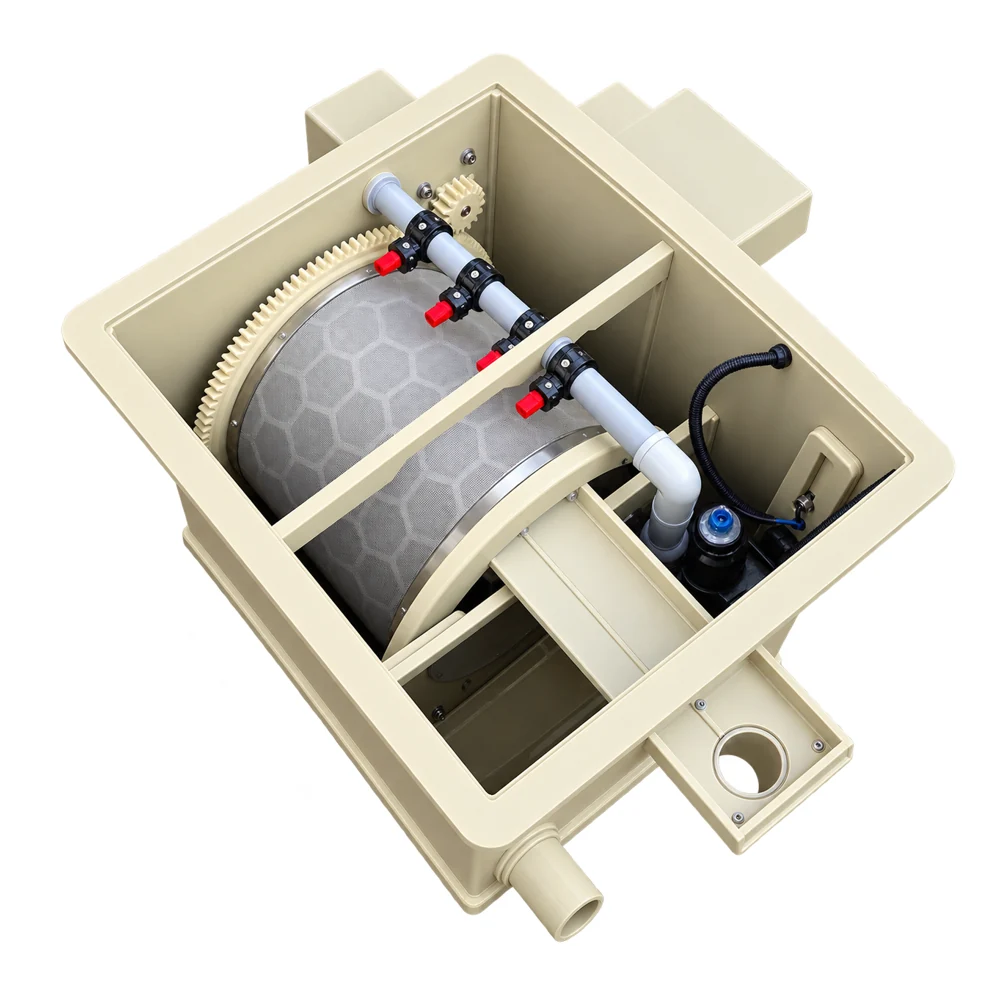
Select a route or a stage to inspect the process. The cutaway explains the equipment and water environment; it is a teaching illustration, not a project drawing.
Capture solids
Use actual flow, screen opening and solids duty.
Particles are retained as water crosses the screen. Dissolved contaminants require other treatment stages.
- Use actual flow, screen opening and solids duty.
- Confirm approved levels, wash supply and waste drainage.
- Observe a complete guarded cycle before changing settings.
Key takeaways
- A sump is a flexible, familiar design, but the dirt it catches stays inside the system until someone removes it.
- A drum filter screens solids out and flushes them away on its own, so the dirt leaves before it rots.
- The two are not rivals. A drum filter in front of a sump is a common and very effective combination.
- Choose by tank size, stocking and how much routine work you want to do each week.
Which filter suits a large aquarium?
For a small or lightly stocked tank, a well kept sump is enough. For a large aquarium, a public display, a fish room or a rack of tanks, a drum filter is usually the better way to deal with solids, because it removes dirt automatically and sends it out of the system. The sump then does what it does best: it holds the equipment, the pump and the water volume.
So the real question is rarely “drum filter or sump”. It is “how should solids be removed, and what should the sump do after that?” The rest of this guide answers both.
Work with your own numbers.
Use the tools below to explore the relevant arithmetic. Enter measured values or declared assumptions. An estimate does not establish equipment capacity, biological performance or a safe operating limit.
Water-change volume planner
Calculate the volume changed per event and the original-water fraction remaining after repeated equal changes.
Assumptions and limits
Assumes complete mixing between equal changes. Match replacement-water chemistry and temperature; this is not a safe-change prescription or a treatment guarantee.
Flow & turnover planner
Relate a measured water volume to a selected turnover time. Confirm the time from the application and hydraulic design.
Assumptions and limits
A planning allowance is your assumption. This calculation does not choose a filter, prove treatment capacity or account for pump head.
Convert units before you calculate
Planning arithmetic · inputs remain visible for review · example values are not operating recommendations
What a sump does, and where it struggles
A sump is a second tank below or beside the aquarium. Water overflows from the display into the sump, passes through its filter stages and is pumped back up. It gives you extra water volume that steadies the chemistry, a hidden place for heaters and equipment, and room for a skimmer, media and reactors.
Its weak point is solids. A sump catches dirt in socks, sponges or foam, and these hold the waste inside the system while it breaks down. As they clog, flow drops or water slips around them, and the trapped dirt releases ammonia and feeds algae. They also ask for attention on a fixed rhythm, because a full sock cannot be left alone.
A sump can also overflow if a sock blocks and the return pump keeps running, which is why big systems add alarms and float switches.
How a drum filter and moving bed replace the sump’s filter stages
- Overflow to the drum filterWater leaves the aquarium through the overflow and flows by gravity into the drum filter.
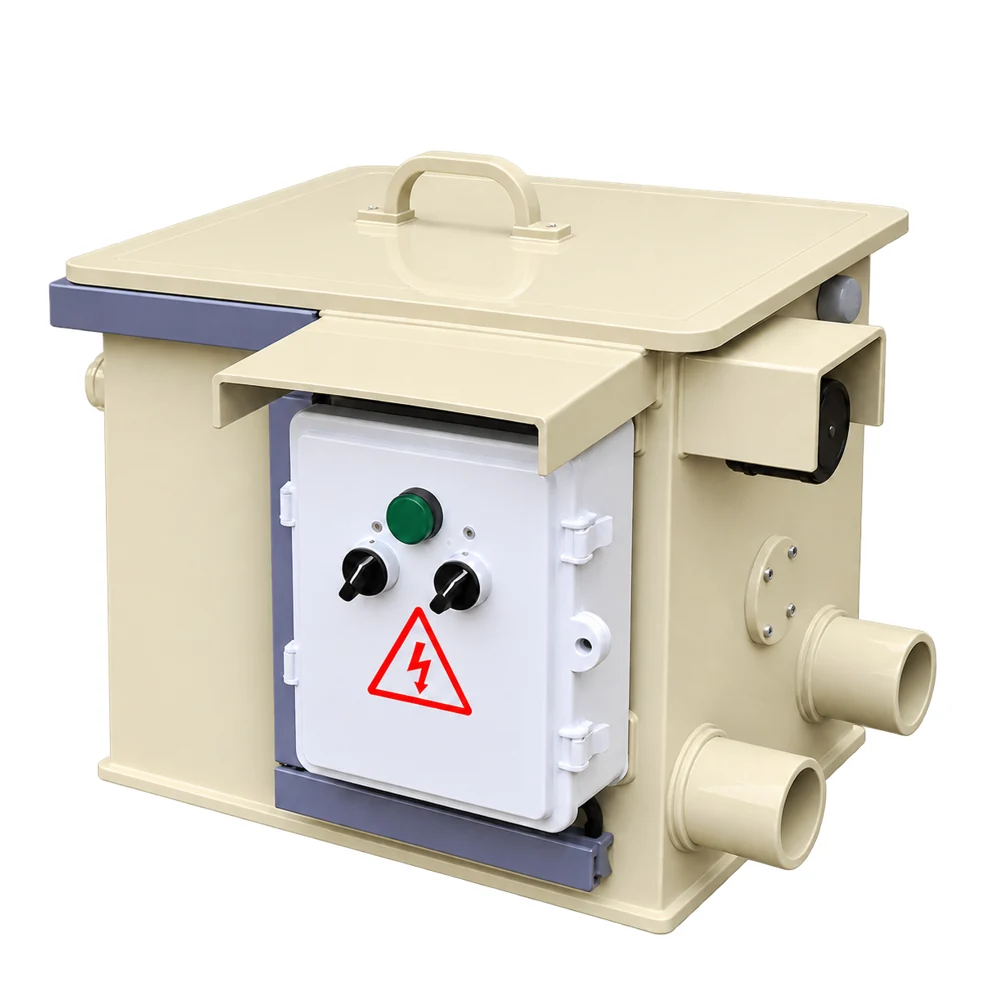
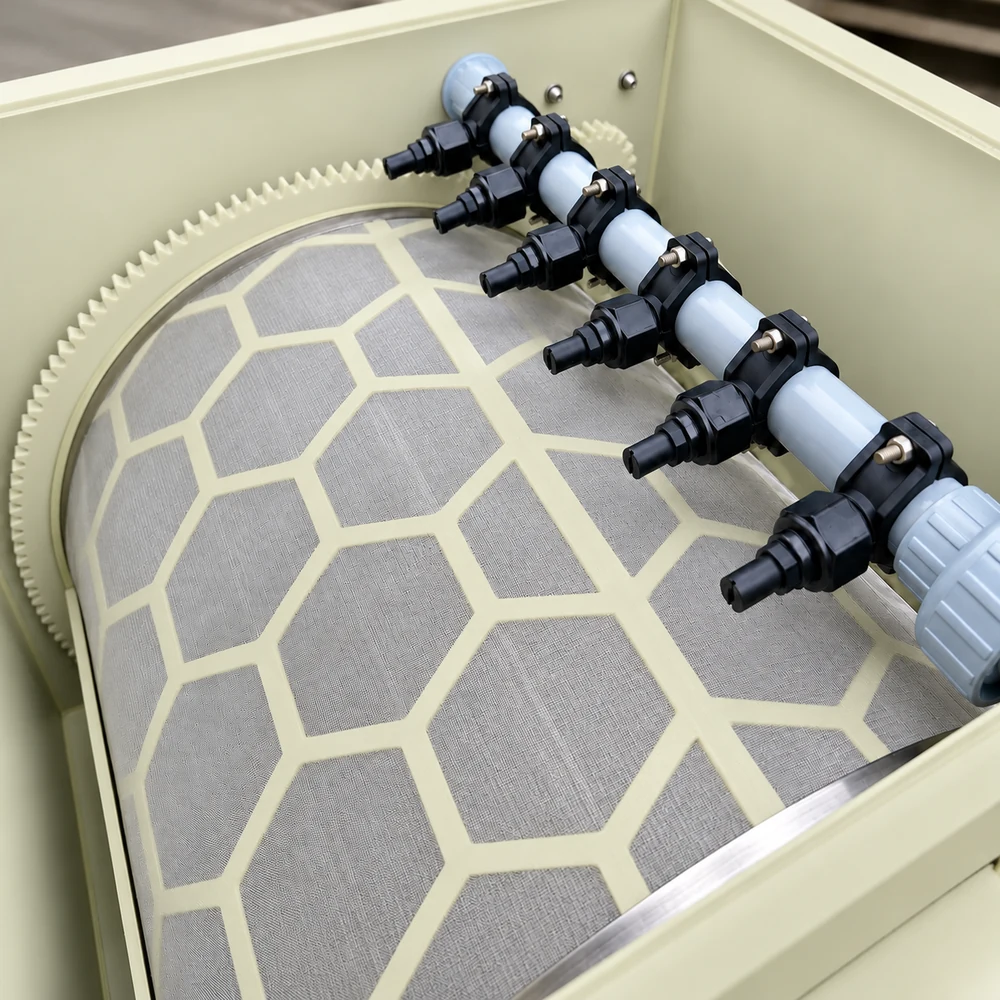
- The screen catches the dirtSolids stay on the fine stainless screen while clean water passes through.
- The drum rinses itselfA level sensor starts a spray that washes the dirt into a waste channel.
- Bacteria on moving mediaClean water flows into a moving bed biofilter where bacteria convert ammonia and nitrite. See our moving bed biofilter guide.
- Back to the aquariumThe return pump lifts the treated water back to the tank.
Our drum filter has a 75 micron SS 316 screen, a level-sensor automatic rinse and high pressure nozzles. For the machine in detail, read how a rotary drum filter works.
An honest comparison
This table sets the two approaches side by side. Neither is perfect, so look at what matters most to you.
| Point | Sump with socks and sponges | Drum filter |
|---|---|---|
| Solids removal | Traps dirt in the system | Screens and flushes it away |
| Weekly work | Replace and wash socks, squeeze sponges | Short look at nozzles and drain |
| Water quality | Dirt breaks down before cleaning | Dirt leaves before it breaks down |
| Flow stability | Falls as socks clog | Constant, the screen is cleaned |
| Power and plumbing | One return pump | Pump plus rinse pump and a waste line |
| Best for | Small and medium tanks | Large tanks, fish rooms, public displays |
A drum filter asks for a drain and a little power, and gives back a good deal of your time.
If you are comparing pond-style filters instead, our guide to drum filters against sieve, bead and vortex filters covers that side.
Filter socks, sponges, fleece rollers and drum filters
All of these remove solids, but they ask different things of you. Here is how each one behaves in practice.
Compare the work, the dirt and the filter size
Use the estimator below to see what flow a drum filter would need for your aquarium. Aquarium filters usually run higher turnover than ponds, so enter the figure you actually plan to use.
Planning estimate. Aquarium drum filters are often fed by part of the pump flow, and the catalogue maximum is not a guaranteed duty at every mesh size. Confirm the model with us before you order.
For more on matching a filter to the system, see our drum filter sizing guide.
What changes when the dirt leaves the system
The effect of removing dirt early shows up across the whole tank. Less waste breaks down inside the system, so there is less to turn into nitrate and less food for algae. Oxygen stays steadier because rotting matter is not using it up, and the fish are under less stress.
None of this removes the need for good husbandry. Feeding sensibly and testing regularly still matter. It means the system carries less hidden waste, which is a safer place for fish and corals to live.
Noise, space and power compared
The best filter on paper is no use if it does not fit your room or keeps you awake. These practical points often decide the matter.
| Point | Sump with socks or sponges | Drum filter and moving bed |
|---|---|---|
| Noise | Water trickling and splashing in the overflow and sump chambers | A slow drum, a short spray when it rinses, and the return pump |
| Floor space | A tank under or beside the aquarium | A drum filter and a biofilter tank; often a similar footprint |
| Power | Return pump, sometimes a skimmer | Return pump, drive motor, rinse pump and sensor |
| Plumbing | Overflow and return | Overflow, return and a waste line to a drain |
| Water use | Only top-up and water changes | Top-up plus a small amount of rinse water |
| Skills needed | Easy to understand and adjust | A little more to plan, then very little to do |
None of these is a deal-breaker. They are just the things to plan for before you choose.
If you are tight on space, a drum filter with a built-in biological chamber saves room. See our rotary drum filter guide for the range of units.
What the first month looks like
Water quality does not change overnight, so it helps to know the pattern. Here is what most owners see when they replace sock filtration with a drum filter and a moving bed.
- Week oneThe drum rinses more often than it will later, because it is clearing old dirt. Nitrate may rise slightly as the system settles.
- Week twoRinse rate falls to a steady pattern. Water clarity improves, and the sump is easier to keep clean.
- Week threeNitrate climbs more slowly between water changes, and algae growth slows.
- Week fourRoutine settles into a weekly look at the nozzles and drain, and a monthly clean of the sensor.
Keep testing during this period. The numbers tell you whether your stocking and feeding suit the new set-up.
Mistakes to avoid when you switch
- Removing the old biofilter too soon. Keep the old media running until the new moving bed has settled.
- Sizing the drum filter on tank volume only. Use the flow, as in our sizing guide.
- Forgetting the drain. The rinse needs somewhere to go, and a bucket is not a plan.
- Running the pump too hard. A pump that is far larger than needed shreds solids before the screen sees them.
- Ignoring salt. In marine systems, tell us at the start so the materials suit your conditions.
- Cutting the weekly look. Automatic does not mean unattended.
Freshwater and marine systems
The two approaches work in both fresh and salt water, with a few differences.
When a sump is still the better choice, and when a drum filter wins
A sump is enough when
- The tank is small to medium and not heavily stocked.
- You like looking after the tank every few days.
- There is no easy way to run a waste line to a drain.
- You want the simplest, most familiar set-up.
A drum filter wins when
- The aquarium is large, or many tanks share one system.
- Fish are fed heavily, as in breeding and growing rooms.
- The filter is hard to reach, or you travel often.
- Water quality has to stay stable without daily attention.
Combining both: a drum filter in front of your sump
- Route the overflow to the drum filterWater leaves the tank and passes straight through the screen.
- Add the moving bed after itClean water goes to a moving bed biofilter for ammonia and nitrite.
- Keep the sump as pump chamberIt holds the return pump, heaters and top-up, and a little spare volume.
With this layout the sump no longer needs socks at all, and the part of it that used to need chores becomes a quiet pump room.
Which drum filter for which aquarium?
Size is set by flow, not by tank size alone. Use the estimator above, then match the result to a model.
| Model | Catalogue flow | Typical use |
|---|---|---|
| RDF-3 | 3 m³/h | Small systems and nurseries |
| RDF-10 | 10 m³/h | Large home aquariums, breeding rooms |
| RDF-20 | 20 m³/h | Fish rooms and small public displays |
| RDF-30 | 30 m³/h | Larger displays and rack systems |
| RDF-50 | 50 m³/h | Big displays and multi-tank systems |
Catalogue flows are maximums and not a guaranteed duty at every mesh size.
If you want UV treatment in the same unit, the Pro RDF range adds lamps inside the housing. See UV lamp sizing and dose before you rely on any lamp rating.
After the switch: what to expect
When you move from a sump with socks to a drum filter, the first weeks are a time of small adjustments.
- Expect a brief rise in rinse frequency while old dirt in the system is removed.
- Check the drain and waste line daily at first, then weekly.
- Leave the biofilter alone while it settles, so the bacteria are not disturbed.
- Watch the nitrate and water clarity over a month and compare with the old set-up.
If anything looks wrong, our troubleshooting guide walks through the checks.
Pureflow equipment for aquarium filtration
Standard RDF drum filterSelf-cleaning SS 316 screen, 75 µm, sizes from 3 to 300 m³/h.Pro RDF with UVThe separate Pro RDF range includes model-specific UV equipment; confirm the supplied configuration and treatment duty.Moving bed biofilter (MBBR)Biological stage that converts ammonia and nitrite.Plan around the collection
Use these questions to prepare a project brief or an operating review. Check an item only when the information has been recorded for your installation.
This checklist is a working aid in the current page session, not a saved maintenance record.
Drum filter vs sump FAQ
Is a drum filter better than a sump?
For large or heavily stocked aquariums, usually yes for solids removal, because it cleans itself. The two also work well together. Every system differs, so share your tank volume, stock and layout with us for a specific suggestion.
Can a drum filter replace a sump entirely?
It replaces the mechanical stage. Many people keep a small sump as a pump chamber and top-up reservoir. Every system differs, so share your tank volume, stock and layout with us for a specific suggestion.
Do I still need a protein skimmer with a drum filter?
In a marine tank, yes. A skimmer and a drum filter do different jobs, and the skimmer removes dissolved organics a screen cannot. Every system differs, so share your tank volume, stock and layout with us for a specific suggestion.
Does a drum filter use a lot of water?
Only a small share of the flow goes out as rinse water. A finer screen increases it. Every system differs, so share your tank volume, stock and layout with us for a specific suggestion.
How big a drum filter does my aquarium need?
Work out the flow from the volume and the turnover you plan to use, add a margin, and pick the model that covers it. Every system differs, so share your tank volume, stock and layout with us for a specific suggestion.
Is it noisy?
The drum turns slowly and the rinse is a short spray. Most owners find it quieter than a sump with a splashing overflow. Every system differs, so share your tank volume, stock and layout with us for a specific suggestion.
Can I use a drum filter in a reef system?
Yes, as a pre-filter ahead of a moving bed biofilter and skimmer. Plan the waste line and the salt water materials carefully. Every system differs, so share your tank volume, stock and layout with us for a specific suggestion.
Do I need a drain?
Yes. The rinse water and the solids leave through a waste line, so plan a drain or a collection tank. Every system differs, so share your tank volume, stock and layout with us for a specific suggestion.
What is the first step if I want to switch?
Measure your current flow and overflow, then send us the details and we can suggest a size. Every system differs, so share your tank volume, stock and layout with us for a specific suggestion.
More guides related to Drum filter vs sump
Discuss your system with Pureflow.
Share your application, operating volume, actual flow, loading and the question you are trying to resolve.