Ozone System for Aquaculture and AquariumsHow It Works and Safety
Ozone systems explained: what ozone does in water treatment, why use it, advantages and considerations for aquariums and aquaculture.
 EQUIPMENT REFERENCE
See the mechanism.
Understand the duty.
Select a route or a stage to inspect the process. The cutaway explains the equipment and water environment; it is a teaching illustration, not a project drawing.
Generate and meter
Review contact, off-gas and residual-control routes together.
The generator and control system supply the selected process. ORP is not a universal dose measurement.
- Review contact, off-gas and residual-control routes together.
- Use the approved monitoring, ventilation and interlock arrangement.
- Do not treat an ORP reading as a universal ozone dose.
What is an ozone system?
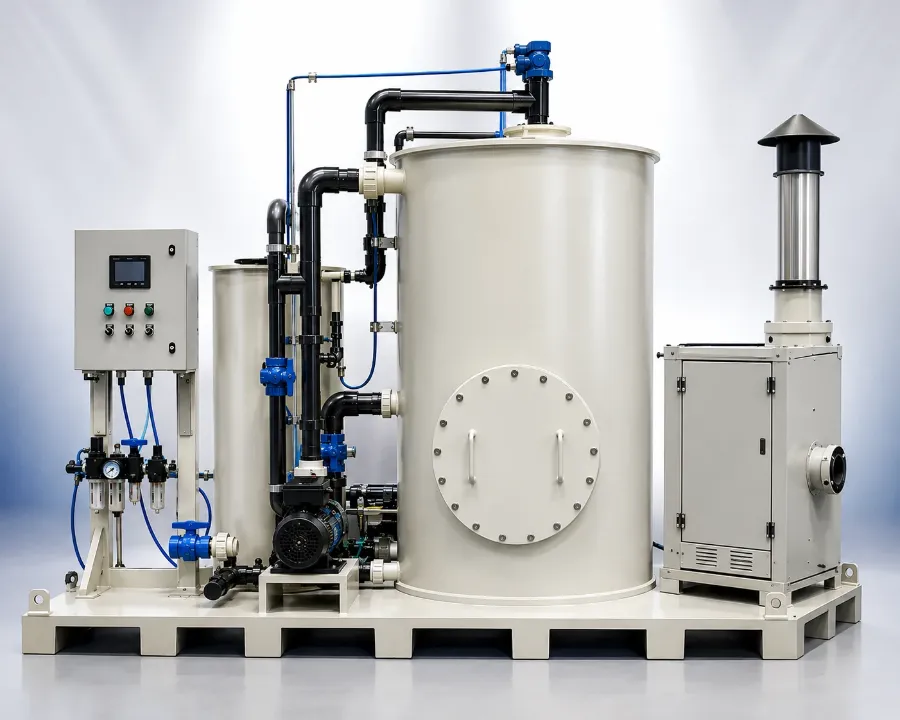
A generator that produces ozone gas, a contact chamber that dissolves it into water, and a destruct unit that removes any excess before water returns.

Why use an ozone system?
Work with your own numbers.
Use the tools below to explore the relevant arithmetic. Enter measured values or declared assumptions. An estimate does not establish equipment capacity, biological performance or a safe operating limit.
Nominal hydraulic residence time
Relate wetted chamber volume to actual flow through that chamber.
Assumptions and limits
Volume ÷ flow is a nominal hydraulic value. It is not UV dose, ozone CT, pathogen inactivation or biological contact effectiveness. Mixing, short-circuiting and validated reactor performance remain separate.
Flow & turnover planner
Relate a measured water volume to a selected turnover time. Confirm the time from the application and hydraulic design.
Assumptions and limits
A planning allowance is your assumption. This calculation does not choose a filter, prove treatment capacity or account for pump head.
Convert units before you calculate
Planning arithmetic · inputs remain visible for review · example values are not operating recommendations
Advantages and considerations
| Advantages | Considerations |
|---|---|
| Strong oxidation | Needs ORP control |
| No chemical residue when destroyed | Toxic to fish and people if mishandled |
| Improves clarity | Corrodes some materials |
See ozone and ORP control and ozone safety.
Pureflow Bio equipment for this
Ozone generators →Ozone for polishing and biosecurity.UV disinfection systems →UV-C chambers.Review the complete safety chain
Use these questions to prepare a project brief or an operating review. Check an item only when the information has been recorded for your installation.
This checklist is a working aid in the current page session, not a saved maintenance record.
Ozone System for Aquaculture and Aquariums FAQ
Is ozone safe for fish?
Only when fully removed before water returns.
Do I need ORP control?
Yes.
Is ozone better than UV?
They do different things and are often used together.
More guides related to ozone system for aquaculture and aquariums
Discuss your system with Pureflow.
Share your application, operating volume, actual flow, loading and the question you are trying to resolve.