
Ozone SafetyDestruct Units, Ventilation and Residual Ozone
Safe handling of ozone: why destruct units matter, how to ventilate, and how to stop residual ozone reaching fish and people.
 EQUIPMENT REFERENCE
See the mechanism.
Understand the duty.
Select a route or a stage to inspect the process. The cutaway explains the equipment and water environment; it is a teaching illustration, not a project drawing.
Generate and meter
Review contact, off-gas and residual-control routes together.
The generator and control system supply the selected process. ORP is not a universal dose measurement.
- Review contact, off-gas and residual-control routes together.
- Use the approved monitoring, ventilation and interlock arrangement.
- Do not treat an ORP reading as a universal ozone dose.
Key takeaways
- Where the risks are: Leaks in gas lines, off-gas from the contact chamber, residual ozone dissolved in treated water, and poor ventilation in the plant room.
- The destruct unit: An ozone destruct unit breaks leftover ozone gas down into oxygen, usually with a catalyst or activated carbon, before the gas is released.
- Water side: After the contact chamber, pass the water over activated carbon or give it enough aeration and time so the dissolved ozone is gone before it returns to animals.
- Ventilation and alarms: Use materials that resist ozone, keep the plant room ventilated, and fit an ambient ozone monitor where people work.
Where the risks are
Leaks in gas lines, off-gas from the contact chamber, residual ozone dissolved in treated water, and poor ventilation in the plant room.
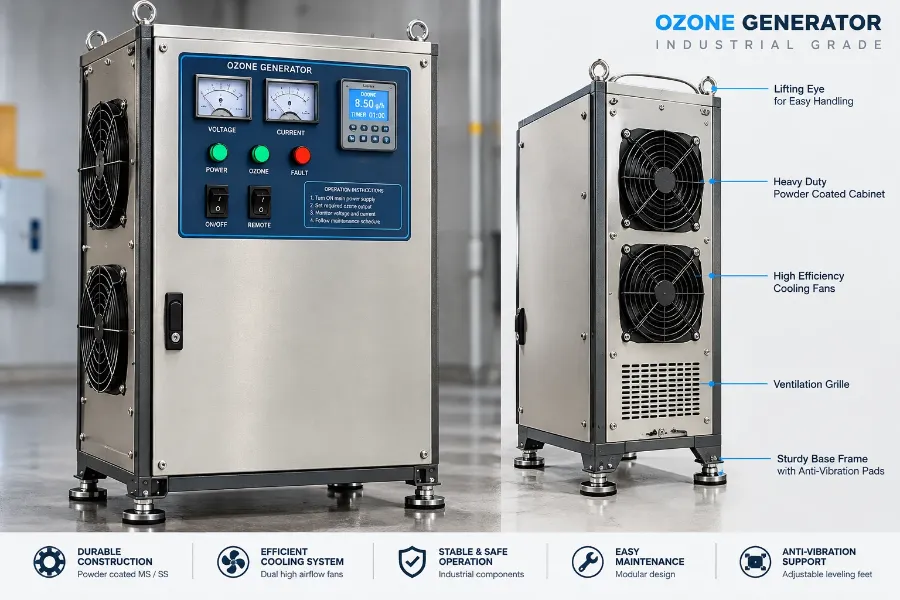
The destruct unit
An ozone destruct unit breaks leftover ozone gas down into oxygen, usually with a catalyst or activated carbon, before the gas is released. Fit one on every contact chamber vent.
Work with your own numbers.
Use the tools below to explore the relevant arithmetic. Enter measured values or declared assumptions. An estimate does not establish equipment capacity, biological performance or a safe operating limit.
Nominal hydraulic residence time
Relate wetted chamber volume to actual flow through that chamber.
Assumptions and limits
Volume ÷ flow is a nominal hydraulic value. It is not UV dose, ozone CT, pathogen inactivation or biological contact effectiveness. Mixing, short-circuiting and validated reactor performance remain separate.
Flow & turnover planner
Relate a measured water volume to a selected turnover time. Confirm the time from the application and hydraulic design.
Assumptions and limits
A planning allowance is your assumption. This calculation does not choose a filter, prove treatment capacity or account for pump head.
Convert units before you calculate
Planning arithmetic · inputs remain visible for review · example values are not operating recommendations
Water side
After the contact chamber, pass the water over activated carbon or give it enough aeration and time so the dissolved ozone is gone before it returns to animals. Test it, do not assume.
Ventilation and alarms
Use materials that resist ozone, keep the plant room ventilated, and fit an ambient ozone monitor where people work.
Training
Anyone who runs the system should know where the shut-off is and what to do if they smell ozone. Read ozone and ORP control too.
Pureflow Bio equipment for this
Ozone generators →Ozone generators.UV disinfection systems →UV-C chambers.Review the complete safety chain
Use these questions to prepare a project brief or an operating review. Check an item only when the information has been recorded for your installation.
This checklist is a working aid in the current page session, not a saved maintenance record.
Ozone Safety FAQ
What does ozone smell like?
A sharp, clean smell like after a thunderstorm. If you smell it, ventilate and check for leaks.
Is a destruct unit optional?
No. It is a basic safety part of any ozone setup.
More guides related to ozone safety
Discuss your system with Pureflow.
Share your application, operating volume, actual flow, loading and the question you are trying to resolve.