
Decoupled AquaponicsSeparate Fish and Plant Loops
Decoupled aquaponics: separate fish and plant loops, why split, coupled vs decoupled, sludge mineralisation, sizing and when to choose it.
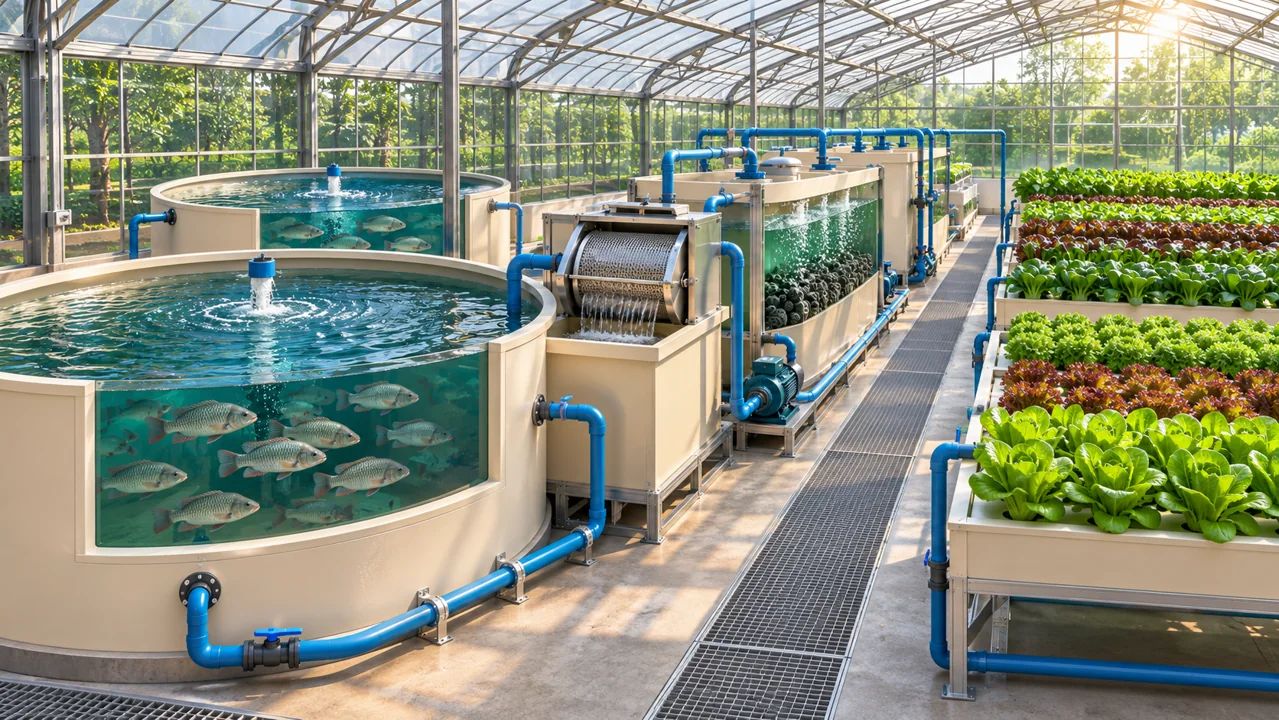 SYSTEM CONCEPT
See the mechanism.
Understand the duty.
Select a route or a stage to inspect the process. The cutaway explains the equipment and water environment; it is a teaching illustration, not a project drawing.
Define the fish load
Define the fish feed input and crop-growing method.
Feed and the fish production stage establish solids and dissolved-waste loading on the fish side.
- Define the fish feed input and crop-growing method.
- Review solids removal and biological treatment.
- Balance both water programmes; plant area does not prove fish capacity.
Key takeaways
- Two or more loops, each at its best pH.
- Fish loop around pH 7 to 7.5, plant loop 5.5 to 6.5.
- Sludge can be mineralised into plant fertiliser.
- Size the fish loop as a RAS, then balance nitrogen to the plants.
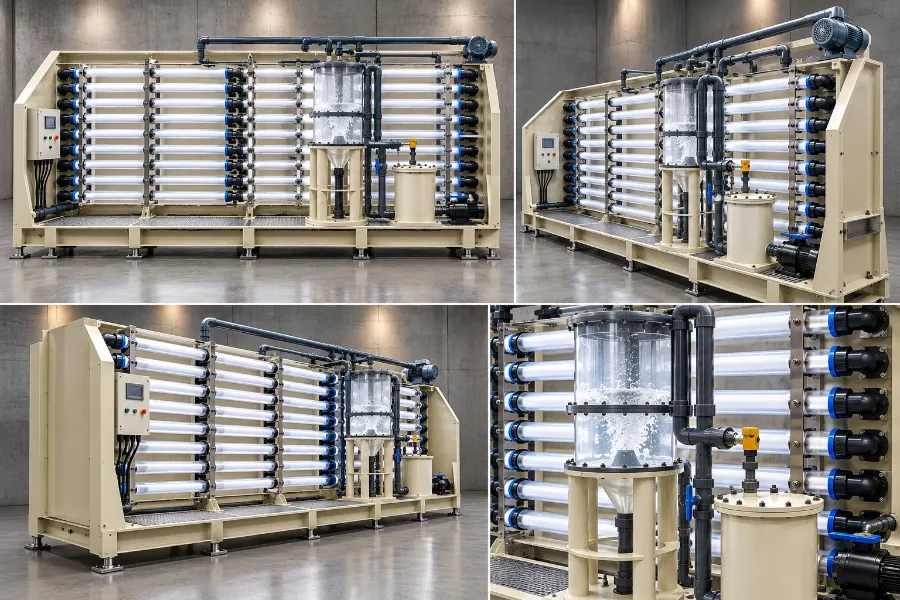
What is decoupled aquaponics?
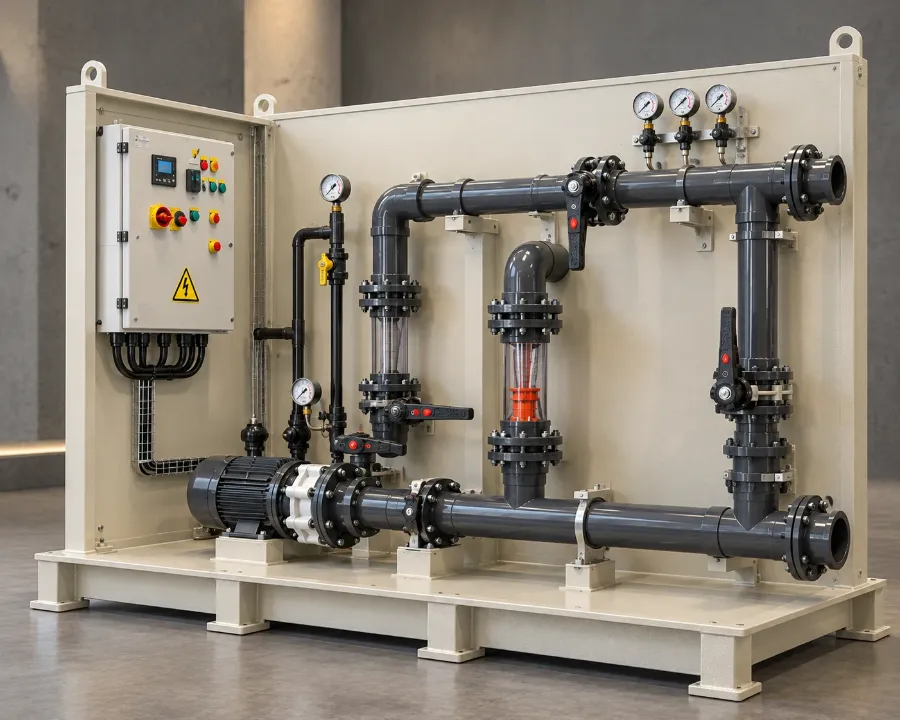
Why decouple? six reasons
- Each loop runs at its ideal pH.
- Fish are protected from plant treatments.
- Plants get exact nutrients.
- Easier to scale each part.
- Less risk when one side fails.
- Better yields.
Work with your own numbers.
Use the tools below to explore the relevant arithmetic. Enter measured values or declared assumptions. An estimate does not establish equipment capacity, biological performance or a safe operating limit.
Aquaponics feed-to-area scenario
Relate plant area to a chosen feed-rate ratio and a selected biomass feeding rate.
Assumptions and limits
Crop, fish, feed and nutrient availability determine the suitable ratio. The implied biomass is not a stocking recommendation or proof of nutrient balance.
Flow & turnover planner
Relate a measured water volume to a selected turnover time. Confirm the time from the application and hydraulic design.
Assumptions and limits
A planning allowance is your assumption. This calculation does not choose a filter, prove treatment capacity or account for pump head.
Convert units before you calculate
Planning arithmetic · inputs remain visible for review · example values are not operating recommendations
Coupled vs decoupled
| Aspect | Coupled | Decoupled |
|---|---|---|
| Water flow | One continuous loop | Fish loop recirculates, water goes one way to plants |
| pH | One compromise (6.8 to 7.0) | Fish 7 to 7.5, plants 5.5 to 6.5 |
| Nutrients | Fish feed plus supplements | Fish water topped up with hydroponic nutrients |
| Complexity | Lower | Higher |
Sludge mineralisation
- Collect and thickenDrum filter sludge to a tank.
- DigestAerobic or anaerobic.
- Let the pH dropReleases nutrients.
- Settle, test and doseAdd to plant loop.
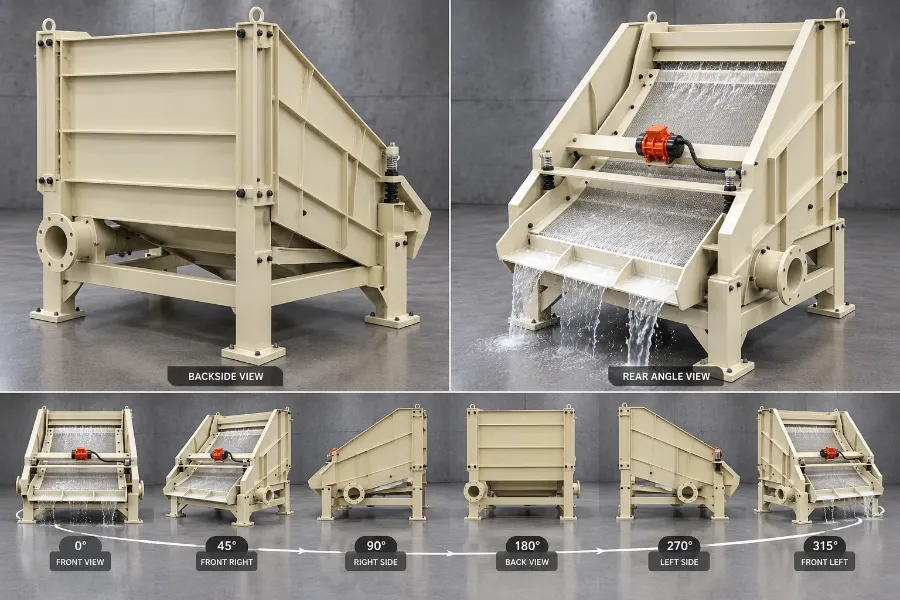
How to size
- Size the fish loop as a RASSee RAS filtration.
- Estimate the plants’ water usePer day.
- Balance the nitrogenMatch feed to plant demand.
- Fill the gapsAdd missing nutrients.
- Plan for the seasonsPlant water use changes.
Coupled or decoupled?
Balance both living systems
Use these questions to prepare a project brief or an operating review. Check an item only when the information has been recorded for your installation.
This checklist is a working aid in the current page session, not a saved maintenance record.
Decoupled Aquaponics FAQ
Is decoupled aquaponics organic?
Rules vary. Check local standards.
Can I convert a coupled system?
Yes with added loops and tanks.
Is it harder to run?
More equipment, but each part is easier to control.
More guides related to decoupled aquaponics
Discuss your system with Pureflow.
Share your application, operating volume, actual flow, loading and the question you are trying to resolve.