
Aquarium FiltrationMechanical, Biological and Chemical Stages
Aquarium filtration explained: the three jobs of a filter, cycling, filter types from sponge to drum filter, flow rates, chlorine and what to test.
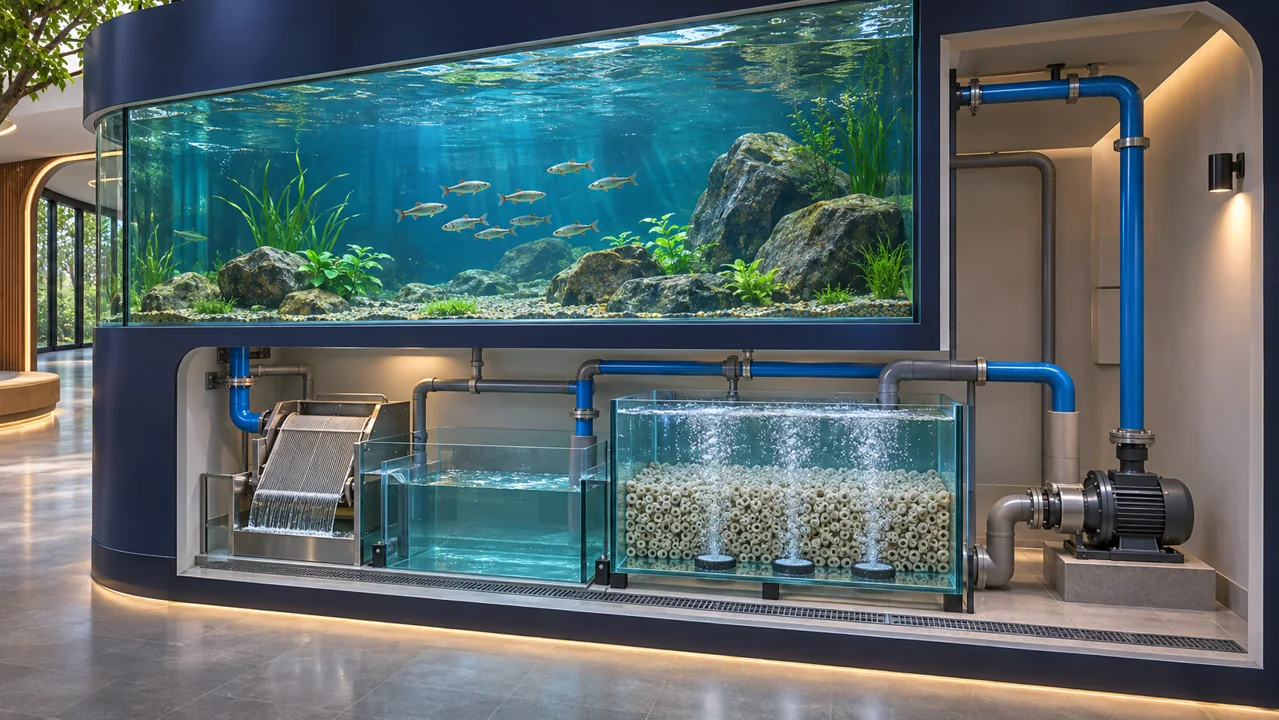 SYSTEM CONCEPT
See the mechanism.
Understand the duty.
Select a route or a stage to inspect the process. The cutaway explains the equipment and water environment; it is a teaching illustration, not a project drawing.
Manage the display
Record the stock, feeding and operating water volume.
Use the actual operating water volume, stock and feeding programme to establish the life-support review.
- Record the stock, feeding and operating water volume.
- Keep mechanical, biological and gas duties distinct.
- Review quarantine, maintenance access and safe water replacement.
Key takeaways
- Three jobs: mechanical (particles), biological (ammonia and nitrite), chemical (dissolved substances).
- A new filter needs weeks to grow bacteria, so cycle before adding fish.
- Pick the filter type by tank size and use: sponge, hang-on, canister, sump or drum filter.
- Test ammonia, nitrite and nitrate regularly.
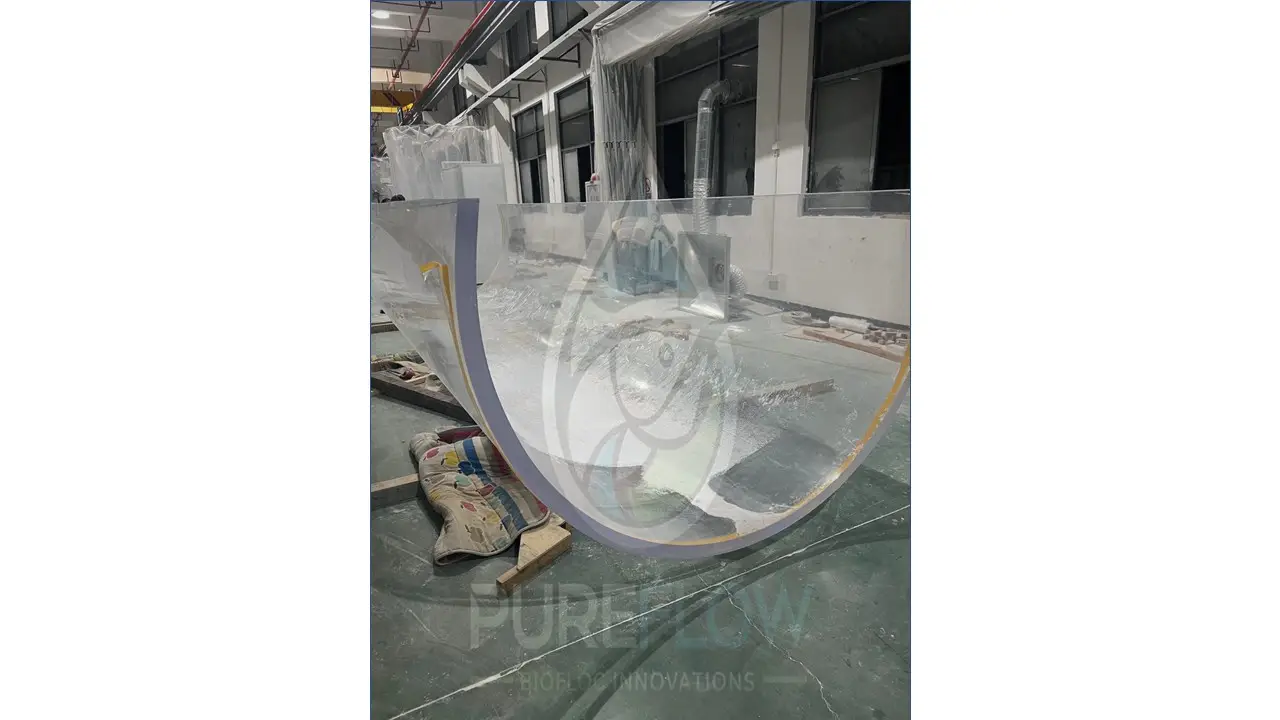
The three jobs of a filter

Why a new filter needs weeks
Bacteria grow slowly. Until they establish, ammonia from fish builds up. Cycle first, without fish, or stock very lightly.
- Set up and run the filterAdd dechlorinated water.
- Add an ammonia sourcePure ammonia or fish food.
- Test every day or twoAmmonia, nitrite, nitrate.
- Wait for ammonia and nitrite to read zeroNitrate appears.
- Stock graduallyAdd fish in small groups.
Work with your own numbers.
Use the tools below to explore the relevant arithmetic. Enter measured values or declared assumptions. An estimate does not establish equipment capacity, biological performance or a safe operating limit.
Water-change volume planner
Calculate the volume changed per event and the original-water fraction remaining after repeated equal changes.
Assumptions and limits
Assumes complete mixing between equal changes. Match replacement-water chemistry and temperature; this is not a safe-change prescription or a treatment guarantee.
Flow & turnover planner
Relate a measured water volume to a selected turnover time. Confirm the time from the application and hydraulic design.
Assumptions and limits
A planning allowance is your assumption. This calculation does not choose a filter, prove treatment capacity or account for pump head.
Convert units before you calculate
Planning arithmetic · inputs remain visible for review · example values are not operating recommendations
How toxic is your ammonia reading?
Toxicity depends on pH and temperature. Higher pH and warmer water make ammonia more toxic. Use a test that reports total ammonia and compare with a toxicity chart. See ammonia toxicity and pH.
Six filters, from fry tank to public aquarium
| Filter | Best for | Notes |
|---|---|---|
| Sponge filter | Fry, quarantine, small tanks | Cheap, gentle, air-driven |
| Hang-on-back | Small to medium tanks | Easy, moderate capacity |
| Canister | Medium to large tanks | High capacity, hidden |
| Undergravel | Old design | Rarely recommended |
| Sump | Large home tanks | Extra volume and equipment space |
| Drum filter | Large tanks, racks, public aquariums | Automatic fine solids removal. See aquarium drum filter |
How much water should the filter move?
Many home aquariums turn the water over several times an hour, while public displays are slower but larger. See turnover rate.
Chlorine, chloramine and your filter
| Chlorine | Chloramine | |
|---|---|---|
| Toxic to fish | Yes | Yes |
| Disappears by standing | Slowly | No |
| Releases ammonia when removed | No | Yes |
Always use a conditioner that handles both.
What to measure, and how often
Weekly: ammonia, nitrite, nitrate, pH. Marine tanks also salinity. Keep a log.
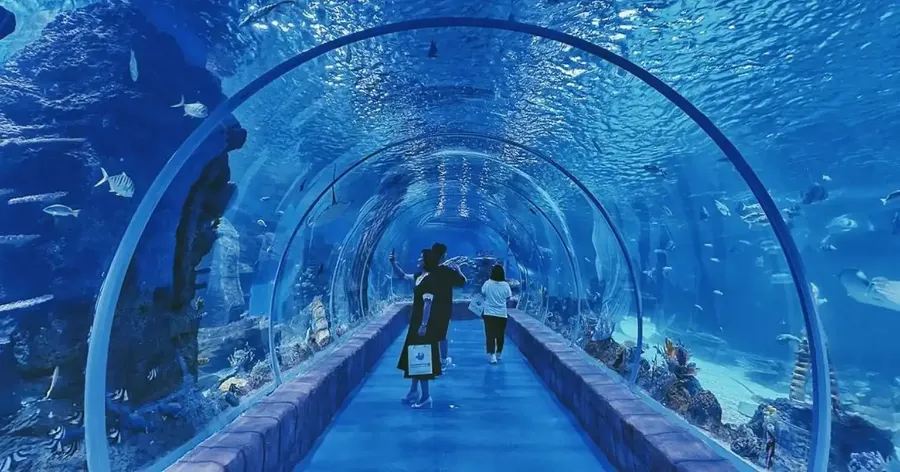
How public aquariums keep millions of litres clean
They use central filtration with drum filters, biofilters, protein skimmers, UV and ozone. See aquariums and oceanariums.
Plan around the collection
Use these questions to prepare a project brief or an operating review. Check an item only when the information has been recorded for your installation.
This checklist is a working aid in the current page session, not a saved maintenance record.
Aquarium Filtration FAQ
What is the best aquarium filter?
The one sized for your tank and fish load. For large systems, a drum filter plus biofilter.
How long should I cycle a tank?
Usually four to eight weeks.
Do I need to clean the filter?
Rinse mechanical media in tank water. Never use tap water on biological media.
More guides related to aquarium filtration
Discuss your system with Pureflow.
Share your application, operating volume, actual flow, loading and the question you are trying to resolve.