
Trout FarmingCold Water, Oxygen and RAS Basics
Rainbow trout farming in RAS: water values, temperature and oxygen, growth time, densities, feeding, flow-through vs RAS, filtration, biosecurity, UV-C and ozone.
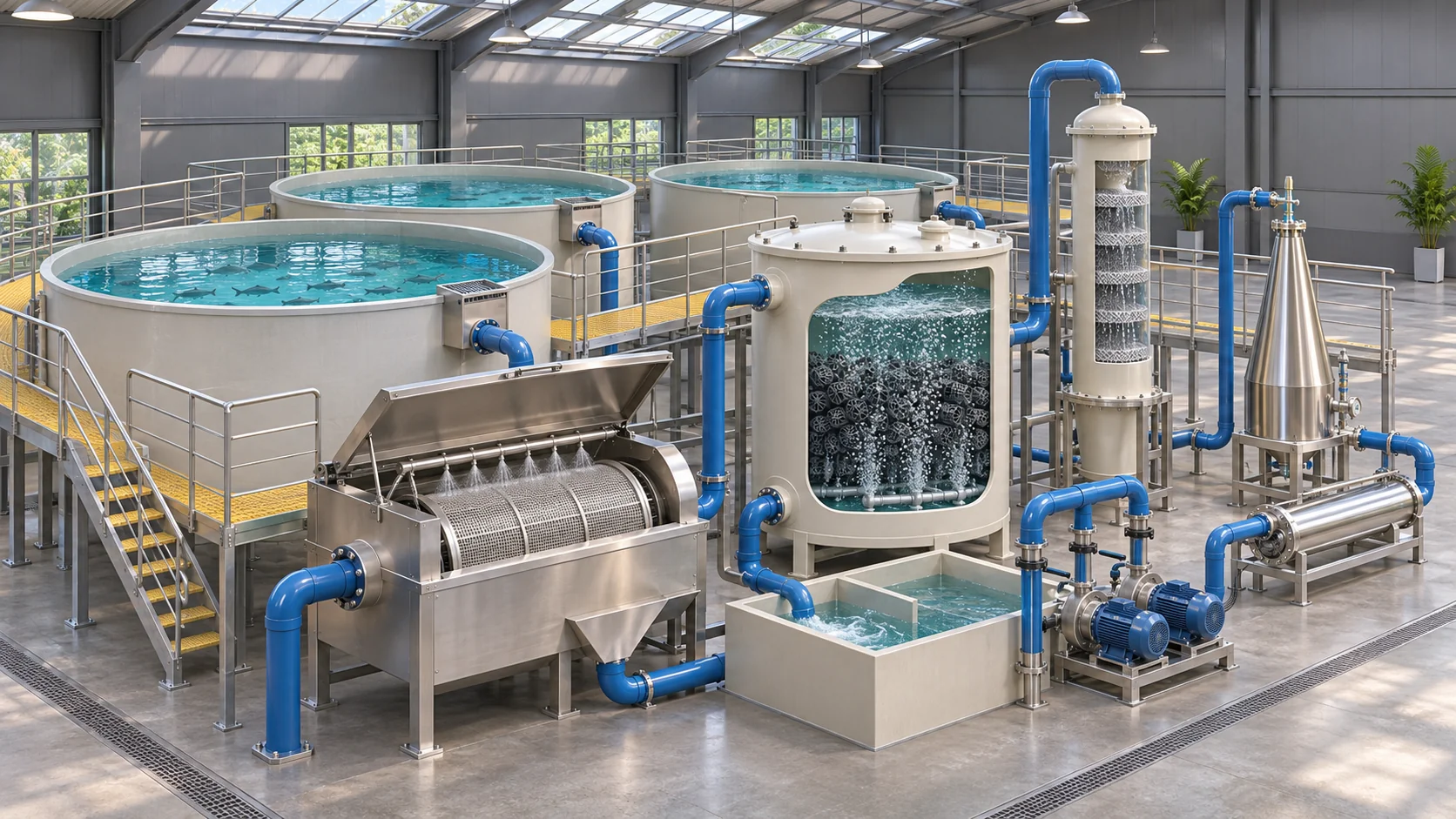 SYSTEM CONCEPT
See the mechanism.
Understand the duty.
Select a route or a stage to inspect the process. The cutaway explains the equipment and water environment; it is a teaching illustration, not a project drawing.
Culture tanks
Collect waste before it settles.
The culture tank is both an animal environment and a hydraulic vessel. The return flow should distribute oxygenated water and move settleable waste toward the intended outlet. Tank shape, drain arrangement and the behaviour of the stock determine how well this happens.
- Confirm the operating water volume and peak feed.
- Check circulation, drain capture and access for inspection.
- Record oxygen at the animal zone, not only in the return pipe.
Key takeaways
- Best temperature 13 to 17 °C. Heat stress starts around 21 °C.
- Oxygen at 8 to 10 mg/L, and CO2 below 15 mg/L.
- Plan chilling in warm climates.
- Biosecurity matters: start from eggs, quarantine, all-in all-out.
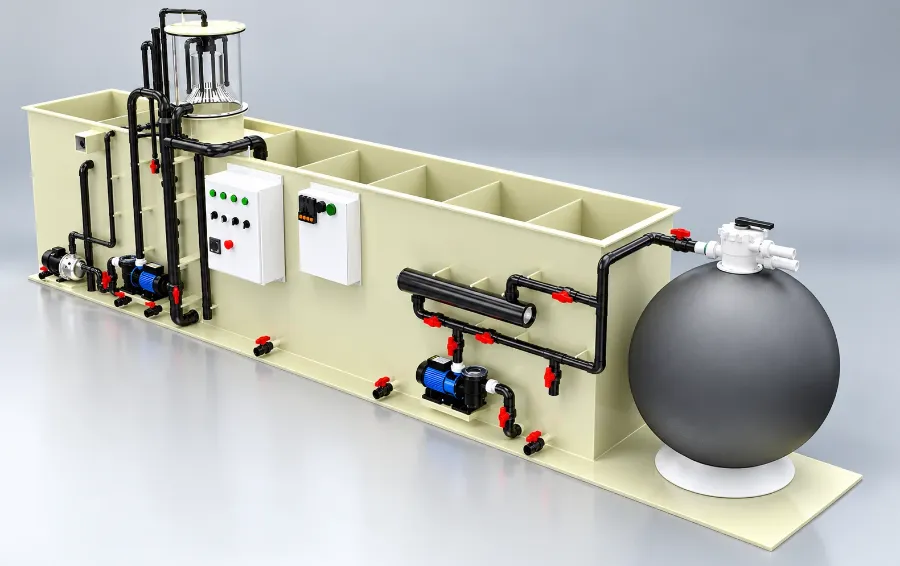
Ideal water values for rainbow trout
| Parameter | Target | Notes |
|---|---|---|
| Temperature | 13 to 17 °C | Good at 10 to 20; stress above 21 |
| Dissolved oxygen | 8 to 10 mg/L | At least 80% saturation |
| Carbon dioxide | Below 15 mg/L | Harmful above 20 |
| pH | 6.8 to 7.8 | Tolerates 6.5 to 8.5 |

Temperature and oxygen requirements
Cold water holds more oxygen but trout use a lot. Farms use pure oxygen and oxygen cones to maintain levels. See oxygen cones.
Work with your own numbers.
Use the tools below to explore the relevant arithmetic. Enter measured values or declared assumptions. An estimate does not establish equipment capacity, biological performance or a safe operating limit.
Dissolved-oxygen mass inventory
Convert measured dissolved concentration and water volume into the mass currently dissolved.
Assumptions and limits
This is an inventory, not oxygen-delivery capacity or safe survival time. Fish, bacteria, transfer efficiency and changing demand require a separate oxygen balance.
Pump or equipment energy cost
Estimate electrical use from measured input power and a declared daily operating schedule.
Assumptions and limits
Use electrical input, not hydraulic power or the pump’s flow rating. Starting load, variable duty, taxes and demand charges are not included.
Convert units before you calculate
Planning arithmetic · inputs remain visible for review · example values are not operating recommendations
How long does it take to grow trout?
About nine to twelve months to portion size (250 to 400 g) at ideal temperatures; longer for large trout.
How many trout per cubic metre?
| System | Typical density |
|---|---|
| RAS | 20 to 60 kg/m³ |
| High end | About 80 kg/m³ |
Feeding trout: rations, protein and fcr
| Fish size | Feed per day | Meals |
|---|---|---|
| Under 1 g | 5 to 10% | 8 to 12 a day |
| 1 to 10 g | 3 to 5% | 6 to 8 a day |
| 10 to 50 g | 2 to 3% | 4 to 6 a day |
| 50 to 200 g | 1.5 to 2% | 3 to 4 a day |
| 200 g to 1 kg | 1 to 1.5% | 2 to 3 a day |
Typical rates at 14 to 15 °C.
Flow-through or ras: which suits a trout farm?
Flow-through raceways need lots of cold, clean water. RAS recycles it and allows temperature control. Choose RAS where water is scarce or warm. See biofloc, RAS and ponds.
Filtration for a trout ras
Trout are sensitive to CO2 and fine solids. Use a drum filter, a biofilter and strong CO2 stripping.
Example: a 20 m³ trout pilot
A pilot of 20 m³ at 40 kg/m³ holds 800 kg of fish. With feed near 1.5 percent a day that is about 12 kg of feed daily, a good size to learn on.
Trout health: biosecurity, uv-c and ozone
- Start from eggsDisinfected eggs are cleaner than live fish.
- Quarantine and all-in, all-outPrevent disease carrying over.
- Treat the waterUV-C or ozone.
- Work with a fish vetEarly diagnosis.
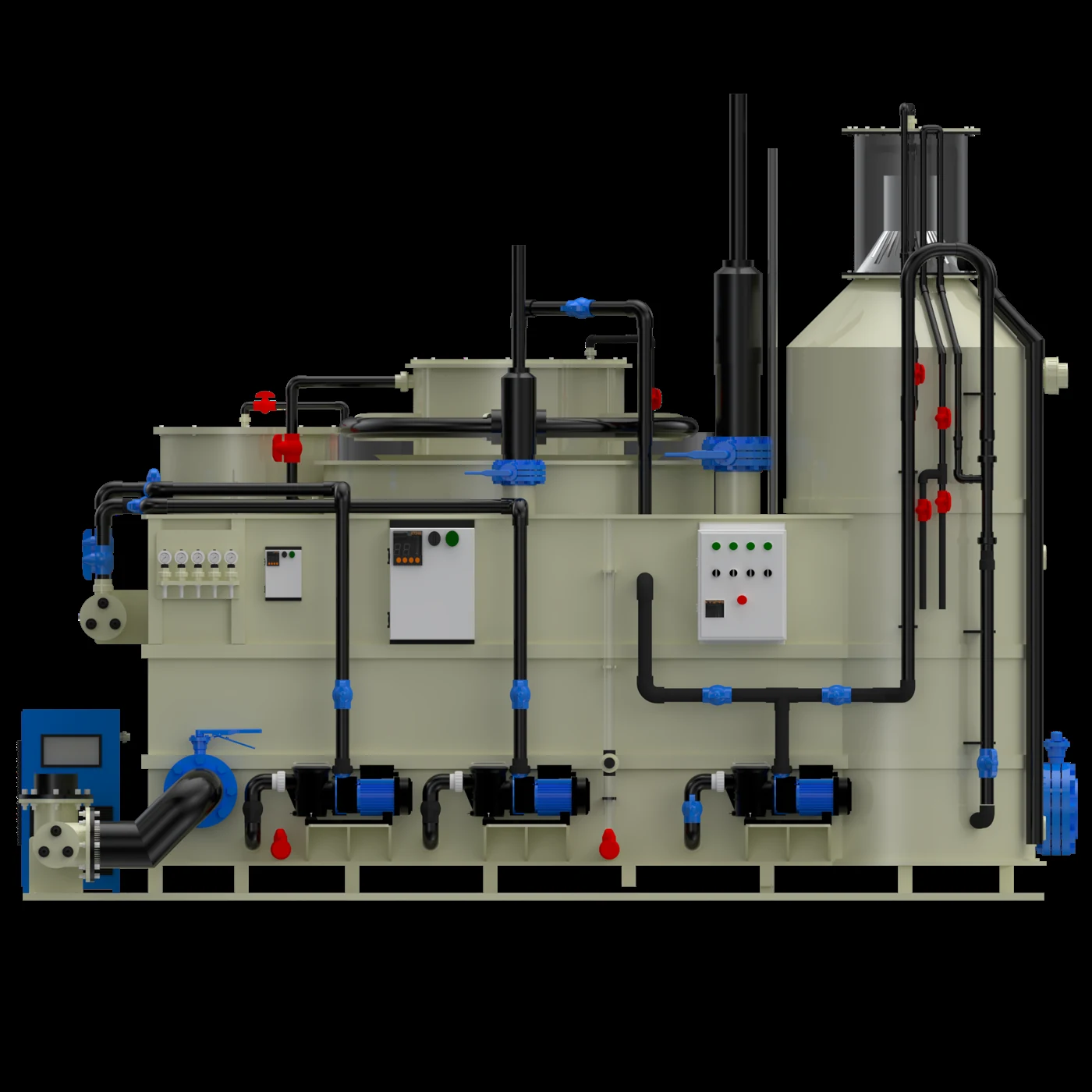
See UV for hatcheries.
Review the design at peak load
Use these questions to prepare a project brief or an operating review. Check an item only when the information has been recorded for your installation.
This checklist is a working aid in the current page session, not a saved maintenance record.
Trout Farming FAQ
What temperature is too hot for trout?
Stress starts above about 21 °C and it is often fatal near 25 °C.
Do I need chilling?
In hot climates, yes.
Is RAS better than raceways for trout?
When water is limited or temperature control matters.
More guides related to trout farming
Discuss your system with Pureflow.
Share your application, operating volume, actual flow, loading and the question you are trying to resolve.