
Drum Filter vs Sieve, Bead and Vortex Filters Compared
Compare how seven mechanical filter types capture solids, remove retained waste and affect cleaning and hydraulic duty. Explore each mechanism and compare the alternatives for your pond.
Which pond filter is actually better?
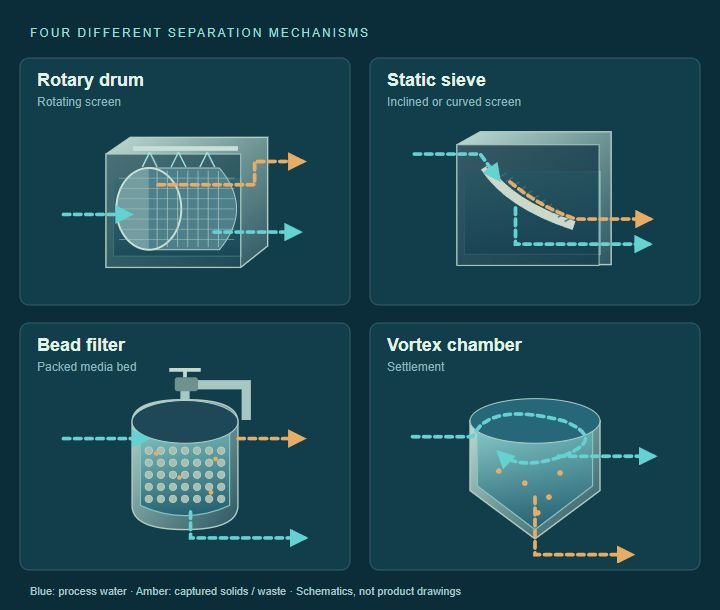
Start with the separation job and the cleaning arrangement. A rotary drum uses a screen and an automatic wash system. A static sieve separates particles on a fixed screen. A bead vessel stores retained solids in its media until backwashing. A vortex chamber relies on particles settling out of the flow.
The diagrams below show how each separator works, with process water and retained-waste routes identified separately. Use those differences to compare the equipment at the same operating duty.
When automation matters
A drum can automate routine screen cleaning. It still needs suitable flow and levels, wash water, drainage, monitoring and service access.
When simpler equipment fits
A sieve or settling stage may suit the hydraulic layout and solids duty. The operator still needs a reliable plan to clear captured waste.
What the comparison cannot prove
Pond volume alone does not establish the right filter. Check peak flow, feeding, particle characteristics, maintenance resources and the complete treatment train.
Different filters.
Different ways to remove dirt.
Choose a filter to see its own mechanism, cleaning requirements and limitations. Blue marks process water; amber marks retained solids or the waste route. The paths are conceptual and are not flow-rate or cleaning-time simulations.
A waste path does not mean continuous discharge. Screens, bed filters and settling chambers use different cleaning and purge sequences.
Rotary drum
Where the retained waste goesRetained on the screen, then sprayed into a separate waste gutter.
What cleaning involvesAutomatic wash; inspect screen, nozzles, drive, sensing and drainage.
Where the mechanism has limitsCapture follows screen opening, particle properties, flow and loading. Dissolved waste passes through.
Where does the dirt go?
A mechanical filter captures or separates particles. The next question is how retained material leaves the circulating water and where the discharge goes. Solids left wet can break down; separation without an effective cleaning or purge routine is incomplete waste management.
Capture
Screen, intercept or settle particles under the actual operating duty.
Retain
Recognise where deposits collect and how loading changes flow or water quality.
Remove
Use the specified wash, drain, backwash or element-service route.
Verify
Check restored flow, operating levels and waste discharge after cleaning.
Removing particulate waste does not remove all dissolved nitrogen or prevent every water-quality problem. Fish excretion, feed, oxygen supply, biological conversion and water replacement remain separate design questions.
Clear water and healthy water are different checks.
Solids and oxygen demand
Organic deposits can add oxygen demand as they break down. Maintain the oxygen balance for stock and biology; visual clarity is not an oxygen measurement.
Ammonia and nitrite
A drum screen does not remove dissolved ammonia or nitrite. A biofilter needs its own loading, oxygen, pH, alkalinity and temperature review.
Algae and fish health
Solids capture can support water management, but it does not guarantee algae control, biosecurity or disease prevention. Interpret measurements for the stock and operating conditions.
Every filter has an operating duty.
Compare filters at the same actual flow and loading. A gravity-fed screen needs an acceptable water-level difference; a pressure vessel needs pump head. Both clean and loaded conditions matter. There is no universally “zero head loss” filter.
Gravity-fed routes
Confirm normal pond level, dirty- and clean-side levels, screen drawdown, inlet pipe capacity and the downstream pump position. Include protection against overflow and low water.
Pressurised routes
Check vessel rating, air management, isolation and the pump operating point with the filter and valves included. Backwash may require a different operating flow.
Cleaning and drainage
Confirm the wash-water source, drain or waste collection arrangement, permitted discharge and access. Passive separation does not make the whole circulating system power-free.
Seven filter types, side by side.
| Filter | Separation | Retained waste | Cleaning obligation | Important limit |
|---|---|---|---|---|
| Rotary drum | Rotating screen | Retained on the screen, then sprayed into a separate waste gutter. | Automatic wash; inspect screen, nozzles, drive, sensing and drainage. | Capture follows screen opening, particle properties, flow and loading. Dissolved waste passes through. |
| Static sieve | Inclined or curved screen | Separated onto the screen and collection area; removed through the designed waste route. | Clear collected waste and clean the screen according to the unit’s instructions. | Particles smaller than the effective screen opening pass through. Fouling can restrict delivery. |
| Bead filter | Packed media bed | Stored in the media bed until the backwash and rinse sequence removes it. | Use the specified agitation, backwash and rinse procedure. Isolate and depressurise as instructed. | Trapped solids increase resistance and need effective removal. Biological contribution depends on media, conditions and operating duty. |
| Vortex chamber | Settlement | Settleable particles collect at the base and leave when the sludge drain is purged. | Purge accumulated sludge and inspect for deposits and blocked drains. | Fine, buoyant or slow-settling particles may carry over. There is no fixed screen opening. |
| Brushes & mats | Interception in fibres | Held among fibres until the material is lifted, rinsed or otherwise cleaned. | Provide accessible sections, a dirty-water route and a procedure that protects any biological stage. | Capture and cleaning performance depend on density, layout and loading. A brush chamber is not a defined micron screen. |
| Sand / granular media | Depth filtration | Stored within the granular bed until an effective backwash removes it. | Follow the vessel’s backwash procedure and confirm the required flow, duration and discharge route. | Fine capture is possible in suitable designs; organic loading, channel formation and poor backwashing can undermine performance. |
| Cartridge | Pleated or porous element | Held on or in the element until it is cleaned or replaced. | Isolate the housing, release pressure and use the element manufacturer’s cleaning or replacement procedure. | Element grade, area and solids duty govern performance. High organic loading can make service frequent. |
This compares mechanisms, not manufacturer-specific capture tests, flow ratings, prices or biological capacities. A quoted micron grade is not a complete system specification.
Where each filter can fit.
Rotary drum
When automated solids removal is a priority and wash supply, drainage and servicing can be provided.
Hydraulic questionAvailable in gravity-fed and pump-fed arrangements; check permitted operating levels and loaded-screen head loss.
Static sieve
When a screen prefilter fits the available levels and the operator can manage its waste collection.
Hydraulic questionThe screen, water-level control and pump position must match the installation. A gravity-fed unit needs the specified level relationship.
Bead filter
When a compact media vessel suits the pressure system and its backwash demand and biological duty are established.
Hydraulic questionCommonly a pressurised installation. Include clean and loaded vessel losses, valves and pipework in the pump duty.
Vortex chamber
When useful settlement can be achieved with the available chamber space, flow and solids characteristics.
Hydraulic questionChamber geometry, flow distribution, particle settling and the outlet arrangement govern separation.
Brushes & mats
When accessible manual cleaning is acceptable and the capture arrangement fits the actual solids load.
Hydraulic questionLoading raises resistance and can cause bypass or overflow if the arrangement is not protected.
Sand / granular media
When a designed depth-filtration stage and its backwash facilities are appropriate; a pool specification alone does not establish suitability for a fish system.
Hydraulic questionInclude vessel pressure loss and the backwash operating point when selecting the pump and valves.
Cartridge
When the element grade and accessible service routine suit the loading, often in a defined polishing duty.
Hydraulic questionCheck housing rating, clean and loaded pressure loss, flow and a safe isolation arrangement.
Automation is useful.
It still needs an operating plan.
What a drum can automate
The control system can initiate a screen-wash cycle and carry removed solids into a waste route. Confirm how the supplied model senses loading and manages cleaning.
What remains an operator task
Inspect accessible screen areas, spray pattern, wash supply, drainage, sensing and drive condition. Follow the model’s service schedule and isolation procedure.
What to establish before purchase
Use actual peak flow, solids duty, screen choice and permitted levels. Confirm installation dimensions, wash demand, electrical supply and the response to loss of power or water.
Avoid comparing the wrong numbers.
“A larger pond needs this exact model.”
Volume helps establish circulation, but feed, peak flow, solids, mesh and hydraulics determine the mechanical duty. A model number is not a stocking limit.
“Finer filtration is always better.”
Review the capture objective alongside clean and loaded flow, cleaning demand and downstream requirements. Finer screening is a design choice, not an automatic improvement.
“Automatic means maintenance-free.”
A wash cycle does not inspect the equipment, unblock drains or manage a failed supply. Keep routine checks and a contingency plan.
“One filter treats everything.”
Mechanical separation, biological conversion, gas management and any disinfection stage perform different jobs. Some vessels combine roles, but each claimed duty needs support.
“A backwash removes all retained waste.”
The result depends on the vessel, media and specified operating procedure. Confirm recovery and discharge; do not infer cleaning performance from the valve position alone.
“A filter is safe because the water looks clear.”
Clarity does not establish dissolved oxygen, ammonia, pathogen control or stock safety. Use the relevant measurements and operating limits.
Use the pond’s demands to frame the choice.
A lightly fed garden pond
Define the real flow, leaf load and time available for cleaning. Compare an accessible manual arrangement with a sieve or automated screen without assuming that small volume means low maintenance.
A koi pond with seasonal leaf loading
Plan collection at the surface and bottom, handle large debris before vulnerable components, and compare peak seasonal loading. Automated screen cleaning can help, with drainage and dependable service access.
A nursery or recirculating fish system
Review maximum feeding, particle characteristics, multiple-tank peaks and the downstream biological stage. Consider monitoring, standby arrangements and waste handling alongside the separator.
Compare the complete ownership duty.
A credible cost comparison includes the equipment and installation, electrical input at the real operating point, cleaning or wash water, discharge handling, consumables, replacement parts and staff time. Equipment price alone does not describe the operating cost.
Record observed cleaning frequency rather than applying an assumed universal schedule. If comparing energy, include the pump duty and any wash pump, blower, motor or controls. If comparing water use, distinguish wash supply from total wastewater. Neither is a fixed percentage for every installation.
Mechanical capture and biology work together.
After mechanical separation, dissolved ammonia and nitrite can remain. Biological treatment converts nitrogen compounds under suitable operating conditions. Media volume alone does not prove conversion capacity; loading, oxygen, water chemistry and the supported media performance matter.
Some media filters can contribute both mechanical and biological treatment. That does not make their cleaning procedure or biological duty interchangeable with a dedicated screen and reactor. Review each function in the complete design.
UV treatment is a separate question. Suitability depends on the target duty, reactor flow, UV transmittance and validated performance. A screen opening or lamp wattage alone does not establish disinfection.
Understand the biological stage ↗ · Review the UV treatment duty ↗
Two filters.
The differences that matter.
Select the two alternatives you are considering. The comparison shows their differences without assigning a winner from pond volume alone.
| Decision point | Rotary drum | Bead filter |
|---|---|---|
| Mechanism | Rotating screen | Packed media bed |
| Waste storage and removal | Retained on the screen, then sprayed into a separate waste gutter. | Stored in the media bed until the backwash and rinse sequence removes it. |
| Cleaning | Automatic wash; inspect screen, nozzles, drive, sensing and drainage. | Use the specified agitation, backwash and rinse procedure. Isolate and depressurise as instructed. |
| Hydraulics | Available in gravity-fed and pump-fed arrangements; check permitted operating levels and loaded-screen head loss. | Commonly a pressurised installation. Include clean and loaded vessel losses, valves and pipework in the pump duty. |
| Limitation | Capture follows screen opening, particle properties, flow and loading. Dissolved waste passes through. | Trapped solids increase resistance and need effective removal. Biological contribution depends on media, conditions and operating duty. |
Confirm both alternatives at the same actual duty. This comparison is not a product selection or an installation approval.
Calculate circulation. Then review filter duty.
These tools convert pond dimensions and a chosen turnover time into hydraulic flow. They do not select a filter, establish capture efficiency or validate biological capacity. Use the actual operating flow, solids load and manufacturer data for equipment selection.
Flow & turnover planner
Relate a measured water volume to a selected turnover time. Confirm the time from the application and hydraulic design.
Assumptions and limits
A planning allowance is your assumption. This calculation does not choose a filter, prove treatment capacity or account for pump head.
Pond or tank volume
Estimate a rectangular water volume from internal wetted dimensions and average operating depth.
Assumptions and limits
Irregular shapes, sloping walls, freeboard and displaced equipment change the usable water volume. Confirm with a fill meter where practical.
Convert units before you calculate
Planning arithmetic · inputs remain visible for review · example values are not operating recommendations
Pond-filter comparison FAQs.
Is a drum filter always better than a sieve?
No. A drum automates screen cleaning; a static sieve uses a different collection and service arrangement. Compare capture requirements, actual flow, levels, drainage, maintenance resources and supported model performance.
Does a drum filter replace a biofilter?
No. A drum screen separates particles. It does not perform the biological conversion of dissolved ammonia and nitrite. Review the biological duty separately.
Can a vortex remove the same particles as a screen?
Not necessarily. A vortex relies on settling behaviour, while a screen presents a defined opening. Fine, buoyant and slow-settling particles can pass a settling chamber; performance depends on the actual duty.
Are bead filters only mechanical filters?
Some are designed to contribute biological treatment as well. Verify the media, conditions and supported duty, and follow the specified cleaning procedure. Do not assign biological capacity from vessel volume alone.
Does a drum have no head loss?
No. Flow through a screen needs a hydraulic driving force. Screen loading, permitted drawdown and the installation arrangement affect the operating levels and delivered flow.
How much water does each filter use for cleaning?
There is no universal value. Measure the relevant wash supply or discharge across complete cleaning cycles, and use the observed frequency. Backwash, rinse, element washing and sludge purging are different duties.
Can I replace an existing filter with a drum?
Possibly, after checking the complete route: actual flow, operating levels, available head, connections, service space, wash supply, drainage, electrical protection and an operating contingency plan.
Which model should I choose for my pond?
Prepare the operating volume, actual and peak flow, stock and feed programme, particle loading, proposed screen and installation levels. Use verified model specifications and a project review rather than a pond-volume-only recommendation.
Check the mechanism against the manufacturer’s instructions.
The distinctions above describe filter principles. Manufacturer documents show specific implementations and service requirements; their ratings and procedures must not be transferred to a different product.
- AquaForte UltraSieve III — manufacturer product and manual resources: a static screen implementation.
- Evolution Aqua K1 Micro Bead — manufacturer cleaning instructions: retained waste, agitation, backwash and rinse.
- OASE ProfiClear — manufacturer drum-filter example: an automatic screen-cleaning arrangement.