
Freshwater Stingray AquariumTank Size and Filtration
Freshwater stingray aquarium: tank size, water values, feeding and its effect on water, filtration with drum filter and moving bed, setup, sting safety and legal buying.
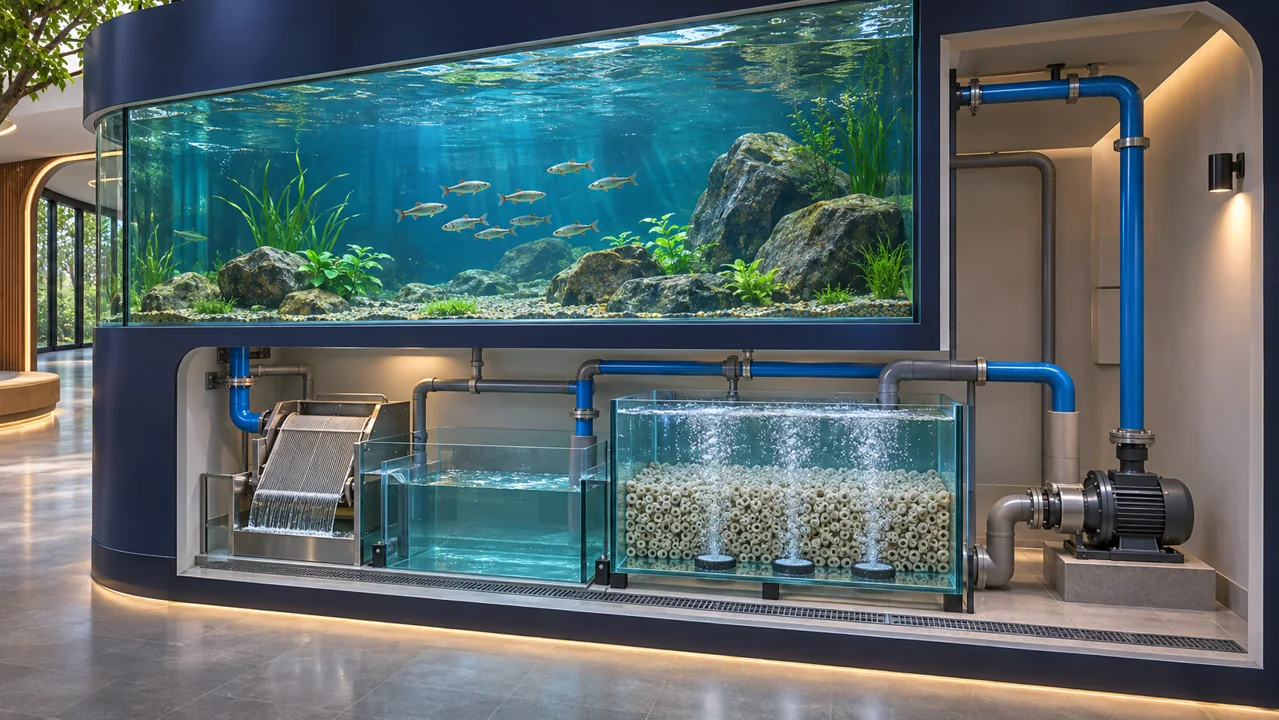 SYSTEM CONCEPT
See the mechanism.
Understand the duty.
Select a route or a stage to inspect the process. The cutaway explains the equipment and water environment; it is a teaching illustration, not a project drawing.
Manage the display
Record the stock, feeding and operating water volume.
Use the actual operating water volume, stock and feeding programme to establish the life-support review.
- Record the stock, feeding and operating water volume.
- Keep mechanical, biological and gas duties distinct.
- Review quarantine, maintenance access and safe water replacement.
Key takeaways
- Floor area matters more than depth. One adult ray needs at least 180 x 60 cm.
- Keep temperature steady, 24 to 29 °C, with heating in the filter loop, not in the tank.
- Feeding creates lots of waste, so plan strong filtration.
- Check permits and CITES before buying.

How big should a stingray tank be?
| Adult rays | Floor area | Water at 50 cm depth |
|---|---|---|
| 1 ray, minimum | 180 x 60 cm | About 540 L |
| 1 ray or a pair | 180 x 90 cm | About 810 L |
| 2 to 3 rays | 240 x 120 cm | About 1,440 L |
| 4 to 5 rays | 300 x 150 cm | About 2,250 L |

Water values
| Value | Target | Notes |
|---|---|---|
| Temperature | 24 to 29 °C | Keep steady. Heat in the filter loop |
| pH | 6.0 to 7.5 | Stability counts more than the exact figure |
| Ammonia and nitrite | 0 mg/L | Always |
| Nitrate | Low | Frequent changes |
Work with your own numbers.
Use the tools below to explore the relevant arithmetic. Enter measured values or declared assumptions. An estimate does not establish equipment capacity, biological performance or a safe operating limit.
Water-change volume planner
Calculate the volume changed per event and the original-water fraction remaining after repeated equal changes.
Assumptions and limits
Assumes complete mixing between equal changes. Match replacement-water chemistry and temperature; this is not a safe-change prescription or a treatment guarantee.
Flow & turnover planner
Relate a measured water volume to a selected turnover time. Confirm the time from the application and hydraulic design.
Assumptions and limits
A planning allowance is your assumption. This calculation does not choose a filter, prove treatment capacity or account for pump head.
Convert units before you calculate
Planning arithmetic · inputs remain visible for review · example values are not operating recommendations
Feeding stingrays, and what it does to your water
Rays eat protein-rich foods such as shrimp and fish pieces, which create a lot of waste. Feed measured portions and remove leftovers.
Why a drum filter and moving bed beat a sump for rays
Rays stir fine debris on the floor. A drum filter removes particles quickly and a moving bed biofilter keeps ammonia at zero. See drum filter vs sump.
Setting up the tank
- Soft sand substrate.
- Smooth decor with no sharp edges.
- Careful choice of tank mates.
The sting: handling safely
Rays have a venomous barb. Avoid direct handling, wear gloves when needed, and know the first-aid steps (hot water immersion and medical care).
Buying a ray: quarantine, permits and cites
Some species are protected or regulated. Check local rules and quarantine new rays. See quarantine.
Plan around the collection
Use these questions to prepare a project brief or an operating review. Check an item only when the information has been recorded for your installation.
This checklist is a working aid in the current page session, not a saved maintenance record.
Freshwater Stingray Aquarium FAQ
Are freshwater stingrays hard to keep?
They need large tanks and excellent water.
Why not use a heater in the tank?
Rays rest on the bottom and can burn themselves.
Can I keep them with other fish?
Some peaceful fish work. Avoid those that nip.
More guides related to freshwater stingray aquarium
Discuss your system with Pureflow.
Share your application, operating volume, actual flow, loading and the question you are trying to resolve.