
Discus BreedingWater Quality, Tanks and Filtration
Discus breeding: pair tanks, grow-out tanks and one central filter, from spawn to sale in four months, water values, tank density and keeping disease out.
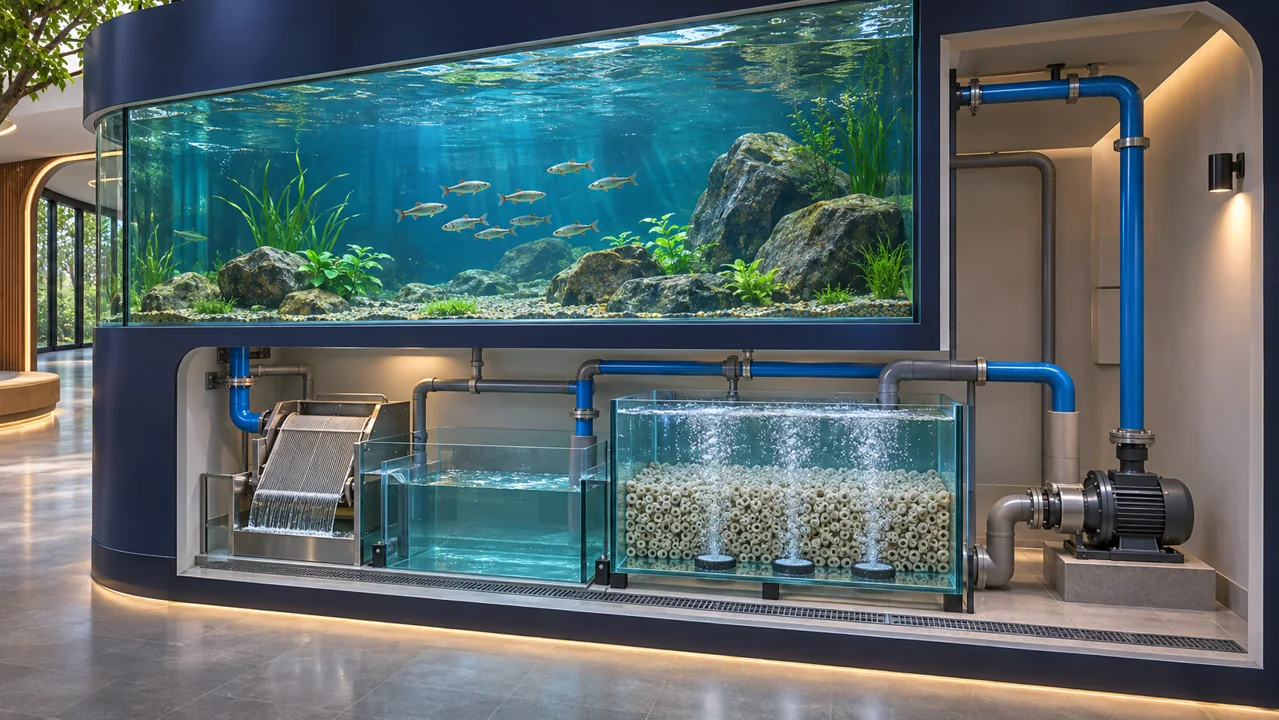 SYSTEM CONCEPT
See the mechanism.
Understand the duty.
Select a route or a stage to inspect the process. The cutaway explains the equipment and water environment; it is a teaching illustration, not a project drawing.
Manage the display
Record the stock, feeding and operating water volume.
Use the actual operating water volume, stock and feeding programme to establish the life-support review.
- Record the stock, feeding and operating water volume.
- Keep mechanical, biological and gas duties distinct.
- Review quarantine, maintenance access and safe water replacement.
Key takeaways
- Pair tanks run at 28 to 30 °C and pH 5.5 to 6.5.
- The cycle from spawn to sale takes about four months.
- Grow-out tanks need space and clean water. Density falls as fish grow.
- Central filtration with a drum filter and moving bed suits discus racks.

How discus breeding works
- Spawning, day 0Pair lays eggs on a surface.
- Hatching, after 2 to 2.5 daysWrigglers attach.
- Free-swimming, about 4 days after hatchingFry feed from parents.
- First food, day 7 to 10Brine shrimp nauplii.
- Separation, 3 to 5 weeksMove to grow-out tanks.
- Grow-out to 3 or 4 monthsReady to sell.
Water for pair tanks and grow-out tanks
| Value | Pair tanks | Grow-out tanks |
|---|---|---|
| Temperature | 28 to 30 °C | 29 to 30 °C |
| pH | 5.5 to 6.5 | About 6.0 to 7.0, steady |
| Conductivity | 35 to 80 µS/cm (RO) | Less critical |
| Ammonia and nitrite | 0 mg/L | 0 mg/L |
| Nitrate | Below 20 mg/L | Below 20 mg/L |
Work with your own numbers.
Use the tools below to explore the relevant arithmetic. Enter measured values or declared assumptions. An estimate does not establish equipment capacity, biological performance or a safe operating limit.
Water-change volume planner
Calculate the volume changed per event and the original-water fraction remaining after repeated equal changes.
Assumptions and limits
Assumes complete mixing between equal changes. Match replacement-water chemistry and temperature; this is not a safe-change prescription or a treatment guarantee.
Flow & turnover planner
Relate a measured water volume to a selected turnover time. Confirm the time from the application and hydraulic design.
Assumptions and limits
A planning allowance is your assumption. This calculation does not choose a filter, prove treatment capacity or account for pump head.
Convert units before you calculate
Planning arithmetic · inputs remain visible for review · example values are not operating recommendations
Grow-out tanks: where the space goes
| Age | Water per fish | Fish per tank (example) |
|---|---|---|
| Up to 2 weeks | 2.5 L | About 90 young |
| Up to 6 weeks | 5 L | About 45 young |
| 12 weeks, best growth | 7.5 L | About 30 young |
Why a drum filter and moving bed suit a discus rack
Discus eat rich food and need very clean water. A drum filter takes out waste before it rots and a moving bed biofilter handles ammonia, in one central system. See rack filtration.
Building a rack and keeping disease out
Use clean intake water, UV-C, strict hygiene and quarantine. See quarantine.
Plan around the collection
Use these questions to prepare a project brief or an operating review. Check an item only when the information has been recorded for your installation.
This checklist is a working aid in the current page session, not a saved maintenance record.
Discus Breeding FAQ
How long from spawn to sale?
About four months.
What pH do discus need?
5.5 to 6.5 in pair tanks.
Do I need RO water?
For breeding, usually yes.
More guides related to discus breeding
Discuss your system with Pureflow.
Share your application, operating volume, actual flow, loading and the question you are trying to resolve.