
Natural PondsDesign for Clear Water and Wildlife
Natural and wildlife ponds: zones, plants, why some stay clear, building steps, algae types, oxygen, seasonal care, safety and when a filter helps.
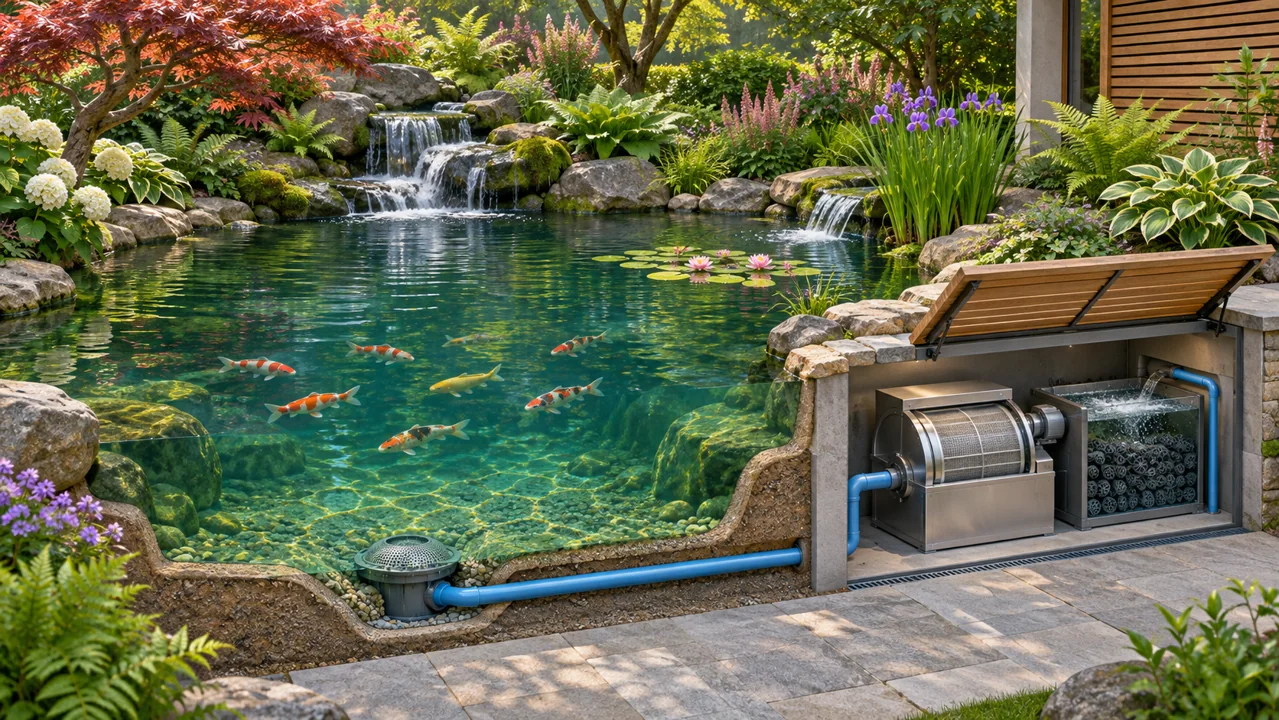 SYSTEM CONCEPT
See the mechanism.
Understand the duty.
Select a route or a stage to inspect the process. The cutaway explains the equipment and water environment; it is a teaching illustration, not a project drawing.
Collect surface debris
Use the operating pond volume and actual loading.
A skimmer can collect floating debris. Its duty and position depend on the pond layout.
- Use the operating pond volume and actual loading.
- Review collection, filtration, oxygen and return distribution.
- Record water chemistry and changes in fish behaviour.
Key takeaways
- Shallow edges, a bog zone and deeper water give you habitat and natural filtration.
- Ponds stay clear when nutrients are low. They turn green when nutrients are high.
- Wildlife ponds are better without fish. If you want fish, plan for filtration.
- Warm water holds less oxygen, so shade and plants matter in summer.
What is a natural pond?
A pond designed to work like a small wetland. It has shallow margins, plant zones and open water, and often no pump or filter at all. It supports frogs, insects, birds and plants.
From damp edge to deep water
| Zone | Depth | What grows |
|---|---|---|
| Bog zone | No standing water | Moisture-loving plants, rushes, irises |
| Marginal shelf | 0 to 20 cm | Reeds, rushes, marginal plants |
| Shallow water | 20 to 60 cm | Water lilies, floating plants |
| Deep water | 60 cm or more | Oxygenating plants, open water for wildlife |
Choose plants native to your region. Some popular species are invasive in certain countries.
Work with your own numbers.
Use the tools below to explore the relevant arithmetic. Enter measured values or declared assumptions. An estimate does not establish equipment capacity, biological performance or a safe operating limit.
Pond or tank volume
Estimate a rectangular water volume from internal wetted dimensions and average operating depth.
Assumptions and limits
Irregular shapes, sloping walls, freeboard and displaced equipment change the usable water volume. Confirm with a fill meter where practical.
Flow & turnover planner
Relate a measured water volume to a selected turnover time. Confirm the time from the application and hydraulic design.
Assumptions and limits
A planning allowance is your assumption. This calculation does not choose a filter, prove treatment capacity or account for pump head.
Convert units before you calculate
Planning arithmetic · inputs remain visible for review · example values are not operating recommendations
Why some ponds stay clear and others turn green
It comes down to nutrients. Every source (fish food, leaf fall, fertiliser runoff, tap water phosphate) feeds algae. Every sink (plants, gravel, bacteria, water changes) starves them.
Building a natural pond in six steps
- Pick the siteSun and shade, away from trees that drop many leaves.
- Mark and dig zonesInclude shelves and a deeper centre.
- Line itButyl or EPDM liner lasts 25 to 50 years.
- Add substrateWashed gravel, never rich soil.
- PlantUse native plants, not too densely at first.
- Fill and settleRain or treated water, then let it mature.
Clear water without chemicals
Three kinds of algae, three fixes
- Green water: reduce nutrients, add plants, consider UV. See green pond water.
- Blanket weed: remove by hand, shade, reduce nutrients.
- Duckweed: skim it off and add shade.
The daily rhythm of a pond
Plants and algae make oxygen by day and use it at night, so oxygen is lowest just before dawn. Warm water holds less oxygen, so hot nights are the risk. A small waterfall or air pump helps. See dissolved oxygen.
A wildlife pond is better without fish
Fish eat insects and tadpoles and stir sediment. Without them the pond hosts more wildlife and stays clearer. If you want fish, keep a small number and plan filtration for them.
A few hours a year, at the right time
Safe for children, safe for wildlife
Shallow edges, gently sloping sides and fencing where needed. Make escape routes for hedgehogs and frogs, such as a ramp or stones.
Why a filter is a smart choice
If you keep fish or want crystal-clear water all year, a filter takes pressure off the plants. See swimming pond filters.
Review the whole water environment
Use these questions to prepare a project brief or an operating review. Check an item only when the information has been recorded for your installation.
This checklist is a working aid in the current page session, not a saved maintenance record.
Natural Ponds FAQ
Do natural ponds need a pump?
Not always, but gentle circulation and aeration help.
Why is my wildlife pond green?
Too many nutrients and too much sun. Add plants and shade.
Can I keep fish in a natural pond?
Yes, but expect more nutrients and plan filtration.
More guides related to natural ponds
Discuss your system with Pureflow.
Share your application, operating volume, actual flow, loading and the question you are trying to resolve.