
Swimming Pond Plants and the Regeneration Zone
How plants and gravel beds in the regeneration zone clean a swimming pond, which plants to use and how big the zone should be.
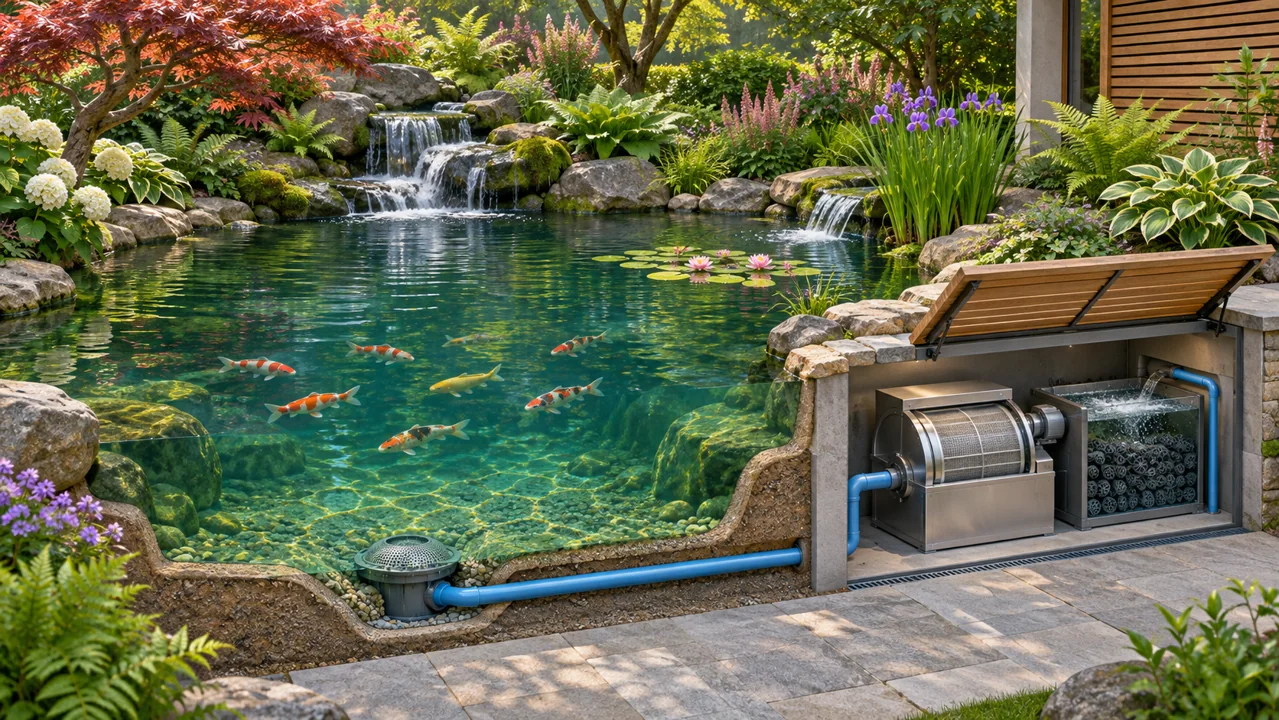 SYSTEM CONCEPT
See the mechanism.
Understand the duty.
Select a route or a stage to inspect the process. The cutaway explains the equipment and water environment; it is a teaching illustration, not a project drawing.
Collect surface debris
Use the operating pond volume and actual loading.
A skimmer can collect floating debris. Its duty and position depend on the pond layout.
- Use the operating pond volume and actual loading.
- Review collection, filtration, oxygen and return distribution.
- Record water chemistry and changes in fish behaviour.
Key takeaways
- What the zone does: It holds plants and sometimes a gravel bed.
- Which plants: A mix works best: submerged oxygenators, floating plants and marginal species that grow at the edge.
- How big: Designs vary, but many put the regeneration area at about the same size as the swimming area or larger.
- Look after it: Trim, take out dead material before it rots, and watch nutrient levels.
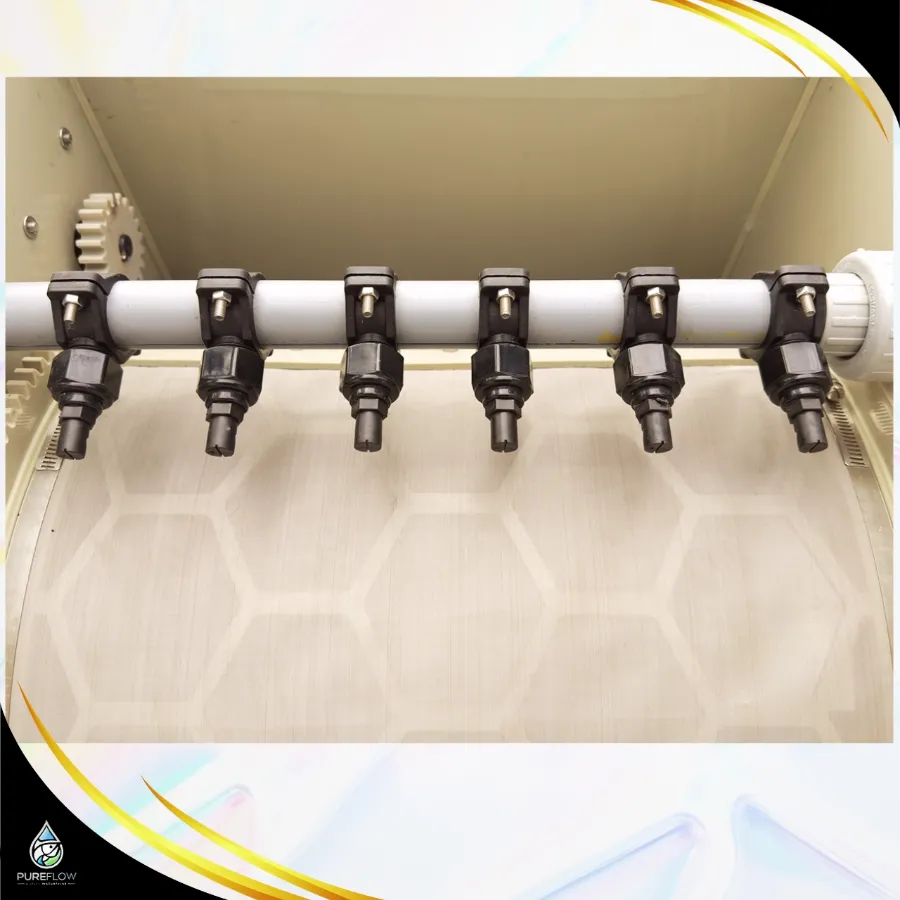
What the zone does
It holds plants and sometimes a gravel bed. Water flows through, bacteria and roots take nutrients out, and cleaner water goes back to the swimming area.
Which plants
A mix works best: submerged oxygenators, floating plants and marginal species that grow at the edge. Choose plants that suit your climate and that will not take over. Ask a local nursery for non-invasive species.
Work with your own numbers.
Use the tools below to explore the relevant arithmetic. Enter measured values or declared assumptions. An estimate does not establish equipment capacity, biological performance or a safe operating limit.
Flow & turnover planner
Relate a measured water volume to a selected turnover time. Confirm the time from the application and hydraulic design.
Assumptions and limits
A planning allowance is your assumption. This calculation does not choose a filter, prove treatment capacity or account for pump head.
Pond or tank volume
Estimate a rectangular water volume from internal wetted dimensions and average operating depth.
Assumptions and limits
Irregular shapes, sloping walls, freeboard and displaced equipment change the usable water volume. Confirm with a fill meter where practical.
Convert units before you calculate
Planning arithmetic · inputs remain visible for review · example values are not operating recommendations
How big
Designs vary, but many put the regeneration area at about the same size as the swimming area or larger. A bigger zone gives more buffer against algae.
Look after it
Trim, take out dead material before it rots, and watch nutrient levels. A mechanical filter and skimmer keep leaves out. See swimming pond filters and our biological pool filtration systems.
Pureflow Bio equipment for this
Biological swimming pool filtration →Natural pool filtration.Standard drum filters (RDF) →Automatic solids removal.Review the whole water environment
Use these questions to prepare a project brief or an operating review. Check an item only when the information has been recorded for your installation.
This checklist is a working aid in the current page session, not a saved maintenance record.
Swimming Pond Plants and the Regeneration Zone FAQ
Do I need a pump in the zone?
Usually yes, to move water through it. Design flow depends on size.
Will mosquitoes breed?
Moving water and fish or other predators help keep numbers down.
More guides related to swimming pond plants and the regeneration zone
Discuss your system with Pureflow.
Share your application, operating volume, actual flow, loading and the question you are trying to resolve.