
How to Build a Swimming PondPlanning and Filtration
How to build a natural swimming pond: site, rules, zones, liner, capillary barrier, regeneration zone, filter options, first water and common mistakes.
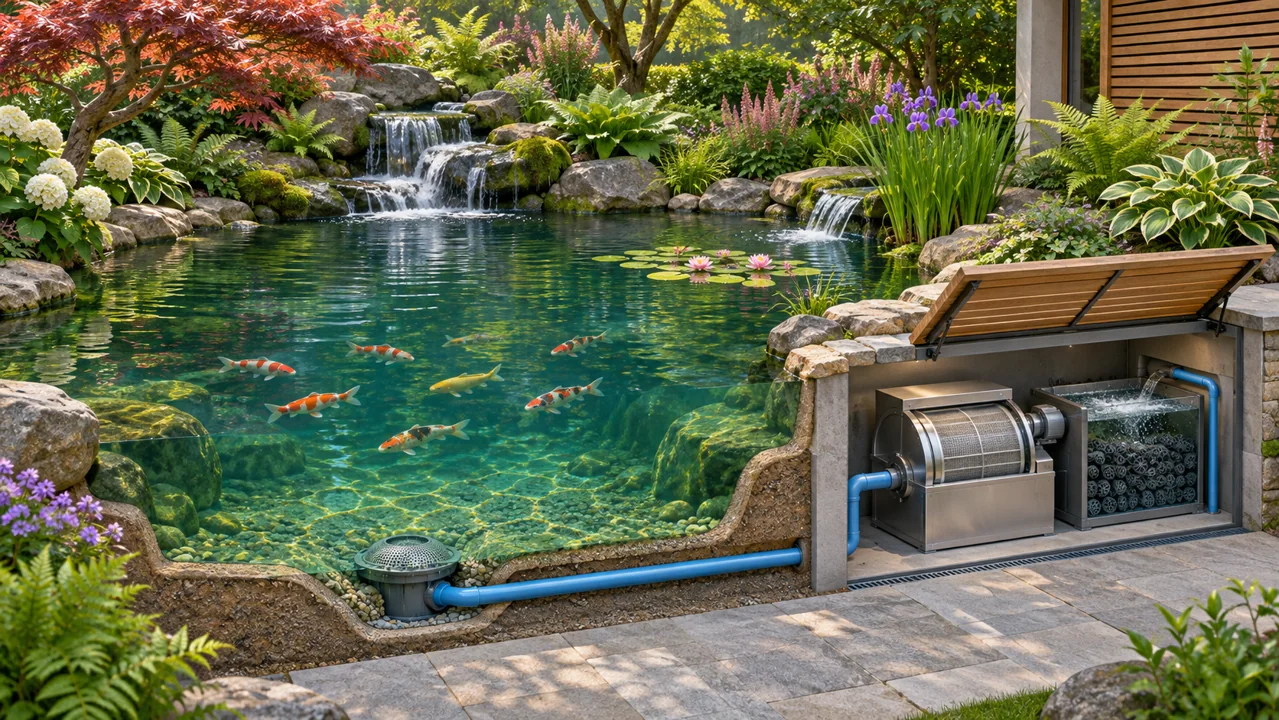 SYSTEM CONCEPT
See the mechanism.
Understand the duty.
Select a route or a stage to inspect the process. The cutaway explains the equipment and water environment; it is a teaching illustration, not a project drawing.
Collect surface debris
Use the operating pond volume and actual loading.
A skimmer can collect floating debris. Its duty and position depend on the pond layout.
- Use the operating pond volume and actual loading.
- Review collection, filtration, oxygen and return distribution.
- Record water chemistry and changes in fish behaviour.
Key takeaways
- Check the ground, local rules and electrics before you dig.
- Keep the swimming zone separate from soil and the garden.
- A capillary barrier stops soil water and nutrients entering the pond.
- Test the fill water. Phosphorus in tap water can ruin a pond from day one.
Choose the spot, check the ground, check the rules
Pick a site with sun and no big trees near the edge. Check for services, groundwater and slopes. Find out what permits are needed for excavation and swimming ponds.
Deep excavations can collapse. Do not work in an unsupported trench. Outdoor electrics must be installed by a qualified electrician, with RCD protection. Plan edges and covers for children.
One basin, several zones
A common design has a swimming zone at least 1.5 to 2 m deep, with a terrace for plants and a regeneration zone with gravel and plants. See regeneration zone.
Work with your own numbers.
Use the tools below to explore the relevant arithmetic. Enter measured values or declared assumptions. An estimate does not establish equipment capacity, biological performance or a safe operating limit.
Pond or tank volume
Estimate a rectangular water volume from internal wetted dimensions and average operating depth.
Assumptions and limits
Irregular shapes, sloping walls, freeboard and displaced equipment change the usable water volume. Confirm with a fill meter where practical.
Flow & turnover planner
Relate a measured water volume to a selected turnover time. Confirm the time from the application and hydraulic design.
Assumptions and limits
A planning allowance is your assumption. This calculation does not choose a filter, prove treatment capacity or account for pump head.
Convert units before you calculate
Planning arithmetic · inputs remain visible for review · example values are not operating recommendations
Your swimming pond in numbers
| Item | Guide |
|---|---|
| Swimming zone depth | 1.5 to 2 m |
| Total depth | Up to about 2 m |
| Regeneration area | About the same as the swimming area, less with a filter |
| Gravel in plant zone | Washed, low in nutrients |
A watertight basin that stays separate
| Liner | Thickness | Notes |
|---|---|---|
| EPDM rubber | 1.0 to 1.5 mm | Flexible and easy to patch |
| PVC-P pool grade | 1.5 mm reinforced | Welded seams |
| HDPE | 2.0 mm | Large public ponds |
Typical products. Confirm with your supplier.
The capillary barrier
A rim of gravel or a vertical barrier stops soil water wicking into the pond and bringing nutrients with it.
Building the regeneration zone
Lay a gravel bed with a suitable depth of water over it, plant it, and circulate water through. See swimming pond filters for adding a drum filter.
The build in ten steps
- Survey and permitCheck services and rules.
- ExcavateDig zones and terraces.
- Compact and levelPrepare a stable base.
- Fit protective underlayProtects the liner.
- Install the linerWelded or one piece.
- Build the barrierStop soil contact.
- Place gravelWashed gravel in the plant zone.
- Install pipework and filterSkimmers, return, drum filter.
- Fill with tested waterCheck phosphorus.
- Plant and waitLet the system mature.
Six mistakes that are hard to undo
- Soil touching the water.
- Compost in the gravel.
- Untested fill water.
- Spreading plants on the liner.
- Making it too small or shallow.
- Ignoring groundwater.
Review the whole water environment
Use these questions to prepare a project brief or an operating review. Check an item only when the information has been recorded for your installation.
This checklist is a working aid in the current page session, not a saved maintenance record.
How to Build a Swimming Pond FAQ
How deep should a swimming pond be?
At least 1.5 m for the swimming zone, often up to 2 m.
Can I build one myself?
Parts of it, but excavation, liner welding and electrics are best left to professionals.
How long until the water is clear?
Often a few weeks to a season as plants establish.
More guides related to how to build a swimming pond
Discuss your system with Pureflow.
Share your application, operating volume, actual flow, loading and the question you are trying to resolve.