Natural Swimming PoolsHow Biological Pool Filtration Works
Natural swimming pools and ponds: how they stay clear without chlorine, the five pond types, space, phosphorus, water standards and seasonal care.
 SYSTEM CONCEPT
See the mechanism.
Understand the duty.
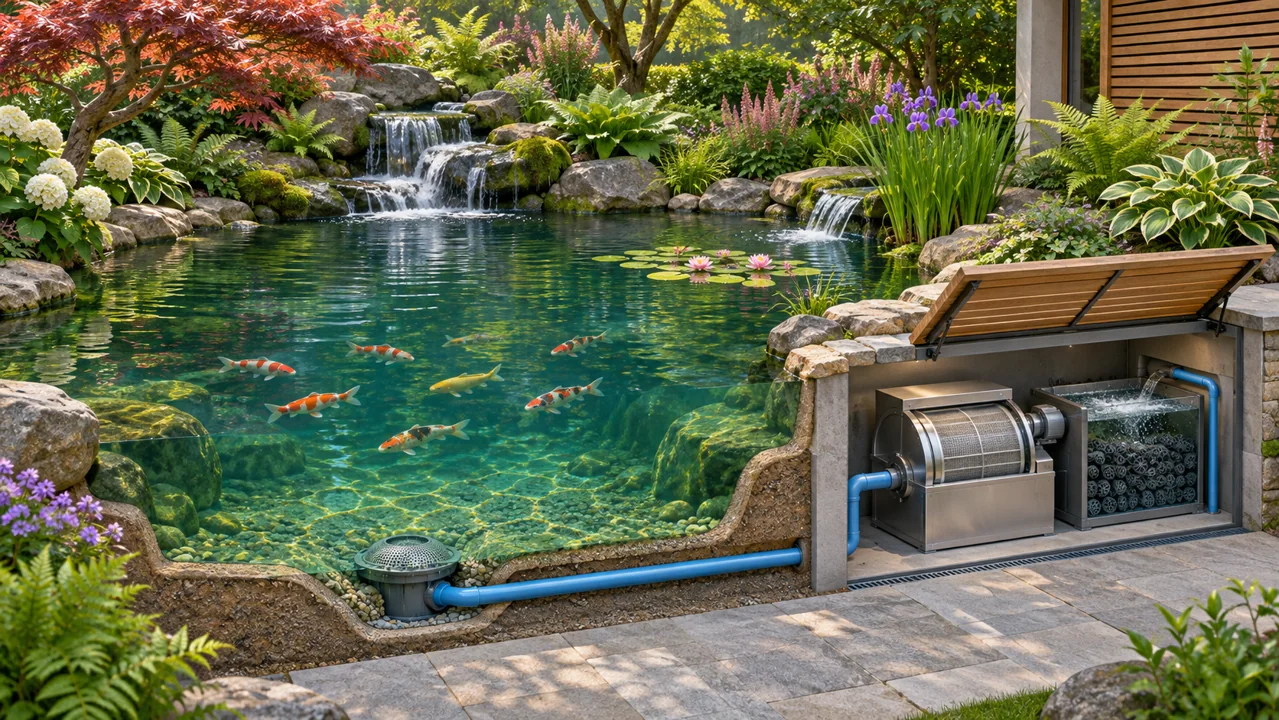
Select a route or a stage to inspect the process. The cutaway explains the equipment and water environment; it is a teaching illustration, not a project drawing.
Collect surface debris
Use the operating pond volume and actual loading.
A skimmer can collect floating debris. Its duty and position depend on the pond layout.
- Use the operating pond volume and actual loading.
- Review collection, filtration, oxygen and return distribution.
- Record water chemistry and changes in fish behaviour.
Key takeaways
- Clear water comes from keeping phosphorus very low, not from chemicals.
- There are five main types, from pure nature to a filtered natural pool.
- A filter keeps water clear every day. Plants alone can struggle in a heatwave or after heavy use.
- Hygiene depends on people and design, not on chlorine.
What is a natural swimming pool?
It is a pool in which water is cleaned by biological processes rather than disinfectant. Part of the area is a swimming zone and part is a regeneration zone with plants and gravel, or a technical filter instead.
How the water stays clear
Algae need phosphorus. Keep it low and algae cannot take hold. Plants take up nutrients, gravel beds host bacteria, and filters remove particles. The tighter the control of phosphorus, the clearer the water.
Plants are seasonal and slow. A filter adds steady daily capacity, especially in warm weather.
Work with your own numbers.
Use the tools below to explore the relevant arithmetic. Enter measured values or declared assumptions. An estimate does not establish equipment capacity, biological performance or a safe operating limit.
Pond or tank volume
Estimate a rectangular water volume from internal wetted dimensions and average operating depth.
Assumptions and limits
Irregular shapes, sloping walls, freeboard and displaced equipment change the usable water volume. Confirm with a fill meter where practical.
Flow & turnover planner
Relate a measured water volume to a selected turnover time. Confirm the time from the application and hydraulic design.
Assumptions and limits
A planning allowance is your assumption. This calculation does not choose a filter, prove treatment capacity or account for pump head.
Convert units before you calculate
Planning arithmetic · inputs remain visible for review · example values are not operating recommendations
From wild pond to natural pool: five types
| Type | What it is | Technology |
|---|---|---|
| 1. Pure nature | Wild-style pond, no pump | None |
| 2. Natural with pump | Circulation through plants | Pump only |
| 3. Planted filter | Gravel and plant filter beds | Pump, planted beds |
| 4. Mechanical and biological filter | Technical filter plus plants | Pump, filter |
| 5. Natural pool | Highest design, tighter control | Pump, filter, strict phosphorus control |
Types follow the German FLL guidelines for swimming ponds.
How much space do you need?
A common guide is that the regeneration area should be roughly equal to the swimming area for plant-based designs. Filtered designs can be smaller. The more people swim, the more space or technology you need.
The one number that keeps the water clear
Total phosphorus. Keep it low in the water and in the fill water. Sources include rain runoff, soil, leaf litter and swimmers. Phosphorus can be removed with gravel and plant filters, filters with phosphate binders, or by limiting inputs.
What the water has to meet
| Parameter | In the pond (types 4 to 5) | Fill water |
|---|---|---|
| Total phosphorus | 0.01 mg/L or less | 0.03 mg/L or less |
| Nitrate | 30 mg/L or less | 50 mg/L or less |
| Ammonium | 0.3 mg/L or less | 0.5 mg/L or less |
| pH | 7.0 to 9.0 | 6.0 to 9.0 |
| Nitrite | 0.01 mg/L or less | n/a |
Based on FLL guideline values for private swimming ponds.
For public ponds, hygiene limits also cover E. coli, enterococci and Pseudomonas, and water visibility.
Looking after a natural pool
A filter system for every swimming pond
See swimming pond filters, how to build a swimming pond and the regeneration zone.
Review the whole water environment
Use these questions to prepare a project brief or an operating review. Check an item only when the information has been recorded for your installation.
This checklist is a working aid in the current page session, not a saved maintenance record.
Natural Swimming Pools FAQ
Do natural pools need chlorine?
No. They rely on biology and design.
Can I swim in a natural pond without a filter?
Yes in some designs, but water clarity is less predictable.
Are natural pools safe?
With good design and low contamination, yes. Hygiene depends on use and water quality.
More guides related to natural swimming pools
Discuss your system with Pureflow.
Share your application, operating volume, actual flow, loading and the question you are trying to resolve.