
How to Size a BiofilterTAN Load, Media and Reactor Volume
Work out biofilter size from daily feed, ammonia production and media conversion rate, with a worked example for trickling and moving bed filters.
 EQUIPMENT REFERENCE
See the mechanism.
Understand the duty.
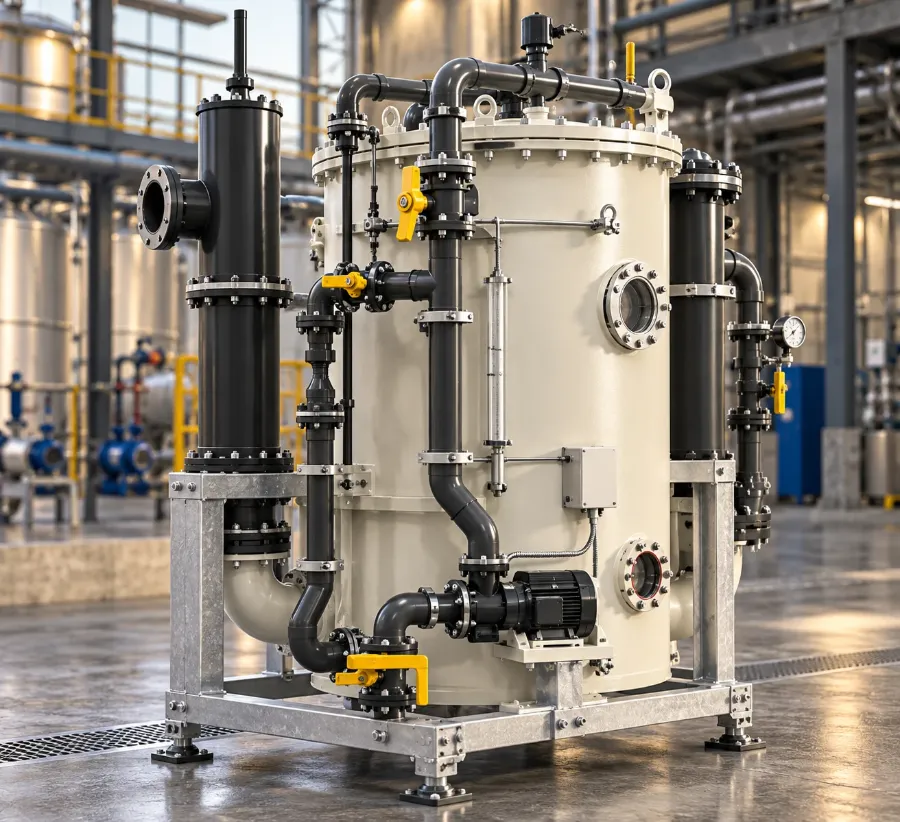
Select a route or a stage to inspect the process. The cutaway explains the equipment and water environment; it is a teaching illustration, not a project drawing.
Feed the reactor
Define peak feed and the nitrogen load.
Pre-screened water enters the biological stage. Effective upstream solids removal helps protect the reactor.
- Define peak feed and the nitrogen load.
- Check oxygen, pH, alkalinity and temperature.
- Use supported media performance and the specified fill arrangement.
Key takeaways
- Step 1: estimate TAN: A common design estimate is that each kilogram of feed with 40 percent protein produces roughly 38 g of total ammonia nitrogen (TAN).
- Step 2: choose a conversion rate: Media is rated by how much TAN a cubic metre removes each day.
- Step 3: divide: Take 60 kg of feed a day at 40 percent protein.
- Why moving bed is popular: You can see from the example: far less volume for the same load.
Step 1: estimate tan
A common design estimate is that each kilogram of feed with 40 percent protein produces roughly 38 g of total ammonia nitrogen (TAN). Your own feed and species will change this, so use it as a start.
Step 2: choose a conversion rate
Media is rated by how much TAN a cubic metre removes each day. Published design values at around 25 °C and good oxygen are about 90 g TAN/m³/day for a trickling filter media of 200 m²/m³, and about 350 g TAN/m³/day for conservatively-rated moving bed media. These vary with media, temperature and water conditions, so verify with your supplier.
Work with your own numbers.
Use the tools below to explore the relevant arithmetic. Enter measured values or declared assumptions. An estimate does not establish equipment capacity, biological performance or a safe operating limit.
Biofilter media planning scenario
Relate a defined nitrogen load to an explicitly supplied media conversion rate and fill share.
Assumptions and limits
Use a conversion rate verified for the media, water chemistry, oxygen, temperature and load. Example numbers are arithmetic inputs, not approved biological capacities or fill recommendations.
Feed & loading scenario
Translate a selected feeding rate and assumed waste yield into a planning load.
Assumptions and limits
The feeding rate and TAN yield are supplied assumptions. Use the species, feed, growth stage and verified process design; the estimate is not a Pureflow capacity rating.
Convert units before you calculate
Planning arithmetic · inputs remain visible for review · example values are not operating recommendations
Step 3: divide
Take 60 kg of feed a day at 40 percent protein. TAN is about 2.3 kg per day, or 2,300 g. At 90 g/m³/day you need about 25 m³ of trickling media. At 350 g/m³/day you need about 6.6 m³ of moving bed media, and, if the media can fill 70 percent of the reactor, a reactor of around 9 to 10 m³.
Why moving bed is popular
You can see from the example: far less volume for the same load. That is why moving bed reactors dominate modern RAS. See moving bed biofilters.
Add margin
Allow for growth in feed, cold weather, and a sudden jump in load. Leave headroom so the biofilter is never at its limit.
Get help
Send your feed rate, protein and temperature to our team via the enquiry form and we will check the size with you. See our MBBR biofilters.
Pureflow Bio equipment for this
MBBR biofilters →Moving bed biofilters.Standard drum filters (RDF) →Automatic solids removal.Check the biological assumptions
Use these questions to prepare a project brief or an operating review. Check an item only when the information has been recorded for your installation.
This checklist is a working aid in the current page session, not a saved maintenance record.
How to Size a Biofilter FAQ
Is the TAN estimate exact?
No. It is a design estimate. Measure your own system once it is running.
What about temperature?
Cold water slows nitrification, so size with margin if your water is cool.
More guides related to how to size a biofilter
Discuss your system with Pureflow.
Share your application, operating volume, actual flow, loading and the question you are trying to resolve.